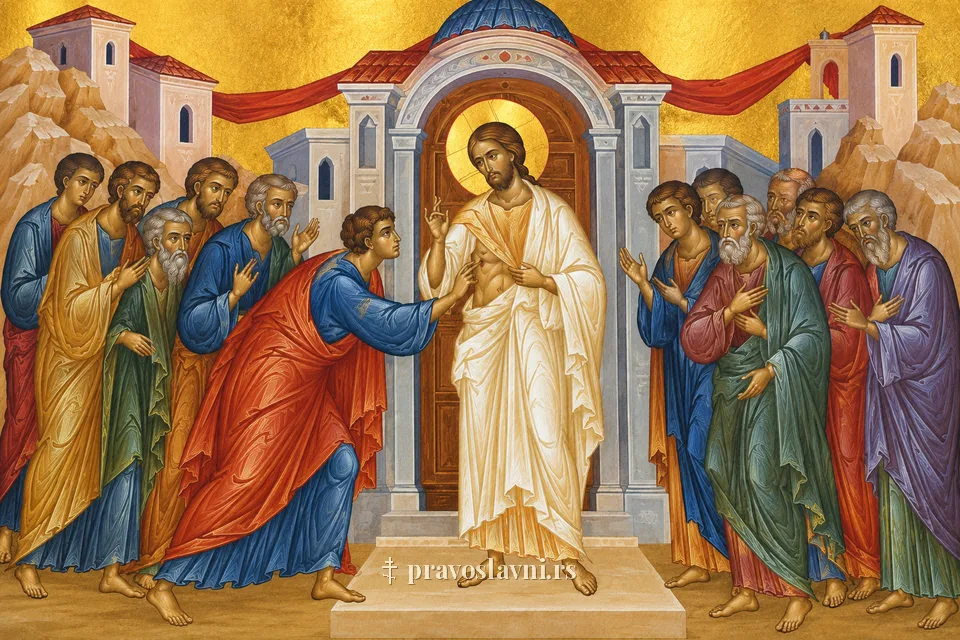
Feast of the day
Thomas Sunday (Antipascha)
What happenedThomas Sunday (Antipascha), the second Sunday of Vaskrs (Pascha), celebrates the appearance of the risen Lord to the Apostle Thomas and Thomas's confession: “My Lord and my God!”
Read the LifeOrthodox Calendar · 6 April according to the Julian calendar
Sunday, 19 April 20266 April (according to the Julian calendar)What happenedThomas Sunday (Antipascha), the second Sunday of Vaskrs (Pascha), celebrates the appearance of the risen Lord to the Apostle Thomas and Thomas's confession: “My Lord and my God!”
Read the Life
You may eat meat, eggs, milk and dairy products, as well as any other food — but try to be moderate.
More about the fast →
Sunday — a festive day · Second Sunday of Pascha – Thomas Sunday
More about the feast →
“Whom having not seen you love. Though now you do not see Him, yet believing, you rejoice with joy inexpressible and full of glory.”
— 1 Pet 1:8Thomas Sunday, the second Sunday of Pascha, has a festal order of service, because on that day the feast of the Resurrection is renewed for the first time after Pascha; that is why it is called Antipascha and the Sunday of Renewal. With Thomas Week the Typikon again permits parastos services (memorial services), so after Bright Week the faithful may once more commemorate their departed.
Radonitsa (Radonjica), the commemoration of the departed, falls on the Tuesday after Thomas Sunday, and in some places on the Monday. It is not prescribed by the Typikon; it is kept by pious custom. On that day memorial services are served in the cemeteries. According to the “Liturgics” handbook, in this way the living share the paschal joy with their departed relatives, and the commemoration is linked to the remembrance of Christ's descent into Hades.
Thomas Sunday is the second Sunday of Vaskrs (Pascha). Liturgics calls it Antipascha, because it stands in the place of Pascha and on it the Resurrection is celebrated again for the first time after Vaskrs, and also the Sunday of Renewal, because the great feast is renewed, although the service does not have a full Paschal character. It is also called the Second Sunday — of Thomas.
At first the apostles did not believe the myrrh-bearing women, nor Luke and Cleopas, and Thomas did not believe either when the other disciples told him that they had seen the Lord. He asked to see the print of the nails and to touch the wounds of Christ. After eight days, when Thomas was with the other disciples, the risen Lord suddenly appeared among them and called him to touch His wounds. Thomas confessed: “My Lord and my God!” The Lord then said: “Blessed are those who have not seen and yet have believed!”
The unbelief of Thomas served the providence of God, for the Resurrection was confirmed by more witnesses; it is one of the best attested of truths. The Lord appeared to His disciples for forty days, and the Apostle Paul mentions an appearance before more than five hundred people. On the Resurrection rests the whole of our faith.
On the Tuesday after Thomas Sunday a commemoration of the departed is served, which the people call Radonica. On that day memorial services are served in the cemeteries, and the commemoration is linked with the remembrance of Christ's descent into Hades. By pious custom, the living thus share the joy of the Resurrection with their departed relatives. The Apostle Peter writes to those who did not see Christ: “whom having not seen you love. Though now you do not see Him, yet believing, you rejoice with joy inexpressible and full of glory”.
According to the Liturgics handbook, Thomas Sunday is the second Sunday of Vaskrs (Pascha), the first one that comes after it. It is also called Antipascha: it is the Sunday that stands in place of Pascha, because on it the Resurrection is celebrated again for the first time in the year. Another name for it is the Sunday of Renewal, because the feast of the Resurrection is then renewed for the first time; the service recalls the festal order, but does not have the full paschal character. It is also the Second Sunday — of Thomas.
At first the apostles did not believe either Mary Magdalene, or the myrrh-bearing women, or Luke and Cleopas. Thomas did not believe either, when the other disciples told him that they had seen the Lord. He asked for proof: to see with his own eyes where the nails had been in the Lord's hands and to touch His wounds (Jn 20:25). The doubt, then, was not Thomas's alone: all the disciples found it hard to believe what they had heard.
When eight days had passed since the Resurrection, the disciples were together again, and this time Thomas was with them. The risen Lord suddenly appeared among them and called Thomas to touch His wounds. Thomas confessed: “My Lord and my God!” And the Lord said: “Blessed are those who have not seen and yet have believed!”
Thomas's unbelief served God's providence: in this way the truth of the Resurrection was confirmed by more witnesses, and so the Resurrection is counted among the best attested of truths. For forty days after the Resurrection the Lord appeared to His disciples, and the Apostle Paul also mentions an appearance before more than five hundred people (1 Cor 15:6). How important that event is can easily be said: without the Resurrection the faith would have nothing to stand on.
The Apostle Peter writes to those who have not seen Christ with their eyes: “whom having not seen you love. Though now you do not see Him, yet believing, you rejoice with joy inexpressible and full of glory” (1 Pet 1:8). Thomas's doubt ended in a confession, and the word of the Lord applies to all who believe without having seen.
The commemoration of the departed which the people call Radonica falls on the Tuesday after Thomas Sunday. It is not prescribed by the Typikon; it is served according to pious custom. Only when Thomas Week begins does the Typikon once again allow memorial services. Then memorial services are served in the cemeteries, and the living share the joy of the Resurrection with their departed kinsfolk. This commemoration is linked with the remembrance of Christ's descent into Hades. In this way the departed too are called into the paschal joy.
When Emperor Justinian the Great began to teach that the body of Christ, even before the Resurrection, could not hunger, thirst or suffer, Eutychius, Patriarch of Constantinople, did not agree, although the emperor loved him and had chosen him himself. He refused to sign the heresy and defended the truth that the body of Christ was like ours in everything except sin. For this he was deposed and banished to a monastery in Amasea.
That monastery was not unfamiliar to him. Born in Phrygia, in a devout family, Eutychius as a boy at play wrote down “Eutychius the Patriarch!”, and when he grew up, he chose the monastic life. His Life says that in Constantinople, where he went at the age of twelve, he surpassed his peers in learning, but valued the wisdom from above more than that of the world. In Amasea he became abbot. Later, in place of the ailing metropolitan, he took part in the Fifth Ecumenical Council and distinguished himself by his learning and piety. The emperor grew fond of him, and Patriarch Menas, before his death, wished to have him as his successor. So Eutychius became patriarch and for twelve years led the Church in peace.
He did not spend his exile in bitterness. The Prologue says that he lived in it for twelve years and eight months and that he healed the sick by prayer and anointing with oil. The Life remembers a deaf-mute boy who began to speak, paralysed children who began to walk, and an empty monastery granary which was filled at his prayer in a time of famine.
In the end Justinian repented and died, and the new emperor Justin restored Eutychius to his throne. The Life says that he was welcomed with joy and that he served in peace until his death, still healing as before. The Life also records that to Tiberius, who visited him on his deathbed, he foretold that he too would soon die, which is what came to pass. He reposed in his seventieth year, in the year 582, and was buried, according to the Life, in the Church of the Holy Apostles.
His life teaches that it is worth more to preserve the truth about Christ than to keep one's position. The Prologue reminds us that Christ truly hungered, thirsted and suffered, and that the Cross is the source of salvation.


