Thomas Sunday (Antipascha)Commemoration: 19 April 2026 · 9 May 2027
Commemoration in our calendar
Sunday, 19 April 2026no fast · Sunday — a festive day · 6 April (according to the Julian calendar)
Sunday, 9 May 2027no fast · Sunday — a festive day · 26 April (according to the Julian calendar)
Sunday09May 202726 April (according to the Julian calendar)
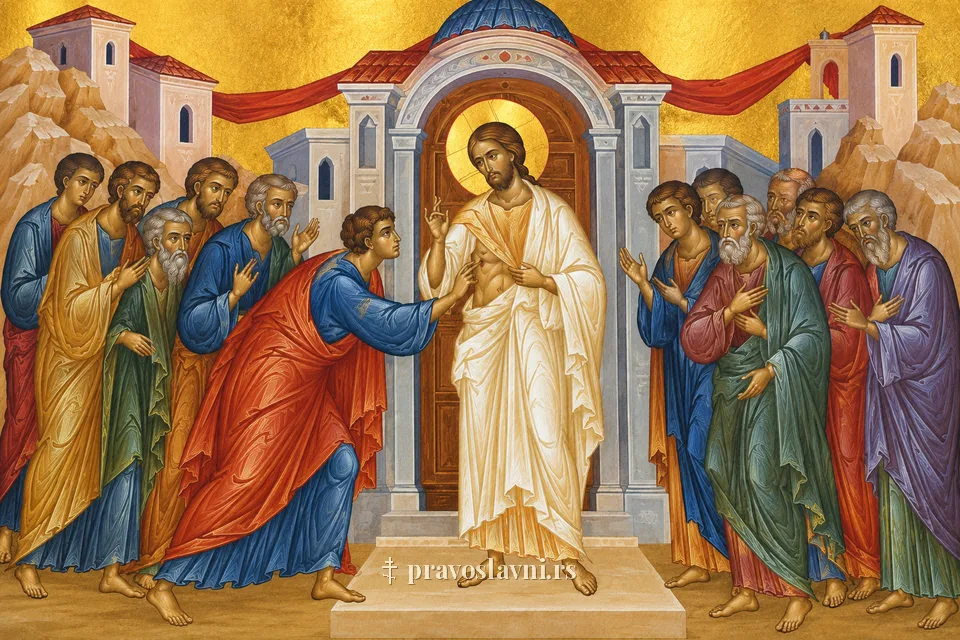
Illustration
Feast of the day
Thomas Sunday (Antipascha)
What happenedThomas Sunday (Antipascha), the second Sunday of Vaskrs (Pascha), celebrates the appearance of the risen Lord to the Apostle Thomas and Thomas's confession: “My Lord and my God!”
“Whom having not seen you love. Though now you do not see Him, yet believing, you rejoice with joy inexpressible and full of glory.”
— 1 Pet 1:8
About this day
Thomas Sunday, the second Sunday of Pascha, has a festal order of service, because on that day the feast of the Resurrection is renewed for the first time after Pascha; that is why it is called Antipascha and the Sunday of Renewal. With Thomas Week the Typikon again permits parastos services (memorial services), so after Bright Week the faithful may once more commemorate their departed.
Radonitsa (Radonjica), the commemoration of the departed, falls on the Tuesday after Thomas Sunday, and in some places on the Monday. It is not prescribed by the Typikon; it is kept by pious custom. On that day memorial services are served in the cemeteries. According to the “Liturgics” handbook, in this way the living share the paschal joy with their departed relatives, and the commemoration is linked to the remembrance of Christ's descent into Hades.
Life
Thomas Sunday is the second Sunday of Vaskrs (Pascha). Liturgics calls it Antipascha, because it stands in the place of Pascha and on it the Resurrection is celebrated again for the first time after Vaskrs, and also the Sunday of Renewal, because the great feast is renewed, although the service does not have a full Paschal character. It is also called the Second Sunday — of Thomas.
At first the apostles did not believe the myrrh-bearing women, nor Luke and Cleopas, and Thomas did not believe either when the other disciples told him that they had seen the Lord. He asked to see the print of the nails and to touch the wounds of Christ. After eight days, when Thomas was with the other disciples, the risen Lord suddenly appeared among them and called him to touch His wounds. Thomas confessed: “My Lord and my God!” The Lord then said: “Blessed are those who have not seen and yet have believed!”
The unbelief of Thomas served the providence of God, for the Resurrection was confirmed by more witnesses; it is one of the best attested of truths. The Lord appeared to His disciples for forty days, and the Apostle Paul mentions an appearance before more than five hundred people. On the Resurrection rests the whole of our faith.
On the Tuesday after Thomas Sunday a commemoration of the departed is served, which the people call Radonica. On that day memorial services are served in the cemeteries, and the commemoration is linked with the remembrance of Christ's descent into Hades. By pious custom, the living thus share the joy of the Resurrection with their departed relatives. The Apostle Peter writes to those who did not see Christ: “whom having not seen you love. Though now you do not see Him, yet believing, you rejoice with joy inexpressible and full of glory”.
Full Life
Antipascha
According to the Liturgics handbook, Thomas Sunday is the second Sunday of Vaskrs (Pascha), the first one that comes after it. It is also called Antipascha: it is the Sunday that stands in place of Pascha, because on it the Resurrection is celebrated again for the first time in the year. Another name for it is the Sunday of Renewal, because the feast of the Resurrection is then renewed for the first time; the service recalls the festal order, but does not have the full paschal character. It is also the Second Sunday — of Thomas.
Thomas who did not believe
At first the apostles did not believe either Mary Magdalene, or the myrrh-bearing women, or Luke and Cleopas. Thomas did not believe either, when the other disciples told him that they had seen the Lord. He asked for proof: to see with his own eyes where the nails had been in the Lord's hands and to touch His wounds (Jn 20:25). The doubt, then, was not Thomas's alone: all the disciples found it hard to believe what they had heard.
When eight days had passed since the Resurrection, the disciples were together again, and this time Thomas was with them. The risen Lord suddenly appeared among them and called Thomas to touch His wounds. Thomas confessed: “My Lord and my God!” And the Lord said: “Blessed are those who have not seen and yet have believed!”
Unbelief that served the faith
Thomas's unbelief served God's providence: in this way the truth of the Resurrection was confirmed by more witnesses, and so the Resurrection is counted among the best attested of truths. For forty days after the Resurrection the Lord appeared to His disciples, and the Apostle Paul also mentions an appearance before more than five hundred people (1 Cor 15:6). How important that event is can easily be said: without the Resurrection the faith would have nothing to stand on.
The Apostle Peter writes to those who have not seen Christ with their eyes: “whom having not seen you love. Though now you do not see Him, yet believing, you rejoice with joy inexpressible and full of glory” (1 Pet 1:8). Thomas's doubt ended in a confession, and the word of the Lord applies to all who believe without having seen.
Radonica
The commemoration of the departed which the people call Radonica falls on the Tuesday after Thomas Sunday. It is not prescribed by the Typikon; it is served according to pious custom. Only when Thomas Week begins does the Typikon once again allow memorial services. Then memorial services are served in the cemeteries, and the living share the joy of the Resurrection with their departed kinsfolk. This commemoration is linked with the remembrance of Christ's descent into Hades. In this way the departed too are called into the paschal joy.
Other saints of the day
Hieromartyr Basil, Bishop of Amasea
The Emperor Licinius offered Bishop Basil of Amasea pardon, honours and even the post of chief over the pagan priests, if only he would offer sacrifice to the idols. Basil, according to his Life, refused twice and so signed his own death sentence. The Emperor charged him on account of a certain maiden: in Amasea Basil had given protection to Glaphyra, who had taken refuge from the Emperor's dishonourable intentions.
Glaphyra, a Christian from Italy according to the Life, was in the service of the Empress. When Licinius, who from a false Christian had turned into a persecutor, wanted to dishonour her, the Empress secretly removed her from the court. The Life tells that she reached Amasea in men's clothing, where she was first taken in by a Christian named Quintius, and that the Empress, so that the Emperor would not search for her, said that the maiden had died. The bishop received her, and she, according to the Life, gave her gold and silver for the church which he was building; the Empress too sent money for that church.
Licinius learnt of the hiding place from a letter which a eunuch handed to him, and so he ordered both Glaphyra and the bishop to be brought to him in chains to Nicomedia. Glaphyra did not live to be taken away, so they brought only the bishop, and according to the Life the deacons Parthenius and Theotimus were with him. The night before the trial, the Life says, he spent in prayer and foretold his own death. He was tortured and then beheaded in the year 322; on the seashore, according to the Life, he took leave of his own people and said to the executioner: “Friend, do what you have been ordered to do.” His body was thrown into the sea.
The body was buried in Amasea, in the church for which Basil had laboured; before that his faithful, following an angel's direction, had drawn it out of the sea near Sinope with fishermen's nets. The Life records that the head was found in its place and that the body was fragrant. Licinius was later defeated by Constantine and died as an exile in Gaul, and the Life adds that the East then received the freedom to worship Christ.
Basil's life shows that faithfulness to Christ outweighs power, honours and life itself.