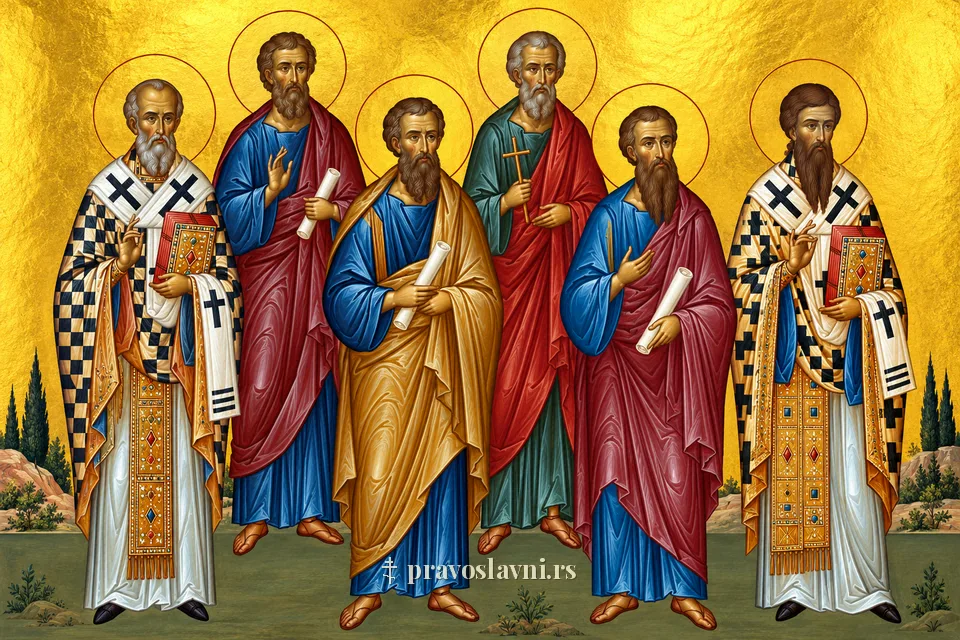
Saints of the day
Holy Apostles Herodion, Agabus, Rufus and others
What happenedSix apostles of the Seventy, among them his kinsman Herodion, are mentioned by the Apostle Paul, and they carried the Gospel through many lands.
Read the LifeOrthodox Calendar · 8 April according to the Julian calendar
Tuesday, 21 April 20268 April (according to the Julian calendar)What happenedSix apostles of the Seventy, among them his kinsman Herodion, are mentioned by the Apostle Paul, and they carried the Gospel through many lands.
Read the Life
You may eat meat, eggs, milk and dairy products, as well as any other food — but try to be moderate.
More about the fast →
Today the Church keeps the commemoration of a saint · not a Red Letter day.
More about the feast →
“Greet Rufus, chosen in the Lord, and his mother and mine.”
— Rom 16:13Six apostles, according to the Prologue from among the Seventy, are celebrated together by the Church: Herodion, Agabus, Rufus, Asyncritus, Phlegon and Hermes. All of them, as the Prologue and the Life record, are mentioned by the Apostle Paul in his epistles; the Life cites the Epistle to the Romans, which Paul wrote from Corinth. The Life says that their preaching brought many to the faith, and that because of it they were tormented by both Jews and pagans.
Rufus, whom Paul calls chosen in the Lord (Rom 16:13), we remember as a bishop in Thebes in Greece. Asyncritus, according to the Life, was bishop in Hyrcania in Asia, Phlegon in Marathon, a city in Thrace, and Hermes in Dalmatia.
Agabus is remembered for the gift of prophecy, and the Acts of the Apostles record two of his prophecies. He foretold a famine that would strike the whole world, and it came in the time of Emperor Claudius. In Caesarea he bound his own hands and feet with Paul's belt and foretold that the man to whom that belt belonged would be bound by the Jews in Jerusalem; the Life adds that they would also deliver him to the pagans. The Life remembers him also as a travelling preacher, through whose word many came to Christ.
Herodion, whom Paul greets as a kinsman, was born, according to the Life, in Tarsus in Cilicia and served the holy apostles in everything. As Bishop of Neopatras he brought many pagans to the faith. The Jews, as the Prologue and the Life record, once beat him so badly that they left him for dead, but, as the Life says, by the grace of God he survived and went on serving the apostles. In Rome he helped the Apostle Peter, and he was beheaded together with many Christians, among whom the Life mentions Olympas, on the same day that Peter was crucified.
All of them suffered much out of love for Christ and all of them passed over into the eternal Kingdom of Christ. The hymn compares them to runners who have reached the goal, for they exchanged what is passing for what is eternal. We ask them to pray for us, that the Kingdom of Heaven may not be denied to us.
In his epistles the Apostle Paul greeted many brethren in the faith. Among those names the Prologue and the Life also find six men whom the Church celebrates together today: Herodion, Agabus, Rufus, Asyncritus, Phlegon and Hermes. The Life singles out in particular the Epistle to the Romans, which Paul wrote from Corinth. The Prologue says that all of them belonged to the Seventy Apostles.
Paul greets Herodion as his kinsman: “Greet Herodion, my kinsman” (Rom 16:11). Of Rufus he writes: “Greet Rufus, chosen in the Lord” (Rom 16:13). He mentions Asyncritus, Phlegon and Hermes in the same place (Rom 16:14).
The Life says that Herodion was born in Tarsus of Cilicia. He was a kinsman of Paul and, according to the Life, served the holy apostles in everything. He became Bishop of Neopatras — the Life states that the apostles themselves appointed him — and there he brought many pagans to the faith.
He suffered greatly for his preaching. The Prologue and the Life say that the Jews rose up against him, and the Life adds the idolaters as well. They wounded him with staves, stones and knives and left him for dead. Yet he survived — the Life says that the grace of God preserved him — and went on serving the apostles.
Later he was in Rome. The Prologue says that there he helped the Apostle Peter, and the Life that he preached the word of God together with Peter. There too he finished his course: he was beheaded with many other Christians, among whom the Life mentions Olympas, on the same day that Peter was crucified.
Agabus had the gift of prophecy, and the Acts of the Apostles record two of his prophecies. First he foretold a famine that would come upon the whole world; it came to pass in the time of the Emperor Claudius (Acts 11:28).
The second concerned Paul himself. Agabus met him in Caesarea, while Paul was on his way to Jerusalem. He took Paul's belt, bound his own hands and feet with it and said, as the Prologue records: “Thus says the Holy Spirit, “So shall the Jews at Jerusalem bind the man who owns this belt”” (Acts 21:11). The Life adds that they would then hand him over to the pagans. Agabus, according to the Life, travelled about preaching Christ and converted many.
The others became bishops in various lands. Rufus, whom Paul calls chosen in the Lord, was bishop in Thebes in Greece. Asyncritus, as the Life says, was bishop in Hyrcania in Asia. Phlegon was bishop in Marathon, a city in Thrace, and Hermes in Dalmatia.
The Life records that they all preached the Gospel of Christ throughout the world and brought unbelievers to the true faith. They suffered much out of love for Christ, and the Life says that the Jews and the pagans tortured them in various ways. They all reposed and passed over into the eternal Kingdom of Christ. Of how Agabus, Rufus, Asyncritus, Phlegon and Hermes met their end, neither the Prologue nor the Life says anything.
The hymn that is sung to them sees them as chosen runners who have reached the goal. The hymn praises them because, out of love for Christ, they exchanged what is passing for what is eternal and brought light to the pagans. We ask them to pray for us, that the Kingdom of Heaven may not be denied us.


