Saint of the day
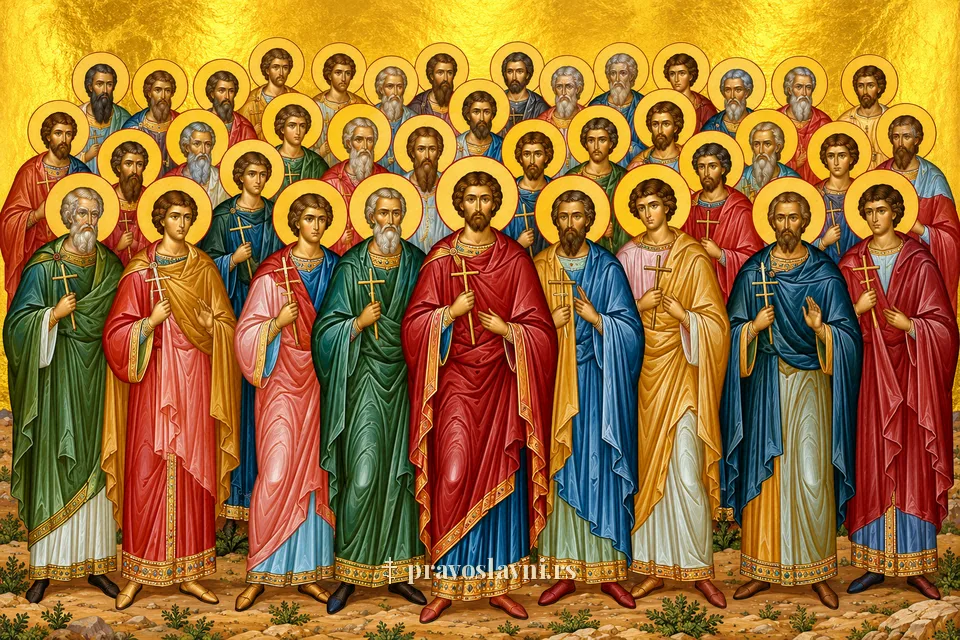
Holy Martyr Terence and the 39 with him
What happenedWhen many in Africa fell away from the faith, Terence encouraged the brethren, and forty of them remained faithful to Christ to a martyr's death.
Read the LifeOrthodox Calendar · 10 April according to the Julian calendar
Thursday, 23 April 202610 April (according to the Julian calendar)What happenedWhen many in Africa fell away from the faith, Terence encouraged the brethren, and forty of them remained faithful to Christ to a martyr's death.
Read the Life
You may eat meat, eggs, milk and dairy products, as well as any other food — but try to be moderate.
More about the fast →
Today the Church keeps the commemoration of a saint · not a Red Letter day.
More about the feast →
“If we endure, We shall also reign with Him. If we deny Him, He also will deny us.”
— 2 Tim 2:12The forty martyrs from Africa are remembered because they kept one another in the faith. When, under Emperor Decius, the governor of Africa commanded, under threat of terrible torments, that all should bow down to the idols, many denied Christ. They did not. Terence strengthened the brethren with words which the Prologue preserves: “let us take heed, brethren, that we do not deny Christ our God”.
The governor divided them into two groups, and their faithfulness was paid for with their lives. Thirty-six of them were beheaded after being tortured, and four remained in prison. An angel of God took off their fetters and fed them abundantly. At the governor's order the sorcerers let snakes and scorpions loose among them, but for three days the martyrs remained unharmed, and in the end the creatures turned against the sorcerers themselves.
In the end the four were condemned as well. They were accompanied to the place of execution by the psalms which they themselves sang, and they rejoiced that God was making them worthy of a martyr's death. The Prologue records that they received the Kingdom in the year 250.
The Prologue does not give the city or the name of the governor, but it does name Terence, Africanus, Maximus and Pompeius. Their example shows that the faith is more easily kept together: when many give way, brother strengthens brother, and God does not abandon those who remain faithful to Him.
The four condemned men went to their death with joy. With psalms they offered up thanks to God for the gift of martyrdom. They received the Kingdom, as the Prologue records, in the year 250.
It all began in the time of the Emperor Decius, when the governor of Africa ordered that everyone should bow down to the idols, and threatened those who refused with terrible tortures.
The order separated many from the faith. Forty men, however, did not give way. Among them Terence said to the brethren: “let us take care, brethren, that we do not deny Christ our God.” Whoever remains faithful to Christ, he told them, Christ will not reject him either before the Father and the angels.
The governor separated them. Thirty-six of them, after being scourged and scraped, were beheaded. Four he kept in chains in prison, and the torture was repeated, and after each time he sent them back to the prison.
It is just there, in the prison, that the Prologue records God's help. An angel of God freed them from their chains and gave them food in abundance.
The governor then made use of sorcerers. At his command they let snakes and scorpions into the prison. The Prologue says that they did the martyrs no harm; for three days they kept away from them. On the third day, when the prison was opened, the creatures turned upon the sorcerers themselves. After that the governor condemned the four to death as well.
The Prologue names neither the city nor the governor, but it does name Terence, Africanus, Maximus and Pompeius. It has preserved what matters most: that forty men remained faithful when many around them gave way, that brother strengthened brother with a word, and that God did not forsake His servants. That is why they went to their death with a song.


