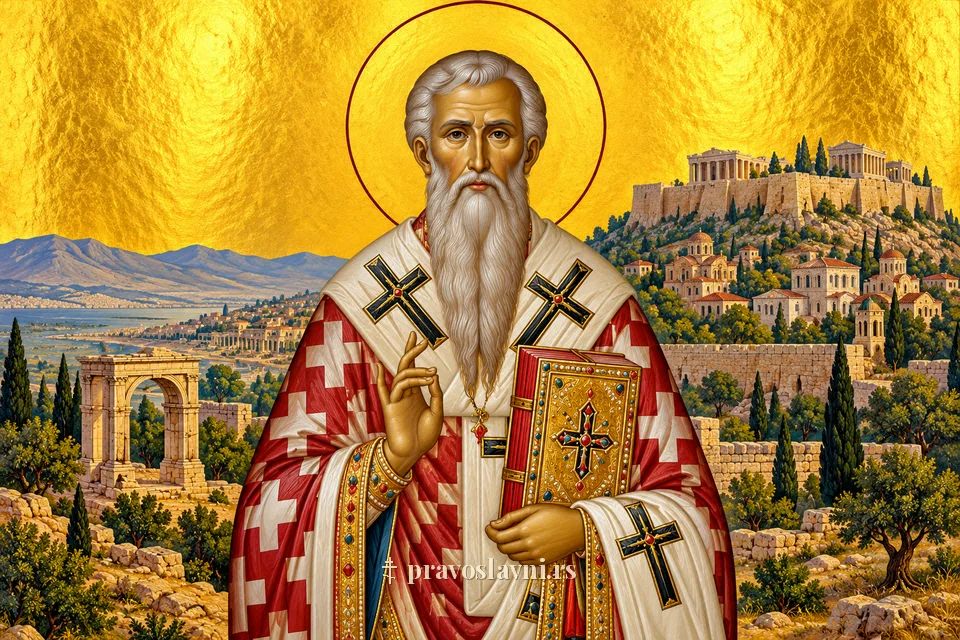
Saint of the day
Hieromartyr Antipas, Bishop of Pergamum
What happenedAntipas, Bishop of Pergamum, is called by the Lord in Revelation His faithful witness, and for preaching Christ the pagans threw him into a red-hot bronze bull.
Read the LifeOrthodox Calendar · 11 April according to the Julian calendar
Friday, 24 April 202611 April (according to the Julian calendar)What happenedAntipas, Bishop of Pergamum, is called by the Lord in Revelation His faithful witness, and for preaching Christ the pagans threw him into a red-hot bronze bull.
Read the Life
No meat, dairy products, eggs or fish — oil and wine are allowed.
This is a recommendation — for your own fast, consult your priest or spiritual father.More about the fast →
Today the Church keeps the commemoration of a saint · not a Red Letter day.
More about the feast →
“I know your works, and where you dwell, where Satan’s throne is. And you hold fast to My name, and did not deny My faith even in the days in which Antipas was My faithful martyr, who was killed among you, where Satan dwells.”
— Rev 2:13In the Book of Revelation the Lord calls Antipas “My faithful martyr” (Rev 2:13). He was bishop of the Church in Pergamum, in Asia, at the time of the persecution which his Life connects with Emperor Domitian. The city was sunk in idolatry, and Antipas was a light among his fellow citizens.
The demons were afraid of him: the Prologue and his Life say that they appeared to the pagan priests in dreams and said that because of Antipas they had to leave the city. The priests therefore stirred up the people, and the crowd demanded that he deny Christ. Antipas answered that gods who flee from a mortal man themselves prove that faith in them is false, and he preached Christ to them as the only saving faith. His Life also remembers his words to the commander: “Commander, know this: I am a Christian, and therefore I will not submit to the senseless and godless order of the Emperor.”
The enraged pagans threw him into a red-hot bronze bull in front of the temple of Artemis. There too he praised God and prayed for his flock and for the world, until he gave up his soul. The Prologue records that he died in the year 92. His relics were buried in Pergamum, and from them, according to his Life, there flowed myrrh which cured diseases.
The hymn sings of him as fearless in the fire, one who prayed for his flock, for the unbelievers, for sinners and for the Church.
In Revelation the Lord calls Antipas “My faithful martyr” and says that he was killed where Satan dwells (Rev 2:13); the Prologue explains that this is Pergamum. Antipas was bishop of the Church in Pergamum, in Asia. The Life places his suffering in the time of the persecution under the Emperor Domitian, while John the Theologian was in exile on Patmos.
The people of Pergamum lived in the darkness of idolatry and debauchery; the Life says that they lived lawlessly and violently. Among such fellow citizens Antipas stood out as a light stands out in the dark. The Life says that he often went out among the people to preach.
The demons were afraid of him. The Prologue and the Life record that they appeared to the pagan priests in dreams and said that because of him they had to flee from the city. The Life also ascribes these words to them: “We neither eat your sacrifices nor delight in the fragrance and the smoke of sacrifice, for the Christian leader Antipas drives us out.”
The priests then turned the people against him. According to the Life, the pagans seized him and brought him to their altar. There was one demand: that he forsake Christ and pay honour to the idols. He answered them that gods who fear a mortal man and flee from him show by themselves that faith in them is false: “do you not recognise by this that all your faith is a delusion,” the Prologue records. Instead of denying, he spoke to them of Christ: only faith in Him is true and only that faith brings salvation.
The Life relates that the commander accused him of opposing the imperial orders and hindering the sacrifices, and gave him the choice between the gods and punishment under Roman law. Antipas answered: “Commander, know this: I am a Christian, and therefore I will not submit to the senseless and godless command of the emperor.” He called on the commander himself to believe in Christ, Who will judge all people at the end of time. When they told him that the old customs were better than the new and that he should respect his years, he reminded them, according to the Life, of Cain, of the builders of the tower, of Sodom and the flood, and warned them of the everlasting fire and the worm that does not die for those who do not repent.
In front of the temple of Artemis there stood a bronze bull, hollow inside. The enraged crowd made it red-hot with fire and threw Antipas into it. In the red-hot bull he praised God and gave thanks to Him — the Prologue compares him with Jonah in the whale and the three youths in the furnace — and prayed for his flock and for the world; the Life says that he prayed that others might be spared. The Life also preserves his last prayer: “Receive my spirit, which is now departing from this life.”
So he received the martyr's crown and eternal glory. The Prologue records that he died in the year 92. The Life says that devout Christians laid his body with honour in a tomb in Pergamum, and the myrrh that flowed from his relics became a remedy for every illness.
Antipas was the faithful witness whom even the demons feared. The hymn sings of how, fearless in the fiery bull, he prayed for his flock, for the unbelievers, for sinners and for the Church.


