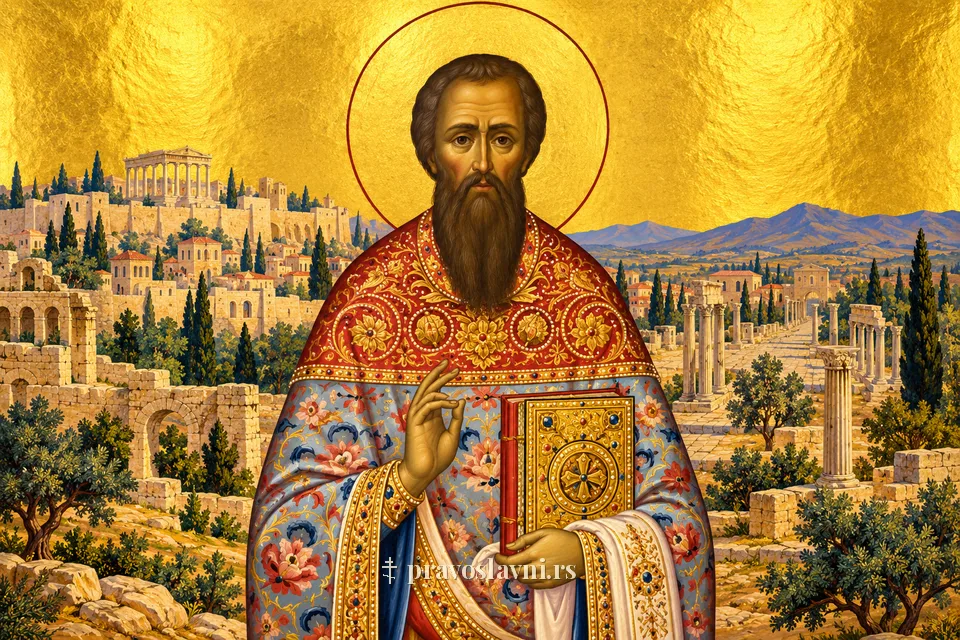
Saint of the day
Hieromartyr Artemon of Laodicea
What happenedThe elder Artemon, a priest of Laodicea, subdued the snakes in the temple of Aesculapius with the sign of the cross, and the pagan priest Vitalius came to believe in Christ.
Read the LifeOrthodox Calendar · 13 April according to the Julian calendar
Sunday, 26 April 202613 April (according to the Julian calendar)What happenedThe elder Artemon, a priest of Laodicea, subdued the snakes in the temple of Aesculapius with the sign of the cross, and the pagan priest Vitalius came to believe in Christ.
Read the Life
You may eat meat, eggs, milk and dairy products, as well as any other food — but try to be moderate.
More about the fast →
Today the Church keeps the commemoration of a saint · Sunday — a festive day · Third Sunday of Pascha – Sunday of the Myrrh-bearing Women.
More about the feast →
“Behold, I give you the authority to trample on serpents and scorpions, and over all the power of the enemy, and nothing shall by any means hurt you.”
— Lk 10:19The Sunday of the Myrrh-bearers is dedicated to the Righteous Joseph of Arimathea and Nicodemus, who begged the body of the Lord from Pilate and buried it, and to the holy Myrrh-bearing Women, who came to the tomb to anoint the Lord with myrrh.
At Vespers the paschal stichera are sung after the aposticha, and at Matins the whole paschal canon is sung, with theotokia added. Where the church is dedicated to the Myrrh-bearers, the magnification is added as well. On the following days of the week the stichera are combined from the Triodion, the Menaion and the Octoechos, and in the first place, instead of the paschal canon, comes the canon of the feast. There is no fasting on this day.
In the temple of Aesculapius the pagan priests kept large snakes, and it was there that they brought the old priest Artemon of Laodicea, after he had, according to his Life, refused to offer sacrifice to Aesculapius. As the Prologue and his Life record, the sign of the cross made them rigid, and the elder's breath, when he carried them out into the courtyard, was death to them. The chief priest Vitalius fell down before him and, as the Prologue records, cried out: “great is the God of the Christians!” Artemon baptised him. His Life adds that he ascribed the miracle not to sorcery, as the governor Patricius claimed, but to the power of Christ and the help of the holy Archangel Raphael.
Artemon served the Church in Laodicea in the time of Emperor Diocletian: sixteen years as a reader, twenty-eight as a deacon and thirty-three as a presbyter. When the persecution began, his Life says that Bishop Sisinius, Artemon and other Christians smashed and burned the idols in the shrine of Artemis by night. According to his Life, he was seized while returning from the outskirts of the city, said openly that he had been a Christian from his youth, and was taken in fetters to Caesarea. Before the judge, according to the Prologue, he called himself a servant of Christ his God and said that he had taught people the way of salvation.
After the miracle with the snakes the tortures continued. The judge intended boiling pitch for him, and his Life records that it was the judge himself who perished in it, for angels in the form of eagles carried him out of his saddle straight into it. His Life records that at the place of suffering, at Artemon's prayer, a spring gushed forth, and that there he instructed and baptised Vitalius and many others; Vitalius later became a bishop in Palestine.
According to the Prologue, he was free for a time and preached, and two deer accompanied him; his Life says that an angel carried him to the seaside town of Bulis, where he worked miracles and converted many. In the end they seized him again and beheaded him — according to the Prologue in 303, and according to his Life in the year 304.
The life of Artemon shows that faithful service through a whole lifetime is crowned with courage in old age, and that the tormentor's snare in the end falls upon the tormentor himself.
Artemon lived in Laodicea in the time of the Emperor Diocletian and was a priest of the Church there. The Prologue and the Life remember his long path through all the degrees of service: for sixteen years he was a reader, for twenty-eight a deacon, and for thirty-three years a presbyter. Thus he had seventy-seven years of service behind him.
The Life says that Patricius was then appointed governor of the region of Laodicea. Before his arrival Bishop Sisinius, Artemon and other Christians broke and burned the idols in the temple of Artemis by night, and the bishop then encouraged his flock in a church about five stadia from the city. Patricius, according to the Life, arrived, offered sacrifices in the temple of Apollo and proclaimed the imperial edict, and then learned as well that the idols of Artemis had been destroyed, and who had done it.
The Life records several signs that accompanied this conflict. A fever struck Patricius down from the saddle just as he was riding against the church with his soldiers. He promised the bishop a golden statue if he recovered; Sisinius told him to keep the gold, and that he would recover if he believed in Christ, and after the bishop's prayer the governor got well.
Patricius, according to the Life, came upon Artemon as he was returning from the countryside around Laodicea, where by the word of Christ he had caught two deer and six wild asses for the bishop's garden. Before the governor he did not hide who he was: “I have been a Christian from my youth.” He was put in chains and taken to Caesarea in Palestine. He sent the animals to the bishop, and the Life says that at the church door one of the deer told Sisinius in a human voice what had happened. The bishop sent the deacon Phileas to the prison with prosphora and prayed for Artemon with tears.
Before the judge, as the Prologue records, he introduced himself with the words: “my name is Artemon, a slave of Christ my God,” and said that he had taught people the way of salvation. The Life adds that he admitted he had broken the statue of the goddess and that he refused to offer sacrifice to Aesculapius, appealing to his long years of service.
So they took him to the temple of Aesculapius, where the priests kept great serpents. According to the Life, they hissed so that the building shook, the people scattered, and the priest Vitalius opened the temple and ran away; one serpent, as the Life states, was five cubits wide and twenty-five cubits long. The Prologue and the Life record that the elder stopped the serpents with the sign of the cross, so that not one of them moved from its place any more. Then he carried them out into the courtyard and breathed on them, and the life went out of them that very instant. The chief priest Vitalius fell at his feet and, according to the Prologue, cried out: “great is the God of the Christians!” Artemon baptised him, and the Prologue says that some of his friends were baptised with him. When Patricius called the miracle sorcery, Artemon, according to the Life, answered him: “By the power of Christ and with the help of the holy Archangel Raphael.”
The tortures went on, and the elder, as the Life says, prayed for a long time, remembering the righteous of the Old Testament. The Life tells that the same deer arrived from Laodicea, licked his feet and in a human voice announced that freedom awaited the elder, and punishment the governor: the birds of heaven would cast him into boiling pitch. The Life records how this was fulfilled: the pitch prepared for Artemon became the grave of Patricius himself. He had no sooner ridden up to it than two angels in the form of eagles carried him out of the saddle and dropped him into the boiling pitch, in which he was burned up.
On that spot, according to the Life, a spring of water gushed forth at Artemon's prayer. Vitalius and many others came to him, and he instructed and baptised them, and at dawn he broke bread for them and blessed the cup. The Bishop of Caesarea, whose name the Life does not give, marked the place of the suffering and later built a church there, ordained some of the converts, and appointed Vitalius a bishop in Palestine.
According to the Prologue, the elder was at liberty for a time and preached, and two deer accompanied him. The Life tells that at night a voice from heaven told him to go to Asia, to the seaside town of Bulis, where he would find Alexander and his mother Pyronia and deliver many from demons and illnesses. An angel, according to the Life, carried him there, and he worked miracles and converted many. At last they seized him again and beheaded him — according to the Prologue in the year 303, and according to the Life in 304, in that town, at the hands of the pagans.
Artemon's life shows that God crowns a whole lifetime of faithful service with courage in old age, that the power of Christ overcomes the serpents of idolatry, and that the torturer's trap in the end falls upon the torturer himself.


