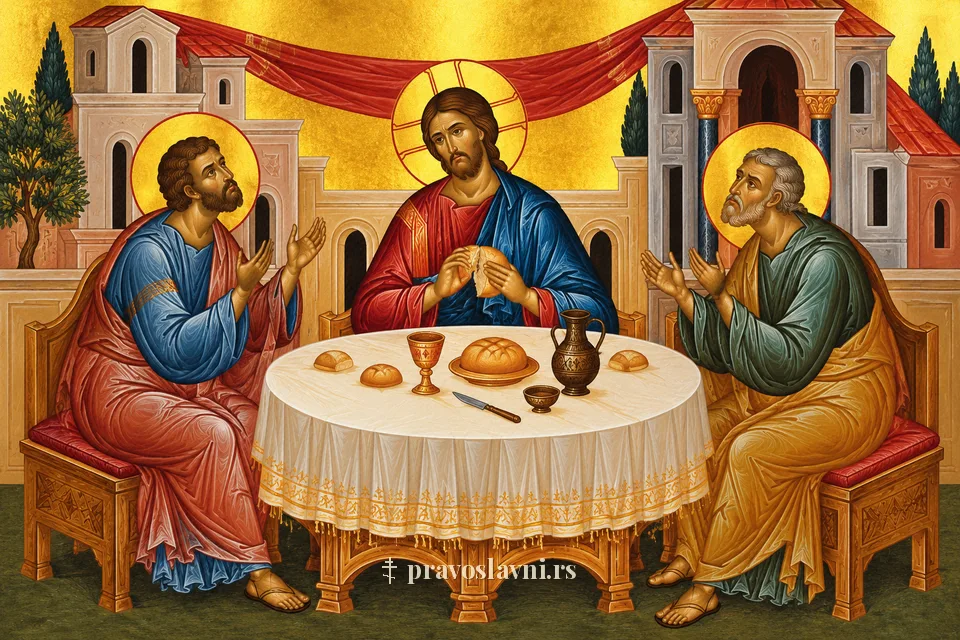
“And they said to one another, ”Did not our heart burn within us while He talked with us on the road, and while He opened the Scriptures to us?”“
— Lk 24:32
About this day
By folk custom, in most of our regions Vaskrs (Pascha, Easter) is celebrated for three days, so on Vaskrsni utorak (Bright Tuesday) too people sit down to a festive table. Relatives, kumovi (godparents and wedding sponsors), neighbours and friends come to visit, and kinsfolk arrive from more distant places as well. Among the people it is said of this day that it is the best Tuesday of the year.
By folk custom, in an occasional village weddings are also arranged for this day: it is believed that the Paschal season is blessed, and so that grace is called down upon the new married couple.
In church the service is as on the first and second day of Pascha, with the Royal Doors open. The day is non-fasting, like the whole of Bright Week.
About the feast
Bright Tuesday is the second day after Vaskrs (Pascha), and the celebration of Pascha continues both in church and in the homes of the faithful. The divine service does not differ from that of the first two days of Vaskrs, and the royal doors still stand open, as a sign of the empty tomb of Christ. Bright Week is celebrated as a single day, and so there is no fasting in it.
The Evangelist Luke describes how two disciples, on the very day the Lord rose, were going to the village of Emmaus, sixty stadia distant from Jerusalem. The risen Jesus drew near and went with them, but they did not recognise Him. On the way, beginning at Moses and all the prophets, He expounded the Scriptures to them. When they sat down at table, He took bread, blessed it and broke it, and then they knew Him: “Then their eyes were opened and they knew Him; and He vanished from their sight.” They returned to Jerusalem and heard from the eleven: “The Lord is risen indeed, and has appeared to Simon!”
According to the Life, the Iveron Icon of the Most Holy Theotokos is also commemorated in Bright Week, the icon which came by sea to the Iveron Monastery on the Holy Mountain (Mount Athos); according to the Prologue, it was received by St Gabriel of Iveron. It received the name Portaitissa, the Gate-keeper, from its place beside the monastery gate.
By folk custom, the Paschal feast lasts three days in most of our regions, and so on this day too relatives, godparents, neighbours and friends are welcomed.
Full Life
The third day of Vaskrs
Bright Tuesday is the second day after Vaskrs (Pascha). The celebration of Pascha continues both in church and in the homes of the faithful, and in church the services are as on the first two days of Vaskrs. Bright Week, the first week after the Resurrection, begins the fifty-day celebration which lasts until Pentecost. The royal doors stand wide open all week, like the empty tomb from which Christ arose and like the veil of the temple in Jerusalem, which was torn in two when He died on the cross. Since all seven days are celebrated as one single day, there is no fasting on them, and so this day too is fast-free.
The travellers to Emmaus
The Evangelist Luke describes how the risen Lord, on the very day of the Resurrection, accompanied two disciples on the road: “Now behold, two of them were traveling that same day to a village called Emmaus, which was seven miles from Jerusalem.” (Lk 24:13) While they were talking, “Jesus Himself drew near and went with them”, but “their eyes were restrained, so that they did not know Him” (Lk 24:15–16). One of them, whose name was Cleopas, asked Him whether He alone in Jerusalem did not know what had happened in those days. Then the Lord, beginning at Moses and all the prophets, explained to them what was written about Him in all the Scriptures.
They knew Him in the breaking of bread
As it was growing dark, the disciples begged Him to stay: “Abide with us, for it is toward evening, and the day is far spent.” (Lk 24:29) At the table He took bread, blessed it, broke it and gave it to them. “Then their eyes were opened and they knew Him; and He vanished from their sight.” (Lk 24:31) They said to one another that their heart had burned within them while He talked with them on the road and opened the Scriptures to them. They returned to Jerusalem and found the eleven, who were saying: “The Lord is risen indeed, and has appeared to Simon!” They told what had happened on the road and how they had known Him in the breaking of bread (Lk 24:34–35).
The Iveron Icon and folk customs
According to the Life, the Iveron Icon of the Most Holy Theotokos is also commemorated in Bright Week. In the time of iconoclasm that icon, according to the Life, came by itself across the sea from Asia Minor to the Iveron Monastery on the Holy Mountain (Mount Athos). It was received from the water by Venerable Gabriel of Iveron, of whom the Prologue says: “Gabriel was found worthy to receive the icon of the wonderworking Mother of God, which came to the monastery by sea.” It stands by the monastery gate, and so it is called Portaitissa, the Gate-keeper.
By folk custom, in most of our regions the paschal feast lasts three days, and so the feasting continues on Bright Tuesday as well: relatives, godparents (kumovi), neighbours and friends are welcomed, and kinsfolk gather even from distant places.
Other saints of the day
Hieromartyr Januarius
St Januarius, a bishop in Campania, in Italy, suffered in the persecution of Maximian. His Life says that the governor Timothy did not win him over to the idols either by fair words or by intimidation, and the Prologue that he bore his torments patiently and without malice. The fire into which he was thrown did him no harm, for an unseen dew cooled it, and in it he praised God.
The tears of his deacon Faustus and his reader Desiderius gave them away as Christians too. All three ended up in prison in Puteoli, along with the deacons Proculus and Sosius and the laymen Eutychius and Acutius. When the seven were thrown to the wild beasts, not one of the beasts attacked them. The Life then tells that the governor went blind and that the prayer of Januarius gave him back the sight of his eyes, although spiritually he remained blind; seeing these miracles, about five thousand people came to believe in Christ. The martyrs were beheaded; the Prologue gives the year 305.
Naples gained its intercessor when the Christians of that city secretly brought the body of Januarius to their home and buried it in a church. The Life also mentions the glass vessel with his blood, which becomes liquid when it is beside the saint's head, and Vesuvius, whose eruption ceased after prayer at his tomb. Both sources say that the miracles at his tomb have not ceased even today. They also remember a certain widow: when her only son died, she laid the saint's icon upon him and prayed in tears, and the child came back to life.
Januarius teaches that torments are to be borne with patience and without hatred, and that God does not forsake those who confess Him.