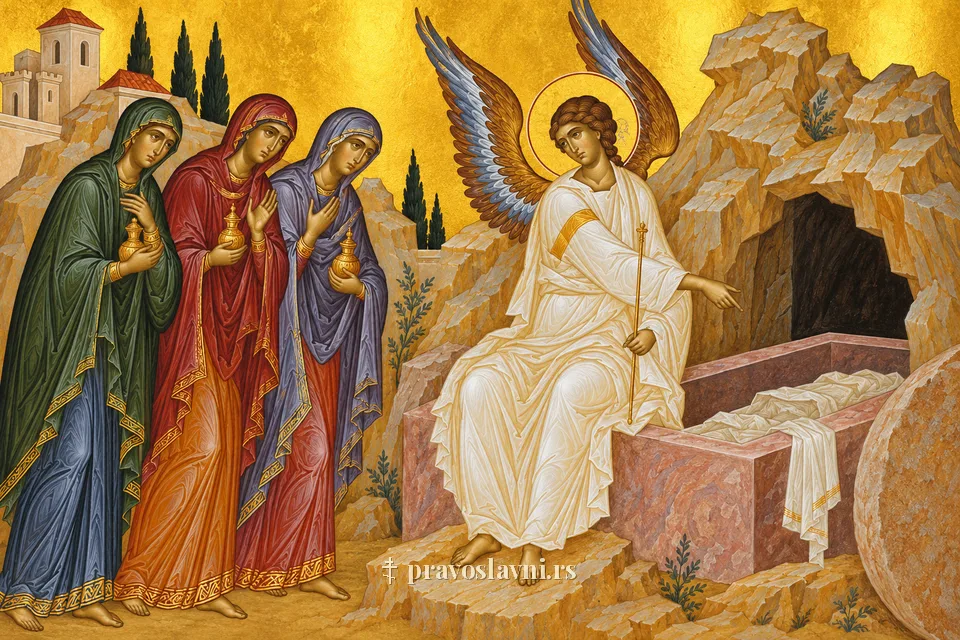
Great feast
Bright Monday
What happenedBright Week, as liturgics teaches, is one unbroken feast: the doors of the altar stand open, and all the services are filled with paschal hymns.
Read the LifeOrthodox Calendar · 31 March according to the Julian calendar
Monday, 13 April 202631 March (according to the Julian calendar)What happenedBright Week, as liturgics teaches, is one unbroken feast: the doors of the altar stand open, and all the services are filled with paschal hymns.
Read the Life
You may eat meat, eggs, milk and dairy products, as well as any other food — but try to be moderate.
More about the fast →
Red Letter day — great feast; by custom, no work is done
More about the feast →
“This Jesus God has raised up, of which we are all witnesses.”
— Acts 2:32Bright Week is the time when the joy of Vaskrs (Pascha, Easter) enters homes from the church. All week long the faithful greet one another: “Hristos Vaskrse!” (“Christ is risen!”), and the reply is: “Vaistinu Vaskrse!” (“Truly He is risen!”); by custom, this greeting lasts until Spasovdan (Ascension). The first day after Pascha is called Vaskrsni ponedeljak (Bright Monday), and the second Vaskrsni utorak (Bright Tuesday). On Bright Monday, the second day of Pascha, after the Liturgy there is a procession, as is kept in practice today. During these days the priest visits the homes of his parish with the cross and sings Paschal hymns; in Serbia he also blesses water on that occasion. There is no fasting on Wednesday or Friday, so the table is non-fasting on all seven days. According to Liturgics, the bells ring all day long, throughout the whole of Bright Week. On Bright Saturday, when the Liturgy and a special prayer are finished, the artos is broken and handed out to the faithful instead of the antidoron.
According to Liturgics, Bright Week is one compact, unbroken feast. From Vaskrs (Pascha) until Saturday the doors of the altar, the royal doors and the north and south doors alike, stand open, like the open tomb of the Lord, and they are closed only on Bright Saturday, after the Liturgy. At the Hours the psalms are not read; instead only Paschal hymns are sung, with “Lord, have mercy” repeated forty times; the same Hour is also served in place of the Midnight Office and Compline. The Liturgy begins with the Paschal exclamations, and at every service the Paschal troparion is sung anew: “Christ is risen from the dead, trampling down death by death, and upon those in the tombs bestowing life.”
The Artos, a sign of the invisible presence of the risen Lord, stands all week before the icon of Christ the Saviour and is carried in the processions. A procession ought to be held after the Liturgy every day, although in practice today it is held only on the second day of Vaskrs, and the bells are heard all day long. The whole week is free of fasting, with no fast even on Wednesday and Friday. On Istočni petak (Bright Friday) the service to the Life-giving Spring of the Most Holy Theotokos is served, which is local in character and is not found in the Typikon. If the feast of a great saint, such as Đurđevdan (St George's Day), falls on these days, his service is joined with the Paschal one.
During these days the priest goes round the homes of the faithful with the cross and sings the Paschal hymns, and in Serbia he also blesses water during that visit. The greeting “Christ is Risen!” — “Indeed He is Risen!” is heard throughout the week. The Apostle Paul reminds us that through baptism we were buried with Christ, so that, just as He rose from the dead, we too should walk in newness of life. The Apostle Peter says that God, through the resurrection of Jesus Christ, has begotten us again to a living hope.
All seven days are celebrated as one single day of Pascha. From Vaskrs (Pascha) until Saturday no one closes the altar: the royal doors and the north and south doors alike stand open. The open doors recall the open tomb of the Lord. Only on Bright Saturday, after the Liturgy, are both the royal doors and the side doors of the altar closed.
At the Hours this week the psalms are not read. Everything that is sung is paschal hymns, and “Lord, have mercy” is repeated forty times. The same Paschal Hour is also served in place of the Midnight Office and Compline. The Liturgy begins with the paschal exclamations, and in place of the Trisagion Hymn another, special hymn is sung. At every service, again and again, one hears the paschal troparion: “Christ is risen from the dead, trampling down death by death, and upon those in the tombs bestowing life.”
According to the Liturgics handbook, a procession ought to be held after the Liturgy on every day of this week, but nowadays in practice it is held only on the second day of Vaskrs. The bells are heard all day long, throughout the whole of Bright Week. The artos, the paschal bread blessed at the paschal Liturgy as a sign of the invisible presence of the risen Lord, stands all week before the icon of Christ the Saviour and is carried in the processions.
The Monday and Tuesday after Vaskrs are called Bright Monday and Bright Tuesday. The whole week is fast-free, and so there is no fasting on either Wednesday or Friday. The Friday of this week is called Istočni petak (Friday of the Spring): on that day the service to the Life-giving Spring of the Most Holy Theotokos is served. That service is local in character and is not found in the Typikon. If the feast of some great saint, such as Đurđevdan (St George's Day), falls in Bright Week, his service is joined with the paschal one.
At Vaskrs and in the days of Bright Week the priest comes with the cross to the homes of the faithful of his parish and sings the paschal hymns, and in Serbia during that visit he also blesses water. In this way the paschal joy passes from the church into the home. The greeting “Christ is risen!” — “Truly He is risen!” is heard all week long, and by custom it continues until Spasovdan (Ascension).
The Apostle Paul writes: “Therefore we were buried with Him through baptism into death, that just as Christ was raised from the dead by the glory of the Father”, we too should walk in newness of life (Rom 6:4). And he adds: “knowing that Christ, having been raised from the dead, dies no more. Death no longer has dominion over Him.” (Rom 6:9) The Apostle Peter says that God, according to His great mercy, has begotten us again to a living hope through the resurrection of Jesus Christ from the dead (1 Pet 1:3).
Before his death, according to his Life, Bishop Hypatius prayed for those who had attacked him, as the Protomartyr Stephen once did: “Lord, do not charge them with this sin!” The Novatian heretics lay in wait for him in a narrow pass on his way home, wounded him and hurled him from the road. Then a woman who was with them dealt him the final blow with a stone.
Hypatius, according to the Prologue, was born in Cilicia, and he was Bishop of Gangra and took part in the First Ecumenical Council. The Prologue and the Life remember him for his holy life and his miracles. According to the Life, the sick found healing with him and the possessed deliverance, and bitter water became fit to drink; at his prayer a warm healing spring also began to flow. When one night he was walking along a river in the dark, light, according to the Life, came to him from the water itself.
He became renowned in Constantinople as well. The Life tells that in the time of Emperor Constantius an enormous serpent appeared in the palace, which no one was able to drive away. The emperor summoned Hypatius. The bishop prayed for a long time, then asked for a fire to be lit in a great furnace at the Hippodrome, and then by the name of Jesus Christ he compelled the serpent to follow him and to enter the fire, where it was burnt up. From then on the emperor honoured him as a father, and according to the Prologue and the Life he kept his portrait in the palace.
The murderers, according to the Life, hid the body in a hay shed. The Life says that the owner, when he came for hay, heard angelic singing and found the body of his bishop, and the people of Gangra buried him with weeping and with honours. The woman who had killed him lost her reason immediately after the murder. According to the Life, she walked behind the funeral procession and publicly confessed her guilt. The Prologue records that those of her household brought her to his grave and that after prayer she was healed, and from then on lived as a penitent. According to the Life, the other murderers were healed as well, and many other miracles also took place at the grave.
Hypatius teaches us that forgiving one's enemies is the mark of a martyr of Christ.


