Monday, 13 April 2026no fast · Red Letter day · 31 March (according to the Julian calendar)
Monday, 3 May 2027no fast · Red Letter day · 20 April (according to the Julian calendar)
Monday03May 202720 April (according to the Julian calendar)
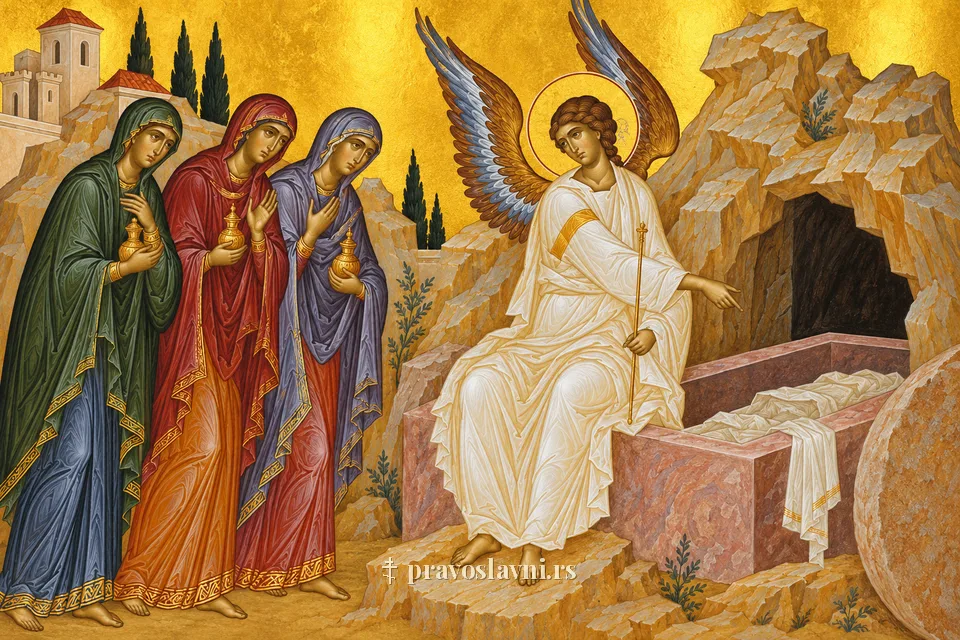
Illustration
Great feast
Bright Monday
What happenedBright Week, as liturgics teaches, is one unbroken feast: the doors of the altar stand open, and all the services are filled with paschal hymns.
“This Jesus God has raised up, of which we are all witnesses.”
— Acts 2:32
About this day
Bright Week is the time when the joy of Vaskrs (Pascha, Easter) enters homes from the church. All week long the faithful greet one another: “Hristos Vaskrse!” (“Christ is risen!”), and the reply is: “Vaistinu Vaskrse!” (“Truly He is risen!”); by custom, this greeting lasts until Spasovdan (Ascension). The first day after Pascha is called Vaskrsni ponedeljak (Bright Monday), and the second Vaskrsni utorak (Bright Tuesday). On Bright Monday, the second day of Pascha, after the Liturgy there is a procession, as is kept in practice today. During these days the priest visits the homes of his parish with the cross and sings Paschal hymns; in Serbia he also blesses water on that occasion. There is no fasting on Wednesday or Friday, so the table is non-fasting on all seven days. According to Liturgics, the bells ring all day long, throughout the whole of Bright Week. On Bright Saturday, when the Liturgy and a special prayer are finished, the artos is broken and handed out to the faithful instead of the antidoron.
About the feast
According to Liturgics, Bright Week is one compact, unbroken feast. From Vaskrs (Pascha) until Saturday the doors of the altar, the royal doors and the north and south doors alike, stand open, like the open tomb of the Lord, and they are closed only on Bright Saturday, after the Liturgy. At the Hours the psalms are not read; instead only Paschal hymns are sung, with “Lord, have mercy” repeated forty times; the same Hour is also served in place of the Midnight Office and Compline. The Liturgy begins with the Paschal exclamations, and at every service the Paschal troparion is sung anew: “Christ is risen from the dead, trampling down death by death, and upon those in the tombs bestowing life.”
The Artos, a sign of the invisible presence of the risen Lord, stands all week before the icon of Christ the Saviour and is carried in the processions. A procession ought to be held after the Liturgy every day, although in practice today it is held only on the second day of Vaskrs, and the bells are heard all day long. The whole week is free of fasting, with no fast even on Wednesday and Friday. On Istočni petak (Bright Friday) the service to the Life-giving Spring of the Most Holy Theotokos is served, which is local in character and is not found in the Typikon. If the feast of a great saint, such as Đurđevdan (St George's Day), falls on these days, his service is joined with the Paschal one.
During these days the priest goes round the homes of the faithful with the cross and sings the Paschal hymns, and in Serbia he also blesses water during that visit. The greeting “Christ is Risen!” — “Indeed He is Risen!” is heard throughout the week. The Apostle Paul reminds us that through baptism we were buried with Christ, so that, just as He rose from the dead, we too should walk in newness of life. The Apostle Peter says that God, through the resurrection of Jesus Christ, has begotten us again to a living hope.
Full Life
The open doors
All seven days are celebrated as one single day of Pascha. From Vaskrs (Pascha) until Saturday no one closes the altar: the royal doors and the north and south doors alike stand open. The open doors recall the open tomb of the Lord. Only on Bright Saturday, after the Liturgy, are both the royal doors and the side doors of the altar closed.
Song instead of psalms
At the Hours this week the psalms are not read. Everything that is sung is paschal hymns, and “Lord, have mercy” is repeated forty times. The same Paschal Hour is also served in place of the Midnight Office and Compline. The Liturgy begins with the paschal exclamations, and in place of the Trisagion Hymn another, special hymn is sung. At every service, again and again, one hears the paschal troparion: “Christ is risen from the dead, trampling down death by death, and upon those in the tombs bestowing life.”
The procession, the bells and the artos
According to the Liturgics handbook, a procession ought to be held after the Liturgy on every day of this week, but nowadays in practice it is held only on the second day of Vaskrs. The bells are heard all day long, throughout the whole of Bright Week. The artos, the paschal bread blessed at the paschal Liturgy as a sign of the invisible presence of the risen Lord, stands all week before the icon of Christ the Saviour and is carried in the processions.
Feasts in Bright Week
The Monday and Tuesday after Vaskrs are called Bright Monday and Bright Tuesday. The whole week is fast-free, and so there is no fasting on either Wednesday or Friday. The Friday of this week is called Istočni petak (Friday of the Spring): on that day the service to the Life-giving Spring of the Most Holy Theotokos is served. That service is local in character and is not found in the Typikon. If the feast of some great saint, such as Đurđevdan (St George's Day), falls in Bright Week, his service is joined with the paschal one.
In the homes of the faithful
At Vaskrs and in the days of Bright Week the priest comes with the cross to the homes of the faithful of his parish and sings the paschal hymns, and in Serbia during that visit he also blesses water. In this way the paschal joy passes from the church into the home. The greeting “Christ is risen!” — “Truly He is risen!” is heard all week long, and by custom it continues until Spasovdan (Ascension).
New life
The Apostle Paul writes: “Therefore we were buried with Him through baptism into death, that just as Christ was raised from the dead by the glory of the Father”, we too should walk in newness of life (Rom 6:4). And he adds: “knowing that Christ, having been raised from the dead, dies no more. Death no longer has dominion over Him.” (Rom 6:9) The Apostle Peter says that God, according to His great mercy, has begotten us again to a living hope through the resurrection of Jesus Christ from the dead (1 Pet 1:3).
Other saints of the day
Venerable Theodore Trichinas
In a monastery in the wilderness of Thrace there lived the ascetic life a monk named Theodore, who was called Trichinas, that is, “the Hair-shirt Wearer”, from his clothing: all his life he wore only a rough garment of haircloth and went bareheaded. The Prologue records that he lay on a stone in order to shorten his sleep, and his Life that he spent his nights standing at prayer, and in the cold as well.
It was not poverty that brought him to the wilderness. He was born in Constantinople, in a wealthy family, but as a young man he left his own people and all his possessions for the sake of God.
The gift of working miracles, which he had both during his life and after his death, Theodore received from God for his labour. Theodore reposed in peace about the year 400. Myrrh flowed from his relics; the Life records that the sick were healed by it and demons were driven out of the possessed.
His example teaches that God glorifies the one who leaves wealth and comfort for His sake.
Translation of the Relics of St Nikolaj of Žiča (Velimirović)
According to his Life, St Nikolaj of Žiča reposed in prayer on 18 March 1956 in the Russian monastery of St Tikhon in South Canaan, in Pennsylvania. The faithful at once began to call upon him in their prayers as a saint. His body was then taken to Libertyville, to the Serbian monastery of St Sava, and with solemn honours it was laid in a grave in the Serbian cemetery beside the monastery. Later the relics were translated to Serbia. The Life sets this event alongside the translation of the relics of St Sava from Tarnovo to Mileševa.
St Joasaf was called Jovan Uroš Nemanjić-Palaiologos in the world; he was the son of Simeon-Siniša of the Nemanjić line and of Thomais, and he was born around 1350. According to his Life, as a young man he often visited the ascetics of the Holy Mountain and the monasteries of Meteora. Around 1369 he inherited his father's rule in Thessaly, but he wished to leave it behind: he handed it over to a kinsman and withdrew to the Great Meteoron, to St Athanasius, where he received the monastic name Joasaf. Before his death Athanasius appointed him to be abbot after him. Joasaf enlarged and adorned the church of the Transfiguration, and with the help of his sister he built cells, a hospital and other buildings, and so he is honoured as the ktetor (founder) of the monastery. When the Turks took Thessaly, he spent several years at Vatopedi on the Holy Mountain, and around 1401 he returned to Meteora. He spent his last years in a small cell at Meteora, devoted to prayer, and there he died in the year 1422 or 1423. His relics rest in the monastery of the Transfiguration, together with the relics of St Athanasius.