Sunday02May 202719 April (according to the Julian calendar)
Illustration
Great feast
Vaskrs — Pascha (Easter)
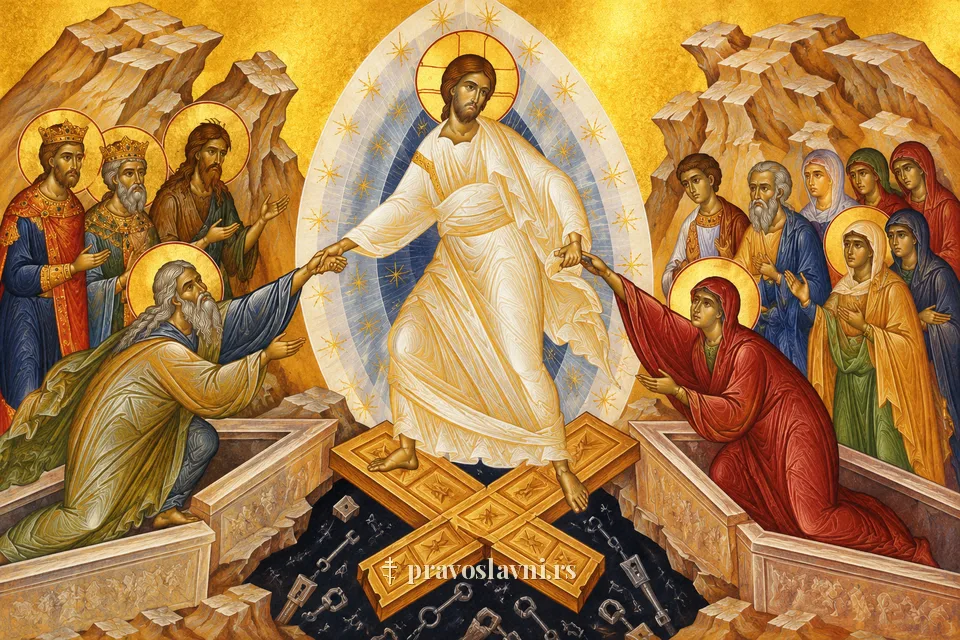
Resurrection of Christ
What happenedVaskrs (Pascha, Easter) is the greatest Christian feast, the day when the Lord Jesus Christ rose from the dead and conquered death, sin and the devil.
“But now Christ is risen from the dead, and has become the firstfruits of those who have fallen asleep.”
— 1 Cor 15:20
About this day
By custom, at Vaskrs (Pascha, Easter) the head of the house goes with his household to church for the holy Paschal service. After the service people greet one another with the words “Hristos Vaskrse!” (“Christ is risen!”) and reply “Vaistinu Vaskrse!” (“Truly He is risen!”). By custom, this greeting lasts right up to Spasovdan (Ascension).
At home, after prayer, the members of the household also greet one another with the Paschal greeting, and then gather around the festive table. By custom, the first thing tasted is a boiled Paschal egg, and after it come the other dishes. Then the egg tapping begins. The head of the house leads the way in it, and after him the other members of the household take an egg too, one after another, and compete to see whose egg will prove the strongest. While they tap eggs, they say the Paschal greeting to one another.
The eggs were dyed red back on Great and Holy Friday, and the first egg dyed, the čuvarkuća (“guardian of the house”), is kept until the next Pascha. According to tradition, the custom of dyeing eggs has its origin in Mary Magdalene and her egg which turned red before the emperor. The egg is a sign of new life, and the red colour is a reminder of Christ's shed Blood. Pascha is a non-fasting day, without a fast.
Among all the Christian feasts Vaskrs (Pascha) is the greatest: it is the day on which life conquered death. It is the greatest because on that day the Lord Jesus Christ rose from the dead. By the Holy Spirit He has set us free from the power of sin, death and the devil. Vaskrs always falls on a Sunday, because the risen Christ first appeared early on the first day of the week. The Apostle Paul bears witness: “But now Christ is risen from the dead, and has become the firstfruits of those who have fallen asleep.” And he cries out: “O Death, where is your sting? O Hades, where is your victory?”
Paschal Matins begins at midnight, in a church full of incense and of the light of all the candles that have been lit. The clergy and the people go around the church in procession, in memory of the myrrh-bearing women and their early coming to the tomb, and when the closed doors of the church are opened, the faithful go in as into the open tomb of Christ. At every service the Paschal troparion is sung again and again: “Christ is risen from the dead, trampling down death by death, and upon those in the tombs bestowing life.” At Matins the rector reads the Paschal Homily of St John Chrysostom. At the Liturgy the first passage of the Gospel according to John is read, all the bells are rung, and the artos is blessed, a sign of the invisible presence of the risen Lord. Red eggs are blessed as well.
According to tradition, Mary Magdalene brought an egg to the Emperor Tiberius with the Paschal greeting, and the white egg turned red before the Emperor; ever since then Christians have dyed eggs at Vaskrs. The egg is a sign of new life, and the red colour recalls the blood that Christ shed. The greeting “Christ is Risen!” — “Indeed He is Risen!” is a confession of the victory over death, which the faithful carry from the church into every home, and by custom it lasts right up to Spasovdan (Ascension).
Full Life
The Feast of Feasts
Among all Christian feasts Vaskrs (Pascha) is the greatest: it is the day when life conquered death. It is the greatest because on that day the Lord Jesus Christ rose from the dead. Rising from the tomb, the Lord freed us by the Holy Spirit from the power of sin, death and the devil. Vaskrs always falls on a Sunday because, according to the Gospel, the risen Christ first appeared early on the first day of the week (Mk 16:9).
The Apostle Paul bears witness: “But now Christ is risen from the dead, and has become the firstfruits of those who have fallen asleep.” (1 Cor 15:20) Of the same victory he writes: “knowing that Christ, having been raised from the dead, dies no more. Death no longer has dominion over Him.” (Rom 6:9) And he cries out: “O Death, where is your sting? O Hades, where is your victory?” (1 Cor 15:55) He calls Christ our Passover: “For indeed Christ, our Passover, was sacrificed for us.” (1 Cor 5:7)
The procession and the open tomb
Paschal Matins begins at midnight. The clergy and the people go out of the church through the royal doors and walk around it in procession, in memory of the myrrh-bearing women and their early coming to the tomb. The procession stops in front of the church, whose doors have been closed since before the beginning. When they are opened, the faithful go in as though they were entering the open tomb of Christ.
Song and word
Most often that night one hears the paschal troparion, which is sung again and again at every service: “Christ is risen from the dead, trampling down death by death, and upon those in the tombs bestowing life.” At Matins the whole paschal canon is sung, and the rector of the church reads the Paschal Homily of St John Chrysostom. At the Liturgy the first pericope of the Gospel according to John is read, and as soon as it has been read, all the bells ring out. In the evening, at Paschal Vespers, the Church listens to the Gospel of how the risen Lord appeared to His disciples that same evening.
Light and signs
For this night the church is prepared more festively than for any other: all the candles are lit, the church is fragrant with incense, and the priests are in their most festive vestments. The artos, the paschal bread, is blessed at the end of the Liturgy, after the prayer behind the ambo; it is a sign that the risen Lord is invisibly present among the faithful. After the Liturgy the eggs dyed red are also blessed in the narthex.
The red egg
According to tradition, St Mary Magdalene, while preaching in Rome, brought Emperor Tiberius a hen's egg with the paschal greeting. The Emperor doubted and said that the resurrection was just as impossible as for a white egg to turn red, and the egg in his hand began to turn red. Ever since then Christians have dyed eggs at Vaskrs. The egg is a sign of new life, and the red colour recalls the blood that Christ shed and the dignity of the Saviour.
Other saints of the day
Venerable John of the Ancient Caves
Venerable John, according to the Prologue, went to Paradise after his death, having long lived the ascetic life in Palestine, in the eighth century.
From his youth he loved Christ with all his heart, soul and mind. His Life says that he rejected worldly pleasures and pride, left his homeland, became a monk and went as a stranger into a foreign land for the Lord's sake. He visited the holy places, Jerusalem first of all, and listened, according to the Prologue, to the teachings of holy men.
He settled in the Old Cave — the Lavra of St Chariton the Great in the desert near Jerusalem, founded before the other lavras. The Life records that this had once been a robbers' cave in which Chariton was miraculously preserved, and that he afterwards made a church in it and built a monastery above it. John lived in that cave and served in the cave church, and for this he was called “of the Ancient Caves”. According to the Life, because of his virtuous life he became a priest.
He fasted, spent his nights in prayer and vigil and constantly remembered death; the Prologue adds that he learnt humility. The Life says that the angels bore his soul to the heavenly dwellings.
His life teaches that love for Christ, humility and the remembrance of death prepare a person for Paradise.
Blessed Matrona of Moscow
Blessed Matrona of Moscow was born in the year 1881 in the village of Sebino in the Tula governorate, the youngest of the four children of the poor and devout peasants Dimitry and Natalia. Her Life says that she was born blind, but the Lord gave her spiritual sight; at baptism she was given her name after St Matrona of Constantinople. From childhood she loved prayer and the church services, and already from the age of seven or eight people came to her because of her gift of clairvoyance and healing. At seventeen she lost the use of her legs, and she lived like that for about fifty years. In her youth she went on pilgrimage to the holy places and met St John of Kronstadt. From 1925 she lived in Moscow, often without documents. She reposed in the year 1952 and was buried in the Danilov cemetery, and her grave became a place of pilgrimage.