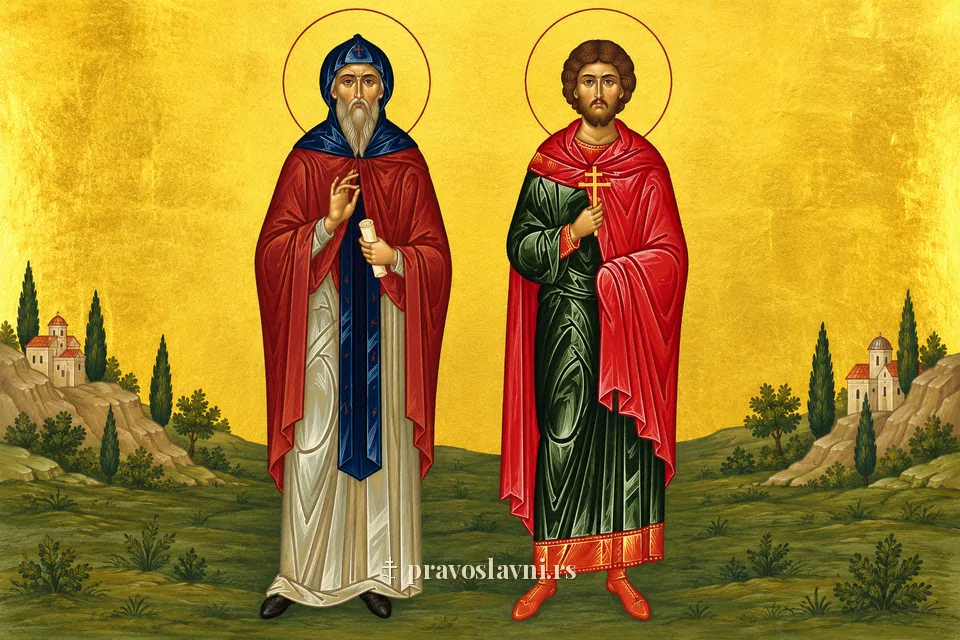
Sts Cyrus and John belong among the Unmercenaries: they healed, and they did not charge for it. Cyrus was a renowned physician from Alexandria; his Life says that he took no money for his labour, and the Prologue adds that he did not put his trust in medicines alone, but also in the power of Christ, and that he taught the sick that sin often stands behind illness and that repentance and prayer heal them. John was an officer from Edessa, a devout Christian.
Diocletian's persecution separated both of them from their old life. Cyrus withdrew to Arabia and became a monk; the Life says that from then on the sick recovered at his prayer alone, and that many pagans accepted Christ because of it. John, according to the Life, left the army and his estate, and when he heard of Cyrus in Jerusalem, he searched for him until he found him in Arabia. From then on they lived together as brothers, in ascetic struggle.
Their greatest trial awaited them in Canopus. There Athanasia and her three daughters, the youngest of whom was eleven years old, were being tortured for Christ. The two ascetics came to encourage them not to give way, and the women, listening to them, endured everything. The Life says that someone denounced them to the governor Syrianus, who offered them honours and freedom in exchange for a sacrifice to the idols, and threatened them with tortures. Their answer was brief: they do not renounce Christ, and the governor's honours mean nothing to them. They were tortured before the women's eyes, but the women did not yield either: Athanasia and her daughters were beheaded, and the Life says that they went joyfully to their death. After them, in the year 311, Cyrus and John were also beheaded with the sword. The Life says that a tomb was provided for them by Christians who had to keep their faith hidden, in a church dedicated to the Apostle Mark.
The Prologue says that miracles through them did not cease even after their death, and that the faithful pray to them at Holy Unction, at the blessing of water and against sleeplessness.
Their example reminds us that repentance and prayer are medicine for both soul and body, and that both a young girl and a soldier can have courage in the faith.
Full Life
Two Different Men
Cyrus was born and grew up in Alexandria, and there he became known as a physician. John came from Edessa; he was a devout Christian and an officer of the Roman army. The Church commemorates them together, as unmercenaries and wonderworkers. Together they lived, together they encouraged others in distress, and together they suffered for Christ.
The Physician Who Needed No Pay
Their Life stresses that Cyrus asked nothing for his healing. Nor did he regard medicines as the only means: the Prologue says that he also healed the sick by the power of Christ. He taught them that sin often stands behind an illness, and that repentance and prayer are a medicine for the whole person. The Life adds that he spoke to the sick about the prophets and the apostles, and that through him many pagans became Christians.
When he later became a monk, the Life says that he gave up medicines altogether. God gave him the gift of working miracles, and the sick recovered at his prayer. Word of him spread through Arabia, and many idol-worshippers, seeing the miracles, came to believe in Christ.
A Flight That Was Not Fear
Diocletian's persecution reached Cyrus too: the Life says that he was reported to the authorities in Alexandria as a teacher of the faith and that an order was issued for his arrest. Cyrus went away to Arabia. According to the Life, it was not fear that drove him to that step: he wanted to prepare himself for martyrdom by the monastic struggle, and until then not to deny help to those who needed it. Besides, Christ Himself said: “When they persecute you in this city, flee to another” (Mt 10:23).
John, at the time of the persecution, according to the Life, left the army, his home and all his possessions, regretting nothing. He heard of the miracles of Cyrus in Jerusalem, looked for him in vain in Alexandria, and at last found him in Arabia. From then on they were like brothers: they shared the same ascetic life, and John followed Cyrus in everything.
The Road to Canopus
From the persecution they had once taken shelter, but to Canopus they went of their own accord. There a Christian woman, Athanasia, was being tortured for Christ, and with her three daughters of fifteen, thirteen and eleven years of age. The ascetics feared that the girls, who were still children, might give way and deny Christ. They visited the prisoners in their chains and encouraged them, and the women, holding to their counsel, endured all the torments.
The Life goes on to tell that someone reported this to the governor Syrianus, who arrested the two newcomers. He accused them of leading the girls astray and insulting the emperor; he enticed them with honours and freedom if they would offer sacrifice, and frightened them with torture and death. The Life ascribes to them a short answer: “It is our custom to say little about many things.” And straight after that: “We neither desire your worthless honours, nor do we deny Christ.”
They tortured them severely, and did so in front of the women, so that they would draw back. Then the governor tortured the women as well, but neither Athanasia nor her daughters gave way, and so, according to the Life, he was ashamed that women did not fall behind men. The mother and daughters were beheaded for Christ, and the Life says that they went to their death rejoicing. Cyrus and John once more refused both the gifts and the threats. For disobedience to the imperial edict Syrianus condemned them, and they were beheaded in the year 311.
What Remained
According to the Life, they found their resting place in the Church of St Mark, and the honourable tomb was cared for by Christians who did not dare to confess the faith openly. The Prologue bears witness that the miracles worked through them did not cease even after their martyrdom, and that they are beyond number. About the relics the sources do not agree. The Prologue knows of Rome: there, it says, they arrived during the reign of Arcadius. The Life speaks of a different translation: much later, under Theodosius the Younger, Patriarch Cyril of Alexandria, at an angel's direction, carried them to Menouthis, a place full of demons, in order to cleanse it of them. The Prologue adds that the Church prays to them at Holy Unction and at the blessing of water, and the faithful also when they cannot sleep.
Cyrus and John healed without payment, left behind their standing and their possessions, and did not hide when it was time to stand beside the persecuted. Their example teaches that repentance and prayer are a medicine for a person, and that courage in the faith does not depend on whether you are a man or a woman.