Red Letter day (great feast)noSunday — a festive day
Slavanone
Sunday22February 20269 February (according to the Julian calendar)‹›
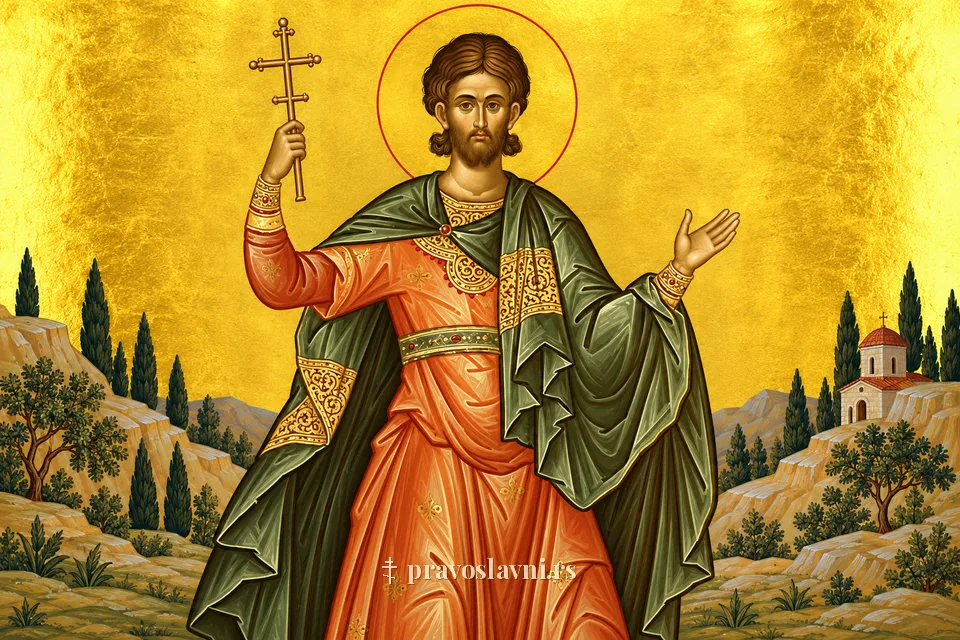
Illustration
Saint of the day
Bele poklade — Cheesefare Sunday (Forgiveness Sunday)
Holy Martyr Nicephorus
What happenedThe layman Nicephorus begged his friend, a priest, for forgiveness in vain, and when the priest denied Christ before the sword, Nicephorus suffered in his place.
“Therefore if you bring your gift to the altar, and there remember that your brother has something against you, leave your gift there before the altar, and go your way. First be reconciled to your brother, and then come and offer your gift.”
— Mt 5:23–24
About this day
Bele poklade — Cheesefare Sunday (Forgiveness Sunday)
Cheesefare Sunday, also known as Cheese or White Sunday, is the day of Bele poklade (the last day before Great Lent, Forgiveness Sunday). They took their name from Bela nedelja (White Week), as the week between Mesne poklade (Meatfare Sunday) and Bele poklade is called, which ends on this very day. On that day cheese, milk and eggs, that is, “beli mrs” (dairy foods), are on the table for the last time before the fast, and the fast begins the very next day. This is also a day of reconciliation, when people forgive one another and leave their quarrels behind, so these poklade are also called Proštene, Proćka or Pročka, and they are spoken of as the Great and the Cheese poklade as well.
On that day the Church remembers the fall of Adam and Eve, teaching that man can regain the bliss of paradise, which was lost through sin, by abstinence and obedience to the Church. The Gospel reading calls for two things: forgiveness of one's neighbours and a fast that is not for the eyes of others but sincere. Vespers, which begins solemnly and then gradually takes on a penitential, Lenten tone, ends with the rite of forgiveness: after the prayers and a homily on forgiveness the priest is the first to ask forgiveness of the people, and then the faithful ask it of one another. With this Vespers the services of the Holy Forty Days (Great Lent) also begin, and because of the rite of mutual forgiveness the people call this day Forgiveness Sunday.
By folk custom, in some regions Bele poklade are marked by fire, so that in Pčinja great stacks of straw are piled up and set alight in the middle of the village, which is called krleštica. The villages of Šumadija gather around the zapis (the village's sacred tree), where large swings are put up for the occasion, and in the villages of Kosovo, along with masks, a game known by the name of mačka (“the cat”) is well known. Among the people no poklade are as festive and widespread as Bele poklade: the whole village celebrates them, and children with their families go to their parents with gifts. It is also the custom for a son-in-law, kissing his father-in-law's hand, to ask his forgiveness, to which the father-in-law replies that he forgives him. Only midnight, with which the fast begins, breaks off the merriment. For more on fasting, see the guide “Fasting — simply explained”.
Along the road to the place of execution in Antioch two men were walking: the priest Sapricius, condemned to death because he had confessed Christ, and the layman Nicephorus, who followed him and begged on his knees for forgiveness. Once they had been inseparable, so that many took them for brothers. Then, as the Life says, the devil kindled hatred between them.
Nicephorus was the first to understand where that hatred was coming from. More than once he sought reconciliation — through friends and neighbours, and then in person, on his knees. Sapricius refused him every time, and now too, before his death, he kept silent and walked on proudly. The executioners mocked Nicephorus, and he, according to the Life, answered them that it was not clear to them what he was asking for, but that it was clear to God.
The priest's heart remained hard, and grace abandoned him. Before the very sword he agreed to offer sacrifice to the idols and so denied Christ. Nicephorus, in tears, tried to turn him back, and when he did not succeed, he himself confessed before the executioners that he was a Christian and offered his own head in place of the other's. The judge accepted the exchange: the apostate was released, and the confessor was executed. Nicephorus suffered with joy in the year 260, at the time of the persecution under Emperor Gallienus, and won the crown of glory.
This story shows that pride can take the crown away even from one who was within reach of martyrdom, while God exalts the humble. Forgiveness and reconciliation, as the Life teaches, ought to come before prayer and the gifts of God.
Full Life
A Friendship That Fell Apart
Nicephorus was an ordinary man from Antioch, a layman who feared God. His closest friend was the priest Sapricius, whom the Prologue calls a learned man. They were so close that many people considered them brothers. But a time came when nothing remained of that love: a bitter hatred crept in between them. His Life blames the devil for this and says that they avoided each other even when they happened to meet on the road.
Who Is the First to Hold Out a Hand
Nicephorus was the first to see clearly and to understand who stood behind that hatred. According to his Life, friends and neighbours came to Sapricius three times in his name with a plea for forgiveness, and all three times they were met with a refusal. At last Nicephorus came in person and fell on his knees before him. Even then Sapricius did not relent; he would not so much as raise his eyes to look at him.
The Crown That Passed to Another
At that time a persecution of Christians began in Antioch, during the reign of the Emperors Valerian and Gallienus (the Prologue mentions only Gallienus). Sapricius was arrested. His Life says that before the judge he confessed that he was a Christian and a priest, and called the idols demons. Tortured on the wheel, he told the judge that he could dispose of his body, but that his soul did not belong to him. He was sentenced to be beheaded.
While they were leading him to the place of execution, Nicephorus walked behind him, knelt and begged: “I beg you, martyr of Christ, forgive me if I have sinned against you in anything!” He wanted only one thing — that they should not part as enemies. Sapricius kept silent and walked on proudly. The executioners, according to his Life, found it laughable that someone should humble himself so much before a condemned man, and so they called him a madman. Nicephorus answered them that what he was asking for was not clear to them, but that it was clear to God.
The heart of Sapricius remained like a stone, and the grace of God withdrew from him. The priest who had endured the wheel broke down when he stood before the sword: he agreed to submit to the emperors and offer sacrifice to the idols, having renounced Christ. Nicephorus wept and called on him to turn back: “do not lose the heavenly crown!” In vain.
Then he turned to the executioners: “I too am a Christian; behead me in place of Sapricius!” The judge, when he heard what had happened, passed a new sentence: the priest goes free, and the layman loses his head. Nicephorus went to his death with joy and in the year 260 received the crown of glory, which Sapricius had lost.
What This Teaches Us
Pride and hatred close a man off from the grace of God — and a priest who was already standing on the threshold of martyrdom lost his crown. But humility and brotherly love God exalts. Therefore, as his Life teaches, forgiveness and reconciliation should come before prayer and before the gifts of God.