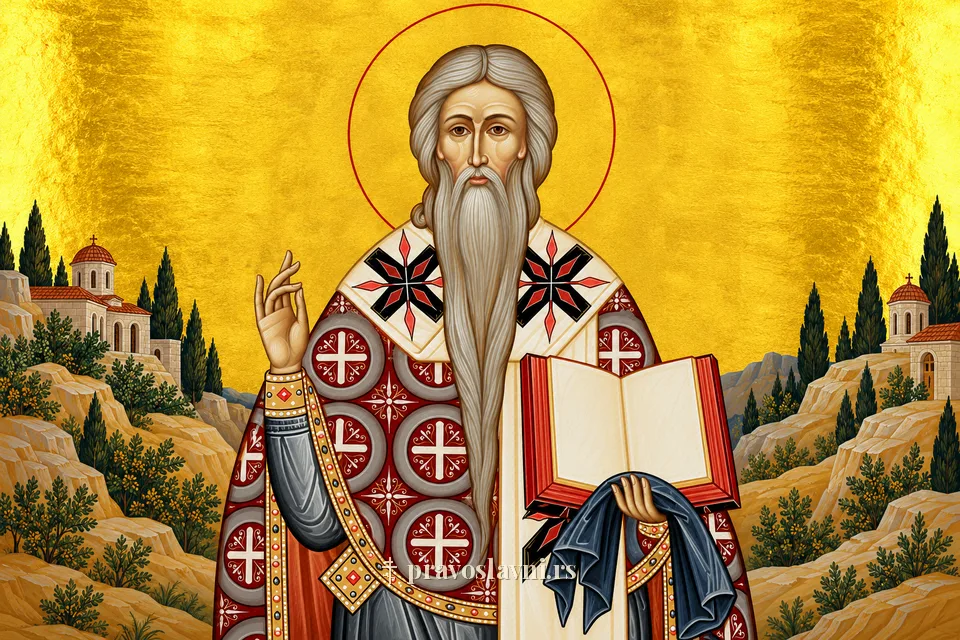
Saint of the day
Hieromartyr Blaise
What happenedBishop Blaise lived in a cave among wild beasts, which came to him for his blessing, and the sick ones were healed under his hand.
Read the LifeOrthodox Calendar · 11 February according to the Julian calendar
Tuesday, 24 February 202611 February (according to the Julian calendar)Save your slava — you'll get a reminder a week and a day before.
Send a greeting card →What happenedBishop Blaise lived in a cave among wild beasts, which came to him for his blessing, and the sick ones were healed under his hand.
Read the Life
The first days of Great Lent: according to the Typikon, no food until Vespers — as far as each person is able, with a priest's advice.
This is a recommendation — for your own fast, consult your priest or spiritual father.Prayer of St Ephraim the Syrian →More about the fast →
Many families celebrate their Krsna slava (family patron saint's day) today
More about the feast →
“A righteous man regards the life of his animal, But the tender mercies of the wicked are cruel.”
— Prov 12:10Whoever looks after livestock has, according to the Prologue, a protector in St Blaise against wild beasts as well, and in the West those who suffer from illnesses of the throat also call upon him. The roots of this are found in his life.
A Cappadocian, gentle and devout from his childhood, he became Bishop of Sebaste. While the persecution lasted he comforted the faithful, and he visited Eustratius and the other imprisoned martyrs in the dungeon. When the persecution scattered his flock, he withdrew to a cave on Mount Argeos and gave himself to prayer. The Prologue and his Life remember that wild beasts used to come to him for a blessing, and that he healed the sick among them by his touch.
According to the Prologue and the Life, a poor widow at his word recovered her only piglet from a wolf, and a certain mother, while he was being led away, at his prayer received back in good health her only son, who was choking on a fish bone. Many pagans, according to the Life, came to believe while he was still being led away. Word of him, according to the Life, spread through Sebaste and Nicopolis. The widow, according to the Life, later brought him that piglet in prison, prepared as food. In return he blessed her.
Before the governor Agricolaus he did not give way: he would not call demons gods, and he rejected the false gods with the words: “Let the gods perish who did not make heaven and earth!” He was beaten and tortured, and his steadfastness, as the Prologue says, converted many. According to the Life, seven devout women also followed him, and they too were beheaded for their faith. Thrown into a lake, according to the Life he walked upon the water, until an angel called him to the shore, to receive his crown. He was beheaded outside the walls of Sebaste in the year 316, together with the two children of one of those women. Before his death, according to the Life, he prayed for all who would keep his memory, and a voice from the cloud promised him that his requests would be granted.
The widow, according to the Life, kept his memory every year, and her house was blessed. God hears those who honour His saints with hospitality and almsgiving.
Blaise was a native of Cappadocia. The Prologue remembers that even as a child he was of a gentle nature and full of the fear of God. His blameless and virtuous life in Sebaste brought him to the episcopal throne of that city. When the persecutions came, he encouraged and guarded his flock. He visited the martyrs in the prisons, especially Eustratius. His Life says that he bribed the guards with gold and came by night, and Eustratius entrusted his last wishes to him.
When the persecution gathered strength, Blaise sought solitude in a cave on Mount Argeos. There he lived as a hermit, in unceasing prayer. The Prologue and his Life tell that the wild beasts did not run away from him, but came to him for a blessing; he would stroke them, and the sick ones recovered when he touched them with his hands.
His Life tells that the hunters of the governor Agricolaus, who were catching wild beasts to which Christians would be thrown, found the saint praying among the animals. When the soldiers came for him, he went willingly, saying that the Lord had appeared to him three times that night and told him to offer the sacrifice. On the way many pagans came to believe.
Two miracles also took place. As the Prologue and his Life record, he healed the only son of a certain mother, who was dying because a fish bone had stuck in his throat: he laid his hand on his throat and prayed. A wolf had carried off a poor widow's only piglet, and at the word of Blaise it brought it back unharmed. His Life says that his name became renowned in Sebaste and Nicopolis.
Later, while the saint was in prison, the widow, according to his Life, brought him that same piglet, prepared as food, together with some fruit and vegetables. Blaise blessed her and left her a charge: to celebrate his memory every year. The promise which he gave along with it — that there would be no want in her home — according to his Life holds good also for everyone who follows in her footsteps. The widow fulfilled the charge: every year she invited her neighbours, and the blessing did not fail. His Life says that others too took up that custom, celebrating it with a candle and incense, hospitality and almsgiving, and that it has endured.
Blaise told Agricolaus openly that demons should not be honoured with the name of gods. He was beaten with heavy clubs, and he said that Christ was strengthening him. At the second trial he said: “Let the gods perish who did not create heaven and earth!” The Prologue and his Life say that because of those words he was tortured with iron combs. The Prologue says that his steadfastness converted many pagans.
His Life also tells of seven devout women who gathered up the saint's blood and were then arrested. They threw the idols, in sacks, into the deepest part of the nearby lake. His Life records that angels comforted them in their torments and that the fire did them no harm. They were beheaded before Blaise, and the two children of one of them asked to go with him.
Agricolaus then ordered that Blaise be thrown into the lake. According to his Life, the lake did not swallow him: Blaise walked and sat upon the water and invited the pagans to try the same, and those who tried, calling upon their gods, sank. Then an angel called him to come out onto the shore and receive his crown, and his face was bathed in light.
He was sentenced to be beheaded together with the two children. Before his death, according to his Life, he prayed both for those who would remember him in future generations and for the whole world. From a bright cloud a voice was heard: “I will fulfil all your petitions, My beloved struggler!” He was beheaded outside the walls of Sebaste in the year 316. The bodies were buried on the spot by the devout Elissa, and at the tomb, according to his Life, healings began.
Even today, according to the Prologue, his name is invoked by those who look after livestock, when they need protection from wild beasts, and in the western lands people also ask for his help when their throat is sore. His life teaches that steadfast faith conquers both the idols and worldly power, and that God honours those who suffer for Him. God also hears those who keep the memory of the saint by hospitality and almsgiving — like the poor widow whose house did not remain without a blessing.
St Đorđe of Kratovo was a Serb, a native of Kratovo. According to his Life, his parents Dimitrije and Sara were devout and sent him to school at the age of six. He was a young goldsmith and a devout Christian. He found himself in Sofia, where he was given refuge by the devout priest Peter, as an orphan without a father, sheltering from the danger of ending up in the Sultan's service. There, according to the Life, a Muslim jurist offered him marriage to the daughter of an aga and a high position; Đorđe refused and defended the faith, pointing to the incorrupt relics of the Christian saints, among them those of King Milutin. He was accused before the qadi, thrown into prison and urged to give way, but he remained faithful to Christ. The Turks tried to force him into Islam when he was eighteen years old. After torture he was burned at the stake in Sofia, in the year 1515, in the time of Sultan Selim. His Life records that in the fire he said: “Lord Jesus Christ, into Your hands I commit my spirit!” According to the Life, the Christians carried his body under cover of night to the Church of St George, and the goldsmiths of Sofia took him as their patron. His life teaches that the truth must be kept even at the cost of one's life, for every earthly torment passes, but eternity remains.


