Saint of the day
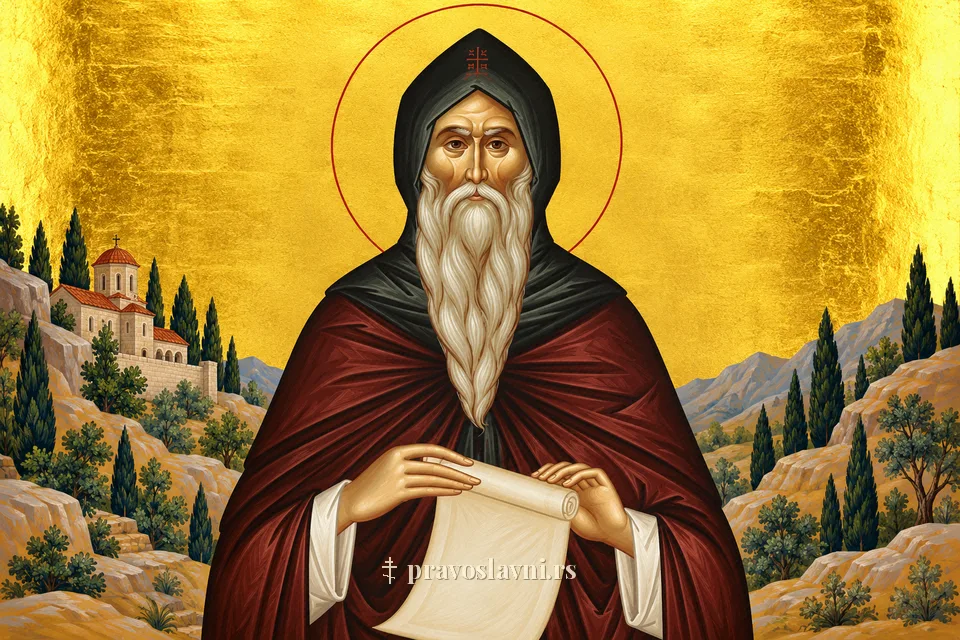
Venerable Simeon the Myrrh-gusher
What happenedThe mighty ruler of the Serbian lands gave up his throne and wealth, was tonsured a monk with the name Simeon, and reposed as a humble monk on the Holy Mountain.
Read the LifeOrthodox Calendar · 13 February according to the Julian calendar
Thursday, 26 February 202613 February (according to the Julian calendar)Save your slava — you'll get a reminder a week and a day before.
Send a greeting card →What happenedThe mighty ruler of the Serbian lands gave up his throne and wealth, was tonsured a monk with the name Simeon, and reposed as a humble monk on the Holy Mountain.
Read the Life
No meat, dairy products, eggs or fish — oil and wine are allowed.
This is a recommendation — for your own fast, consult your priest or spiritual father.Prayer of St Ephraim the Syrian →More about the fast →
Many families celebrate their Krsna slava (family patron saint's day) today
More about the feast →
“For what will it profit a man if he gains the whole world, and loses his own soul?”
— Mk 8:36When, after long years of rule, he gathered his sons and the nobles, Stefan Nemanja told them that worldly power and wealth are passing things. They wept and begged him not to leave them, but he had already made up his mind. He appointed his son Stefan ruler of all his lands and said to the nobles: “Have this one in my place!” To Vukan he gave a part of the land, he commanded the nobles to honour the Church, and he shared out his property among the poor.
The Prologue remembers him as the ruler who united the Serbian lands into an independent state. He was born in Ribnica in Zeta, and he ruled from Ras. He built churches. That did not please his brothers, and his Life tells that he spent some time as a prisoner in a cave, in fetters, until prayer to St George set him free; later he raised a church to that saint. He also defended the true faith: when a heresy that denied the Holy Spirit appeared in the land, he called a council and suppressed it.
On the Annunciation in the year 1195 he became the monk Simeon, and his wife Ana became the nun Anastasija. For two years he lived in Studenica, and then, at the call of his son Sava, he went to the Holy Mountain (Mount Athos). Before that, according to the Life, he entrusted Studenica to the hieromonk Dionisije as abbot. Father and son prayed in Vatopedi, and then raised the monastery of Hilandar.
In Hilandar he spent only eight months. Before his death he blessed his sons and commanded them to love one another. The Life says that in his last days he was nourished only by daily Holy Communion. He himself decided how he would meet death — in his monastic habit, on the floor — and Sava did as he wished. The Prologue records that with his last words he praised God: “Let everything that has breath praise the Lord!” He reposed, according to the Prologue, in the year 1200. Sava buried him, and over the grave, according to the Life, Greeks, Iberians, Russians, Bulgarians and Serbs sang.
St Simeon teaches us that humility is greater than any power: he left the throne in order to follow Christ, and to his sons he left brotherly love as their inheritance.
The Prologue sees in Stefan Nemanja, later the monk Simeon, a ruler who gathered the Serbian lands into one independent state and who guarded Orthodoxy from heretics. His Life records that he was born at Ribnica in Zeta, the youngest of several brothers. The Latin baptism was not the only one he received: according to his Life, an Orthodox hierarch baptised him again in the church of the Holy Apostles Peter and Paul in the Serbian land.
While still a young man he received from his father the rule of Toplica, Ibar and Rasina. According to his Life, from the year 1149 he was župan of Raška, and from 1165 Grand Župan of Serbia, with his capital at Ras. The Greek Emperor, on whom both he and his father had at first depended, in time was no longer his master: Nemanja became the independent ruler of all the Serbian lands. His Life lists a long series of lands that he conquered or won back, from Zeta and Podrimlje to the Nišava, from Duklja and Dalmatia to Kotor, which he fortified.
Nemanja built churches. He raised the church of the Most Holy Theotokos in Toplica, at the mouth of the Kosanica, where he gathered nuns. His Life records that this was not to his brothers' liking. In agreement with the eldest brother, who was then the ruler of the Serbian land, they seized him and, bound in chains, shut him up in a stone cave. There he prayed to the holy martyr George and, as his Life says, he was set free, and afterwards he built the church of St George.
When his brothers with a foreign army broke into his land as far as Pantino, Nemanja sent priests to pray in the church of St George near Zvečan. His Life tells that St George appeared to one of them in the form of a warrior and said that he had been sent to help, and on the following day Nemanja was victorious.
When he was told that a heresy which denies the Holy Spirit and divides the Godhead was spreading in his land, Nemanja, according to his Life, called a council with his hierarch Jevtimije, the monks, abbots, priests and nobles. The outcome of the council was hard for the heretics: some were punished, others were driven out, and their property was given away as alms; the books of their chief teacher were burned and he himself was sent into exile.
His Life says that after thirty-seven years of rule — the nobles also speak of thirty-eight — he decided to leave the throne. He made a vow to build the church of the Most Holy Theotokos at Studenica on the Ibar. He gathered his sons and the chosen nobles and told them that worldly power and wealth pass away. He appointed his son Stefan as the sole ruler of all his lands and said to the nobles: “Have this man in my place!” He made Vukan Grand Prince and gave him a part of the land. He commanded the nobles to honour the Church, the bishops, the priests and the monks, and he gave away his own possessions to the poor.
He received the monastic tonsure on the Annunciation, 25 March 1195, and from then on he was called Simeon; the Prologue places this at Studenica and says that he followed the example of his son Sava. His wife Ana became a nun with the name Anastasija — according to his Life on the same day, in the monastery of the Most Holy Theotokos at Ras. For two years Simeon lived at Studenica, and before he left he appointed the hieromonk Dionisije as abbot. Sava, who was already a monk on the Holy Mountain, called him to himself more than once.
Their first home on the Holy Mountain was Vatopedi, and prayer, according to both sources, filled their time without a break. The Prologue also mentions six chapels which they built there, among them ones dedicated to the Saviour, to St George and to St Nicholas. Then they received a deserted place dedicated to the Entry of the Most Holy Theotokos into the Temple — his Life says that they asked for it from Emperor Alexius, Simeon's friend, and the Prologue that they bought the ruins — and there they built the monastery of Hilandar.
At Hilandar he lived for only eight months. His Life records that, when he fell ill, he taught Sava for a long time, and that from that day his only food was daily Holy Communion. He blessed his sons and heirs, Stefan and Vukan, and commanded them to love one another. He chose his last bed himself: the floor and a rush mat, in his monastic habit, and his Life adds a stone in place of a pillow as well. That is how Sava laid him down, turned towards the icon of the Most Holy Theotokos before which he had vowed that he would give up his spirit.
His Life says that at daybreak, when Matins was beginning, his face shone and he began to praise God in the words of a psalm. Sava asked him: “Father, whom do you see and to whom are you speaking?” He answered with new words of praise and gave up his spirit. The Prologue records that his last words were: “Let everything that has breath praise the Lord!” According to the Prologue, he reposed on 13 February 1200. Sava washed the body and laid it in a new tomb, and Greeks, Iberians, Russians, Bulgarians and Serbs chanted over him one after another.
St Simeon teaches us humility: a man who had power and wealth left everything in order to follow Christ. To his sons, at their parting, he left a testament of brotherly love.
At the age of eighteen Martinian left the world and went to the mountain called the Place of the Ark, which the Prologue places in Cappadocia, and his Life in the region around Caesarea in Palestine. For twenty-five years he lived the ascetic life there in fasting, prayer and night vigil. When a woman came to him in order to tempt him, he walked barefoot into a fire and stood there, and the pain, which made him weep, carried away with it every lust as well. His Life says that she was a harlot who had made a wager with some people from Caesarea that she would bring him down; seeing what he had done, she repented, and he sent her to the holy virgin Paula in Bethlehem. According to the Life, her name was Zoe, she spent twelve years in repentance in a convent, and she reposed in peace. Martinian then went away to live alone on a rock in the sea; the Life says that a sailor used to bring him food and water two or three times a year. One day a shipwrecked maiden reached his rock; then Martinian leapt into the sea, and a dolphin, by the providence of God, carried him to dry land. The Life calls that maiden Photina: she remained on the rock for six years and died there, and she was buried by the Bishop of Caesarea. From then on he resolved not to stay long in any one place; in two years he passed through 164 towns, and everywhere he was a teacher and counsellor to the people. He reposed in Athens in the year 422. Purity is guarded by resolute flight from temptation, and God made use of Martinian's flight for the salvation of others as well.


