Saint of the day
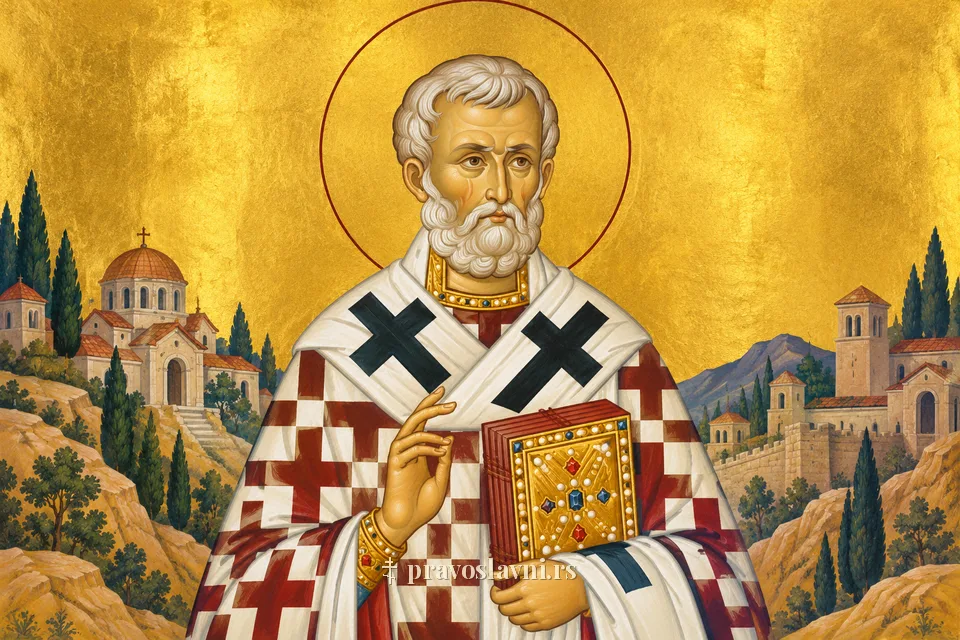
St Leo, Pope of Rome
What happenedSt Leo, Bishop of Rome, went out to meet Attila in his hierarchical vestments and turned destruction away from his city.
Read the LifeOrthodox Calendar · 18 February according to the Julian calendar
Tuesday, 3 March 202618 February (according to the Julian calendar)What happenedSt Leo, Bishop of Rome, went out to meet Attila in his hierarchical vestments and turned destruction away from his city.
Read the Life
No meat, dairy products, eggs, fish or oil — food cooked in water.
This is a recommendation — for your own fast, consult your priest or spiritual father.Prayer of St Ephraim the Syrian →More about the fast →
Today the Church keeps the commemoration of a saint · Second week of Great Lent.
More about the feast →
“And without controversy great is the mystery of godliness: God was manifested in the flesh, Justified in the Spirit, Seen by angels, Preached among the Gentiles, Believed on in the world, Received up in glory.”
— 1 Tim 3:16“The Apostle Peter speaks through the mouth of Leo!” — so, according to the Life, the fathers of the Fourth Ecumenical Council at Chalcedon cried out when the epistle of Leo, Bishop of Rome, was read. Eutyches and Dioscorus were then teaching that Christ has only one nature, and Leo opposed them with his epistle. The Council, according to the Life, gathered 630 holy fathers, but Leo himself was not able to come, and so he sent his envoys. When they saw that it agreed with the teaching of Cyril of Alexandria, the fathers decided that signing it should be an obligation for all.
Leo was born in Italy, in a devout family, and from his youth he studied the sacred books. Before he became bishop he served beside Pope Sixtus III as his archdeacon, and when Sixtus died, Leo became Bishop of Rome — according to the Prologue, against his will, and according to the Life, elected unanimously because of the purity of his life.
As a shepherd he was not afraid of even the most terrible enemy. Attila, the prince of the Huns, intended to destroy Rome. Leo, as the Life says, first prayed to the apostles, and then, not sparing his life for his flock, went out in his bishop's vestments before the conqueror and calmed him. The Prologue and the Life say that Attila saw the Apostles Peter and Paul with swords beside the bishop, and that this is why he withdrew.
The Apostle Peter accompanies Leo in the story of the epistle as well. The Life also records what was told later: Leo laid the epistle on Peter's tomb, and the apostle corrected it and said: “I have read it, and I have corrected it.”
Towards the end of his life Leo wished to know whether God had forgiven him. After he had prayed for forty days at Peter's tomb, he received an answer from the apostle: everything was forgiven him, but there still remained the wrong he had done in appointing priests. Leo prayed even more fervently, until he received the assurance that this too had been cleansed, and he reposed in peace — according to the Prologue, in the year 461.
His life bears witness to a brave and self-sacrificing shepherd, who defended his flock and the faith, and ended his journey in humble repentance. The Prologue also draws from his life the lesson that it is a grave sin to ordain an unworthy man.
Towards the end of his life, already an old man, Leo spent forty days at the tomb of the Apostle Peter in prayer and fasting, with one question: whether God had forgiven him his sins. The answer, as the Prologue and his Life record, was brought by the Apostle himself. Everything was forgiven him except the sins he had committed in appointing priests — according to his Life, if he had not ordained them according to the law and as worthy men. Leo did not stop there. His Life says that he prayed, fasted and gave alms even more fervently, until he gained the assurance that this too had been wiped away. He reposed in peace; the Prologue gives the year of his death as 461, while his Life, without a year, says that it was during the reign of Emperor Leo the Great.
Such an end says a great deal about a man who in his lifetime stood before Attila and defended the faith before the whole Church.
He was born in Italy, in a devout household; his Life gives the name of his father as Quintianus. According to his Life, as a young man he studied both the sacred books and worldly philosophy, and he also made progress in Christian virtue. He served as archdeacon under Pope Sixtus III, and when Sixtus died, it was Leo himself who came to the see of Rome. The Prologue says that he was raised to it against his will, and his Life that all chose him with one voice, valuing his chastity and purity.
The best-known moment of his pastoral service came when Attila, ruler of the Huns, whom his Life calls the scourge of God, set out to destroy and burn Rome. Leo, according to his Life, turned in tears to the Apostles Peter and Paul and went out to meet the enemy, not caring whether he would lose his life for the sake of his flock. He came out before Attila dressed in his hierarchical vestments and calmed him, and so no harm came to the city.
The Prologue and his Life say that Attila saw the Apostles Peter and Paul beside the bishop with swords — flaming ones, according to the Prologue, and drawn ones, according to his Life. To his commanders, according to his Life, he explained that two men of angelic appearance had forced him, with the threat of death, to obey God's bishop.
The other enemy was within the Church itself. Archimandrite Eutyches of Constantinople and Patriarch Dioscorus of Alexandria claimed that Christ has only one nature; according to the Prologue, they mixed the divine and the human nature and did not acknowledge two wills. His Life says that at the council in Ephesus in the year 449 they condemned and put to death the Patriarch of Constantinople, a fighter for Orthodoxy. For that reason Leo, according to his Life, asked the emperors by letter to call an ecumenical council.
The council, according to his Life, met at Chalcedon in the year 451, under Marcian and Pulcheria, with 630 holy fathers. Leo himself did not travel — his Life gives as reasons his age, the distance and the barbarian raids into Italy — but sent four envoys: the bishops Paschasinus and Lucentius and the presbyters Boniface and Basil. His letter was read before the fathers, a letter which, according to his Life, he had written in the year 448 for a council in Constantinople. The fathers compared it with the teaching of Cyril of Alexandria, instructed everyone to sign it and cried out: “The Apostle Peter speaks through the mouth of Leo!”
With that letter his Life also connects a story which, as it says, was told later. Leo fasted and prayed for forty days, and then left it on Peter's tomb, and the Apostle corrected it and said: “I have read it, and I have corrected it.” According to his Life, the story was written down in the Leimonarion by John Moschus and Sophronius of Jerusalem, as told by Abba Menas, an abbot near Alexandria, and it goes back to Gregory, who served as archdeacon in Rome.
St Leo remains an example of a shepherd who feared neither the visible nor the invisible enemy, who guarded his flock and the Orthodox faith, and who ended his life in humble repentance. The Prologue draws a twofold lesson from his life: about the power of a holy man, which even Attila felt, and about how grave a sin it is to ordain an unworthy man.
Because of his blameless life, in the days of Theodosius the Younger and Pulcheria, St Flavian succeeded Proclus on the patriarchal throne of Constantinople; before that, according to his Life, he had been a sacristan and presbyter of the Great Church. The courtier Chrysaphius, a eunuch, opposed his election and demanded that he send a gift to the Emperor. Flavian sent blessed loaves, and when Chrysaphius asked for gold, he answered: “Chrysaphius knows well that the gold and silver of the Church belong to God” — being intended for the poor. He fought resolutely against Eutyches, the godson of Chrysaphius, who taught that the two natures of Christ had merged into one, and the Life records that a local council in Constantinople deposed Eutyches. Chrysaphius and the Empress Eudocia worked against Flavian, and the Prologue says that the Empress secretly helped the heretics. The heretics, whom slanders had not helped, finally decided to kill him. At the council in Ephesus in the year 449, which according to the Life was convened by Dioscorus, Patriarch of Alexandria, Eutyches was declared Orthodox, while Flavian was not even allowed to defend himself, but was deposed and condemned to exile in Lydia. At the council itself he was so badly ill-treated that he died of it that same year — three days later, the Life says — without living to see the victory of Orthodoxy. Chrysaphius was afterwards exposed, removed from the court and died in disgrace, while Pulcheria, according to the Life, solemnly translated the relics of Flavian to Constantinople. The Fourth Ecumenical Council in Chalcedon condemned Eutyches and Dioscorus, and the Prologue records that Flavian and Pulcheria were then proclaimed saints. His life bears witness that falsehood and worldly power may overcome the truth for a time, but that in the end it is vindicated.


