Saint of the day
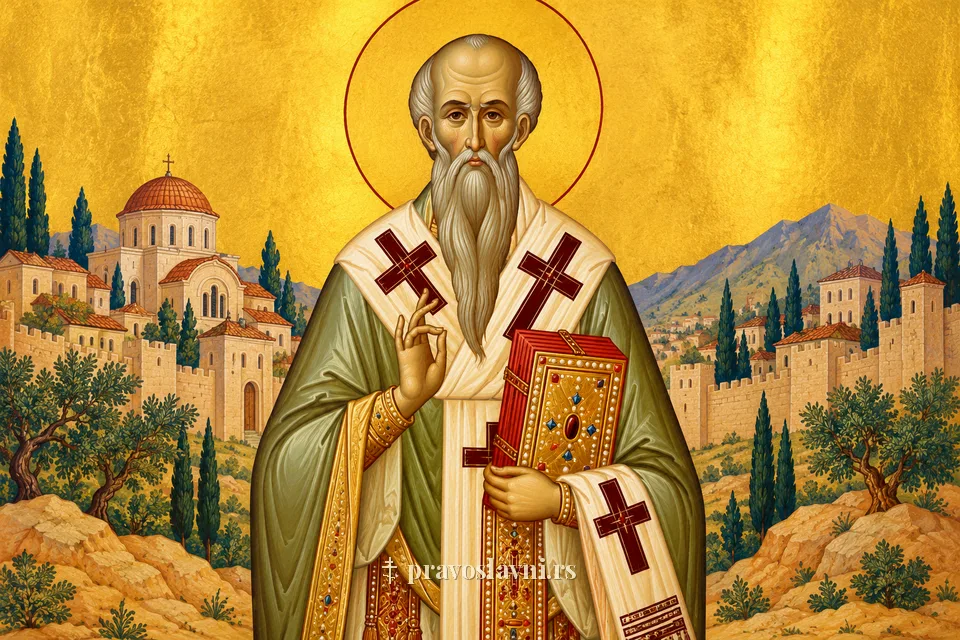
Hieromartyr Polycarp, Bishop of Smyrna
What happenedPolycarp, Bishop of Smyrna, a disciple of the apostles, in deep old age chose the fire rather than deny Christ.
Read the LifeOrthodox Calendar · 23 February according to the Julian calendar
Sunday, 8 March 202623 February (according to the Julian calendar)What happenedPolycarp, Bishop of Smyrna, a disciple of the apostles, in deep old age chose the fire rather than deny Christ.
Read the Life
No meat, dairy products, eggs or fish — oil and wine are allowed.
This is a recommendation — for your own fast, consult your priest or spiritual father.Prayer of St Ephraim the Syrian →More about the fast →
Today the Church keeps the commemoration of a saint · Sunday — a festive day · Second Sunday of Lent (Pačista) – St Gregory Palamas (Great Lent).
More about the feast →
“For I am already being poured out as a drink offering, and the time of my departure is at hand.”
— 2 Tim 4:6“I cannot exchange the better for the worse!” — so, according to the Prologue, Polycarp, Bishop of Smyrna, answered in court when they demanded that he betray Christ and acknowledge the Roman gods. The Life adds that he said he had been serving Christ for eighty-six years already. The crowd demanded the pyre. The Prologue records that he was then a very old man, grey-haired, and that his face shone.
Polycarp was no ordinary old man. He was a disciple of the apostles — the Prologue states that he knew John and Paul — and according to the Prologue it was John the Theologian who brought him to the faith and baptised him. As an orphan he grew up with the devout widow Callista, whom an angel told in a dream to take him in. From childhood he was merciful: the Life remembers how, while she was away, he gave out to the poor the contents of her storerooms, which after his prayer were full again, and how later he gave out the estate he inherited to those in need.
Having been a reader, a deacon and a presbyter, he became Bishop of Smyrna; the Life mentions the signs seen at his consecration. By his prayer a great fire in the city was put out, and after a drought rain fell; he cast out demons and healed the sick. The Life records that he opposed the heretics and that in Rome he turned many away from the heresy of Marcion. He wrote epistles, of which the Epistle to the Philippians has been preserved.
When the persecution arose, he withdrew, according to the Life, to a village, and there he had a dream about his end. Then he foretold that in three days he would be burned for Christ's sake. He met the soldiers who came to take him away calmly and gave them food, surrendering himself to God's will. On the pyre he prayed for a long time, and the flame did not touch him; his life was ended by an executioner with the thrust of a spear, according to the Prologue in the year 167, in the time of the Emperor Marcus Aurelius. The Christians, according to the Life, gathered his bones, and the Church in Smyrna wrote down the testimony of his suffering.
Polycarp's life shows that a man who is used to giving and to praying can calmly choose Christ in his last hour as well.
Polycarp, as the Prologue records, was born a pagan, and it was St John the Theologian who brought him to the faith and baptised him. He was left an orphan at an early age. Both sources say that an angel appeared in a dream to the devout widow Callista and told her to take the boy in, and she brought him up as her own son. Piety and mercy adorned him from his earliest years.
His Life also preserves a story from that time: while Callista was away from home, Polycarp gave out food and goods to the poor and emptied her storerooms. When a servant accused him, the boy prayed, and the storerooms were found full once more. After that Callista became more merciful still, and on her deathbed she left him her estate, which he gave away to those in need.
His Life places Smyrna in Ionia, a region of Asia Minor. There Polycarp led a pure life and cared for sick people, and the bishop of Smyrna at that time made him a reader, then a deacon, and sent him out to preach. Both sources say that he was a disciple of the apostles: the Prologue states that he knew John and Paul, while his Life mentions Paul, John the Theologian and others. From the same bishop he later received the rank of presbyter as well, and before his own death the bishop chose Polycarp to succeed him. According to the Prologue, he was consecrated bishop by the apostolic bishops who had come to bury his predecessor. His Life also mentions the signs that some of those present saw at that time.
Polycarp wrote many epistles. Most of them were lost in the persecutions, but the Epistle to the Philippians has been preserved. Irenaeus, according to his Life, testified that he had seen him in his own youth and that Polycarp stood against the heretics Valentinus and Marcion. In Rome he brought many back from Marcion's error, and when he met Marcion himself he did not spare him sharp words.
The Prologue and his Life remember Polycarp as a man whose prayer had power. When a great fire broke out in Smyrna, he put it out by prayer. After that the people took him for some kind of deity, but he pointed them to the true God, and many received the faith. In a time of drought he obtained rain by his prayers. He cast out demons — his Life tells of the servant of a certain pagan governor from whom a demon fled as soon as Polycarp came near him. He healed the sick, and according to the Prologue he also prophesied. His Life adds that he helped the poor bishop Daphnus in Teos in his time of want, after which Daphnus's fields bore a harvest and his wine was multiplied.
When the persecution began in Asia, Polycarp, according to his Life, was hidden away in a certain village. Three days before his death he foretold his end, and the Prologue preserves his words: “In three days I shall be burned in the fire for the sake of the Lord Jesus Christ!” On the third day the soldiers appeared. Polycarp did not receive them as enemies: he saw to it that they were fed, while he himself prayed and said: “Let the will of the Lord my God be done!”
At the trial they demanded that he betray Christ and bow down to the Roman deities. His faithfulness to Christ had lasted, according to his Life, eighty-six years, and he would not break it off; the Prologue remembers his brief answer: “I cannot exchange the better for the worse!” As soon as it was heard before the people that he remained a Christian, the crowd demanded the pyre. The Prologue stresses that he was a very old man, grey-haired, and that his face shone. Bound to the pyre, he prayed for a long time; his Life says that it was a prayer of thanksgiving. The fire, both sources say, did him no harm. Then one of the executioners pierced him with a spear. This was, according to the Prologue, in the year 167, in the time of the Emperor Marcus Aurelius. His body was then given over to the fire, and his bones, according to his Life, were kept by the Christians.
The Church in Smyrna wrote a letter about his martyrdom, which, according to his Life, was carefully copied by Gaius, Socrates of Corinth and the presbyter Pionius. In this way the testimony about the elder who served the poor, worked miracles by prayer and remained faithful to Christ in the face of the fire has been preserved to strengthen the Church.


