Thursday12March 202627 February (according to the Julian calendar)‹›
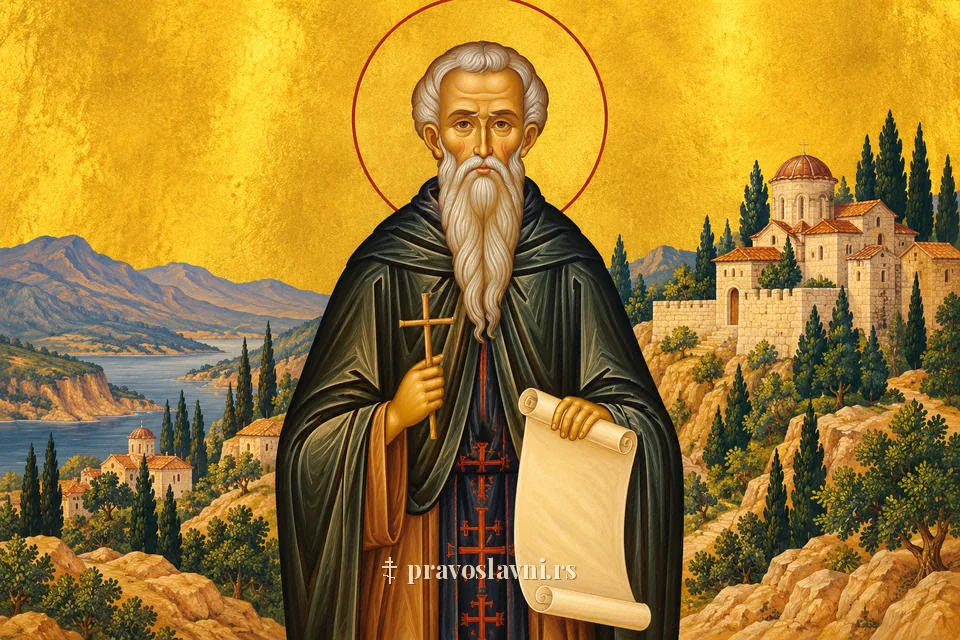
Illustration
Saint of the day
Venerable Procopius the Decapolite
What happenedVenerable Procopius the Decapolite boldly defended the veneration of the holy icons in the time of Emperor Leo the Isaurian, and for this endured tortures and long imprisonment.
The Prologue says of St Procopius the Decapolite that in the Kingdom of God he now beholds with joy the living angels and saints, the very ones whose images on the icons he defended while he was on earth. It is precisely for that defence that the Church remembers him as a confessor.
In his time the Emperor Leo the Isaurian rose up against the veneration of icons. He claimed that it was idolatry, and according to the Life he also condemned the Orthodox emperors, patriarchs and respected Christians who had venerated icons before him. The monk Procopius opposed this publicly and without fear. Both sources remember his boldness and the power of his words, and the Prologue the very heart of the matter as well: whoever venerates an icon does not serve an idol, and Christians do not bow down to dead matter.
He came from the Decapolis, a region beside the Sea of Galilee, which the Gospel also mentions (Mk 7:31). He chose the monastic life early and passed through all its labours, and in this way he gained esteem among the holy fathers.
For his confession he paid with arrest, beatings and torture with iron. The Life says that he was for a long time in chains in a dark prison, and beside him Basil, with whom he had once lived the ascetic life. Their imprisonment, according to the Life, was ended only by Leo's death, and of that emperor both sources say that he was left without life both on earth and in eternity, while the Prologue remarks that he had perished in soul even before his bodily death. The icons were then, according to the Prologue, brought back into the churches, and the confessors, as the Life says, came out into freedom with other saints.
He spent the rest of his days, as both sources record, in his monastery, peacefully, in the same ascetic struggle as before the persecution. To many, according to the Life, he showed the way to virtue and salvation, and he went to the Lord in deep old age. The Life honours him as a twofold victor, both as an ascetic and as a confessor. His life teaches that faithfulness to the truth can cost a man his freedom, but that God does not forsake those who confess Him.
Full Life
The monk from the Ten Cities
St Procopius bears a name taken from the region he came from. The Prologue and his Life say that he came from the Ten Cities, a region beside the Sea of Galilee, that is, the Decapolis, from which he also received the name Decapolite. His Life recalls that this region is mentioned in the Gospel as well, where it is written: “Jesus came to the Sea of Galilee, into the region of Decapolis” (Mk 7:31). Procopius, then, came from a region through which Christ Himself had also passed.
While still a young man he chose the monastic struggle. Both sources record that he fulfilled all the labours that are asked of a monk and that he became known among the holy fathers. But the time in which he lived brought the Church a heavy trial.
When the emperor rose up against the icons
It was then that the heresy of iconoclasm appeared. At the beginning of that error, as both sources testify, stands the Emperor Leo the Isaurian. He claimed that the veneration of the holy icons was the same thing as serving idols, and that was a lie. His Life adds that Leo also condemned the earlier Orthodox emperors, patriarchs and respected Christians because they had venerated icons.
Procopius did not keep silent. Both sources say that he boldly rose up against the heretics and refuted them with inspired words. The Prologue records two of his answers: the veneration of icons is not idolatry, and Christians do not bow down to dead matter.
Chains and a faithful fellow sufferer
The price of that boldness was high. The imperial authorities imprisoned him, and the Prologue and his Life remember the beatings and the torture with iron. According to the Life, he was confined in a harsh dungeon, but he was not alone in it: he shared his chains with Basil, his former companion in the ascetic life, and both of them, the Life says, bore their suffering without faintheartedness.
According to the Life, they spent a long time in confinement, right up to the tyrant's death. Both sources look upon Leo's end in the same way: he lost both earthly and eternal life, and the Prologue says that he perished in soul before he died in body. After that, the Prologue records, the icons were returned to the churches. The Life adds that at that time the two of them, like other saints, also left their confinement.
Peace after the storm
Freedom brought him back to the place from which he had set out — to the monastery. Both sources say that his last years passed peacefully, in the same ascetic labour as before. The Life adds that he was a guide to many who were seeking the way to virtue and salvation. And so the one who had defended the faith in the dungeon became, in freedom, a teacher to others.
In deep old age he departed to Christ the Lord. According to the Prologue, he who on earth defended the images of the angels and the saints now, rejoicing, beholds them in person in the Kingdom of God. The Life praises him as a man with a twofold crown, an ascetic and a confessor.
His life reminds us that faithfulness to the truth sometimes costs a man chains, but that God does not forget those who confess Him. The Life ends with the hope of meeting Christ face to face.
Other saints of the day
Venerable Thalelaeus
When Theodoret, Bishop of Cyrrhus, asked Venerable Thalelaeus why he lived so hard a life, he heard the answer: “I am a great sinner”. His Life says that the ascetic regarded his narrow cell as a prison which he himself had chosen, in the hope that this would lighten for him the eternal torments which he feared. That cell was two cubits high and one cubit wide, and in it he, though a tall man, spent ten years with his body bent double. Before that he had lived for many years in a hut in a place from which others fled: in an old pagan cemetery beside an idol's shrine, some twenty stadia from Gabala, a Syrian city under the metropolis of Laodicea. The sources say that there the demons used to attack passers-by, both people and cattle, and Thalelaeus came precisely in order to overcome fear by faith in God. He endured their attacks both by night and by day, and with God's help he defeated them. God granted him wonderworking power, and with it he healed both people and animals. According to the Life, many pagans from the villages around Gabala became Christians, and together with him they cleared away the idol's shrine and the cemetery and built a church of all the holy martyrs, in which services were held every day. He was born in Cilicia, and before his monastic and priestly path he renounced the vanity of the world; the Prologue says that he first lived in the Monastery of St Sabbas the Sanctified. St Sophronius of Jerusalem, in the Leimonarion, passes on the testimony that he spent sixty years as a monk and that he never ceased weeping. He passed away very old, in about the year 460, and the Life ends with his admonition: “This time, brethren, God has given us for repentance”.