Saint of the day
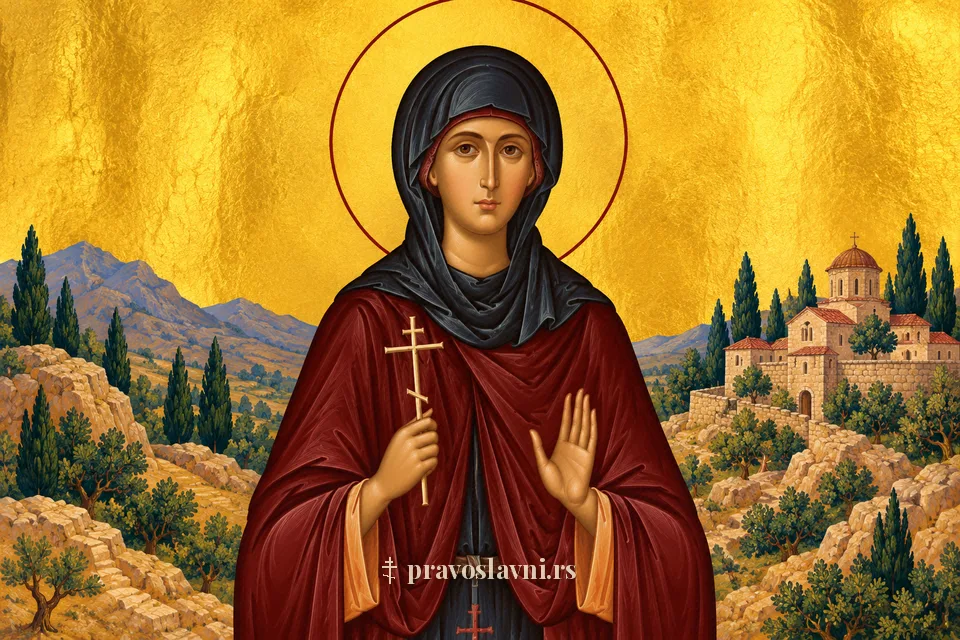
Venerable Martyr Eudocia
What happenedSt Eudocia, once a wealthy sinner of Heliopolis, heard through a wall a monk reading about the Last Judgement and changed her life completely.
Read the LifeOrthodox Calendar · 1 March according to the Julian calendar
Saturday, 14 March 20261 March (according to the Julian calendar)What happenedSt Eudocia, once a wealthy sinner of Heliopolis, heard through a wall a monk reading about the Last Judgement and changed her life completely.
Read the Life
No meat, dairy products, eggs or fish — oil and wine are allowed.
This is a recommendation — for your own fast, consult your priest or spiritual father.Prayer of St Ephraim the Syrian →More about the fast →
Today the Church keeps the commemoration of a saint · Third week of Great Lent.
More about the feast →
“Therefore I say to you, her sins, which are many, are forgiven, for she loved much. But to whom little is forgiven, the same loves little.”
— Lk 7:47One night in Heliopolis, a city of Phoenicia, the rich and beautiful harlot Eudocia could not fall asleep. Through the wall of the neighbouring house she heard the old monk Germanus reading aloud, and the Prologue says that it was the Psalter and a book about the Dread Judgement. Frightened, at dawn she called him to her, and their conversation about faith and salvation changed her life.
According to the Prologue, her life passed through sin and repentance to ascetic struggle and a martyr's end. She lived in the time of the Emperor Trajan, and the Life adds that she was a Samaritan. The Life also remembers the teaching of Germanus that wealth in itself is not evil, but rather gaining it unjustly and spending it sinfully, and his advice that she give to the poor and receive baptism. After that conversation, as the Life records, she prayed and fasted for seven days, asking for a sign that God had forgiven her, and in a vision she saw an angel leading her towards heaven, a demon opposing this, and Michael, the prince of the angels.
She received baptism, according to the Life from Bishop Theodotus, and she gave her wealth to the Church for the poor and set her servants and slaves free. She entered a women's monastery and within thirteen months became abbess. According to the Prologue, she spent fifty-six years in the monastery and by the grace of God raised the dead.
The Life tells a series of miracles about her. Her former lover Philostratus, who came disguised as a monk to seduce her, fell dead before her, and her prayer brought him back to life. When Aurelian's son lost his life, her letter, laid on his breast, raised him up, and so Aurelian was baptised with his whole family. Later, according to the Life, she went of her own will before the governor Diogenes, carrying a particle of Holy Communion, and endured torture, and in the end Diogenes himself received baptism.
Her martyr's end is remembered by the Prologue: in a persecution under a certain prince Vincent, Eudocia was put to death by the sword. Her path assures us that even one who has long lived in sin can return to God, for His grace has the power to make the soul new.
The Prologue sees four stages in the life of St Eudocia: sin, repentance, ascetic struggle and martyrdom.
Her city was Heliopolis in Phoenicia, and her time was the reign of the Emperor Trajan. According to her Life, she was a Samaritan both by descent and by faith. She was beautiful and rich: both sources say that as a harlot she led men into sin and in that way gained great wealth.
The change did not begin by anyone's intention, but, as both sources say, by the providence of God. The old monk Germanus happened to be in the city on some business and spent the night in the house of a certain Christian, wall to wall with Eudocia's home. At night he read aloud, and according to the Prologue it was the psalms and a book about the Dread Judgement. The words that reached her through the wall frightened her so much that she did not close her eyes again. As early as the first light of morning the elder was called to her, and their conversation about faith and salvation lasted a long time.
Her Life remembers what Germanus taught her. Money in itself is not a sin, he said, but rather the way in which it is gained and spent; and so he advised her to give to the poor and to be baptised, quoting psalms about the stench of sin and about the sweetness of the word of God. He assured her that God forgives the one who repents. According to the Life, she wanted a sign of forgiveness, and so for seven days she shut herself away in prayer and fasting, and told the members of her household to say that she was not there. After that she told Germanus of a vision: an angel was leading her towards heaven, a demon objected, and Michael, the prince of the angels, brought her back. The elder told her to seek baptism.
She received baptism from the local bishop — the Life calls him Theodotus — in the name of the Holy Trinity. She handed her property over to the Church for the poor, and to her servants and slaves she gave their freedom, and according to the Life she also made them gifts of gold. Then, with the help of Germanus according to the Life, she went to a convent in the desert. A little more than a year later, after the death of the abbess Charitina, she was chosen to lead the sisterhood. The Prologue says that she spent fifty-six years in the convent and that God gave her the grace of bringing the dead back to life.
Her past came looking for her once more. The Life tells that Philostratus, a former lover, came dressed as a monk to bring her back to her old life. He fell down dead as soon as she breathed on him, but, at the Lord's command received in a dream, he rose again through her prayer.
Through a series of stories the Life shows how people came to the faith through her. Her former lovers reported to Aurelian that she had taken the imperial gold for herself. He sent a commander with three hundred soldiers, but for three days the power of God held them back, and a great serpent put many of them to death; only the commander and three soldiers made it back. Then Aurelian's son, having set out against the convent, met his death on his father's estate, and Philostratus advised that Eudocia's help be sought. Her letter, laid on the dead young man's chest, raised him up, and Aurelian cried out: “Great is the God of the Christian Eudocia!” His whole family was baptised, a church was built on the place where Eudocia lived, and his daughter Gelasia became a nun in her convent.
Later the governor Diogenes began to persecute Christians and desired Gelasia for his wife. When she fled to the convent, he sent fifty soldiers. Eudocia, according to the Life, gave herself up to them of her own accord, carrying a particle of Holy Communion. They tortured her at the trial, but the particle, the Life says, turned into a fire that burned the torturers. Later, through her prayer, Firmina, the wife of the commander Diodorus, who had met her death in the bathhouse, came back to life, and so baptism was received by Diodorus with his household, and then by Diogenes himself too.
Only the Prologue speaks of her death: she ended her life beneath the sword, in the persecution under a certain governor Vincent.
From her life the Prologue draws a comforting lesson: it is never too late for repentance, and the grace of the Holy Spirit can make even the most defiled soul pure and fragrant before God.


