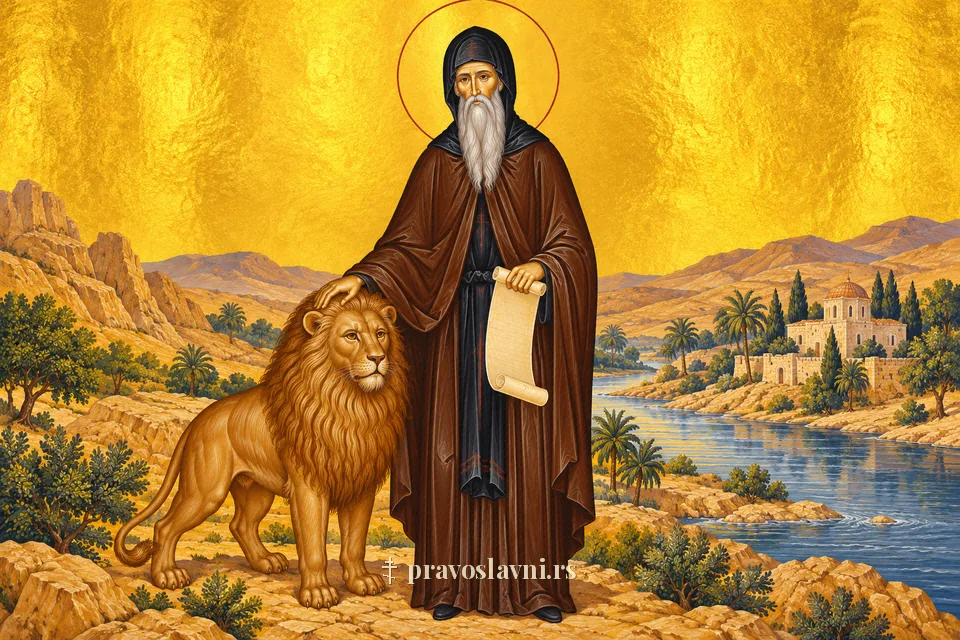
Saint of the day
Venerable Gerasimus of the Jordan
What happenedVenerable Gerasimus drew a thorn from a lion's paw, and the lion stayed by the monastery and died of grief when the elder died.
Read the LifeOrthodox Calendar · 4 March according to the Julian calendar
Tuesday, 17 March 20264 March (according to the Julian calendar)What happenedVenerable Gerasimus drew a thorn from a lion's paw, and the lion stayed by the monastery and died of grief when the elder died.
Read the Life
No meat, dairy products, eggs, fish or oil — food cooked in water.
This is a recommendation — for your own fast, consult your priest or spiritual father.Prayer of St Ephraim the Syrian →More about the fast →
Today the Church keeps the commemoration of a saint · Fourth week of Great Lent.
More about the feast →
“And He was there in the wilderness forty days, tempted by Satan, and was with the wild beasts; and the angels ministered to Him.”
— Mk 1:13Even great ascetics are not spared from error, and the life of Venerable Gerasimus shows this. After the Council of Chalcedon, which condemned Dioscorus and Eutyches, Gerasimus for a time was carried along by their teaching, although, according to the Prologue, he himself had been at the Council. He was led out of that error by St Euthymius the Great, an ascetic from the desert of Rouba. Gerasimus repented, and the Prologue says that from then on he defended Orthodoxy firmly and unshakeably.
By then he was already an experienced monk. The Life says that he was born in Lycia and that he served God from his youth; he lived the ascetic life in the Egyptian Thebaid, and he came to Palestine as a pilgrim. Beside the Jordan he built a monastery, in which about seventy monks gathered, and the Prologue adds that it still exists today. The rule which he gave them was strict, with much solitude, work and want. Poverty was complete: according to the Prologue, each had one garment and did not lock his cell. St Cyriacus the Anchorite, whose ascetic struggle the elder, according to the Life, especially valued, was his disciple, and the best known of them.
Yet Gerasimus is remembered most of all for the lion. A beast which was suffering from a thorn in its paw found help with the elder and from then on did not leave the monastery, and the Life says that the monks fed it. The Life tells a good deal about that lion, and the loveliest story is the one in which the brethren unjustly suspected it when the monastery's donkey disappeared: the lion afterwards showed that it was not guilty, for it brought back what had been lost. The elder gave it the name Jordan, and the lion stayed in the monastery for more than five years.
The elder reposed in the year 475. Nor did the lion outlive him: grief for him killed it, and the Life says that it breathed its last beside the elder's grave.
The life of Gerasimus teaches that God is served by work, humility and poverty, and that a fall into error is not the end if a man repents and firmly returns to the truth.
One day a lion came to the monastery beside the Jordan, roaring with pain: a thorn had stuck in its paw. The elder Gerasimus made the sign of the cross and pulled the thorn out. From then on the beast was tame and stayed by the monastery; his Life says that the monks fed it.
The Life tells a great deal more about that lion. It guarded the monastery's donkey, which used to bring water from the Jordan. When an Arab merchant stole the donkey, the brethren accused the lion of having eaten it, and so the lion had to carry the water itself until a certain soldier bought a new donkey. Later the lion met the merchant on the road and brought the donkey back, together with three camels laden with wheat. Then Gerasimus, according to the Life, said to the brethren: “We scolded the lion for nothing, thinking that it had eaten the donkey.” The elder gave it the name Jordan, and the lion lived in the monastery for more than five years.
Gerasimus, according to his Life, was born in Lycia, dedicated himself to God from his youth and became a monk. He undertook his first ascetic struggle in the desert of the Egyptian Thebaid, after which he returned to his homeland. He then visited Palestine as a pilgrim to the holy places — the Life places this in the last years of the Emperor Theodosius the Younger — and stayed in the desert beside the Jordan. There he founded a monastery with about seventy monks; the Life calls them desert-dwellers and says that the monastery was one stadion from the river. The Prologue adds that the monastery exists to this day.
The desert-dwellers spent most of their time each by himself, in the stillness of his cell and in handiwork — the Prologue mentions the weaving of baskets and mats. No fire was lit in the cells, and food was reduced to bread, dates and water. There was neither lock nor property: according to the Prologue, each one owned one single garment and did not close his cell, so that whoever wished might take what he needed. Then they would gather in the church — the Life mentions the Liturgy and Holy Communion — and eat together, and the Prologue mentions cooked vegetables and a little wine. Each one, according to the Prologue, brought the fruit of his labour to the abbot.
In the time of the Emperor Marcian and the Empress Pulcheria the Fourth Ecumenical Council was held in Chalcedon, and it condemned Dioscorus and Eutyches. The Prologue says that Gerasimus too was at the council. Even so, as both the Prologue and the Life record, for a time he was led astray by the heresy of Eutyches and Dioscorus. The Life tells that in those years the monk Theodosius, a follower of Eutyches, with the support of the Empress Eudocia seized the patriarchal throne of Jerusalem and drove out Patriarch Juvenal.
Gerasimus was brought back to Orthodoxy by St Euthymius the Great, who lived the ascetic life in the desert of Rouba. The Life, referring to Cyril of Scythopolis, the writer of the Life of Euthymius, says that Gerasimus repented. According to the Prologue, from then on he became a strong defender of Orthodoxy. The Life adds that Theodosius, when Juvenal returned to his throne, fled to Mount Sinai, and that the Empress Eudocia repented and returned to Orthodoxy.
The best-known disciple of Gerasimus was St Cyriacus the Hermit. The Life says that Gerasimus valued his ascetic struggle and used to take him along with him into the desert of Rouba.
Gerasimus died in the year 475. The lion, both the Prologue and the Life say, died of grief for him. The Life tells how the monk Sabbatius said to it: “Jordan, our elder has left us orphans and has gone to the Lord.” The lion died beside the elder's grave.
According to the Prologue, the life of Gerasimus is an example of an ordered and humble monastic life in fasting, labour and poverty, but also an example of how a man, when a false teaching has led him astray, can return firmly to the truth. The Life interprets the lion's faithfulness, which lasted even after the elder's death, as a sign that God glorifies those who are pleasing to Him, and it recalls Paradise, where the beasts obeyed Adam while he had not yet sinned.


