Saints of the day
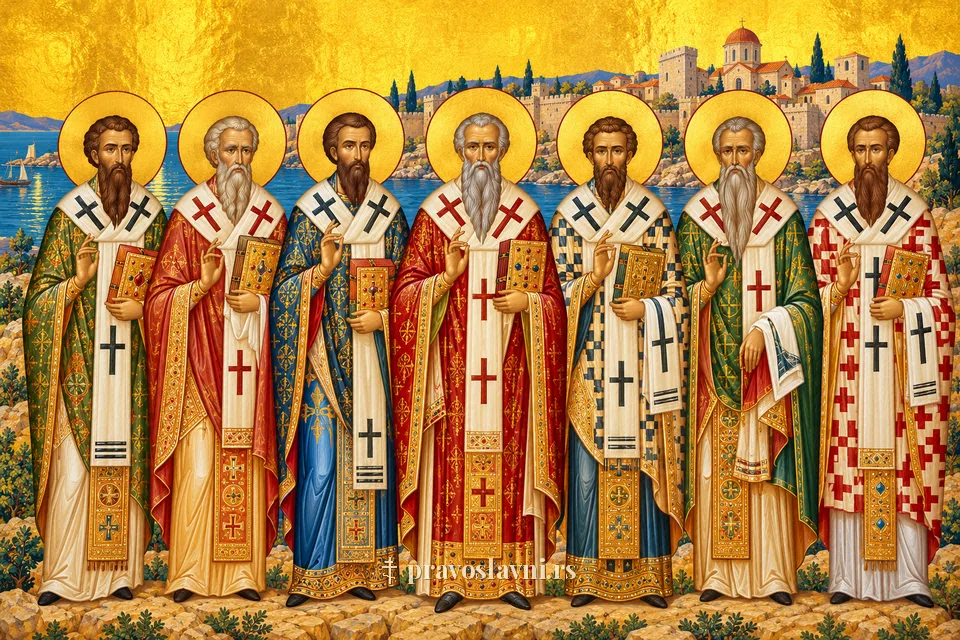
Holy Seven Hieromartyrs, Bishops of Cherson
What happenedBishop Capiton entered a fiery furnace and came out unharmed, and the whole of Cherson with its surroundings received baptism.
Read the LifeOrthodox Calendar · 7 March according to the Julian calendar
Friday, 20 March 20267 March (according to the Julian calendar)What happenedBishop Capiton entered a fiery furnace and came out unharmed, and the whole of Cherson with its surroundings received baptism.
Read the Life
No meat, dairy products, eggs, fish or oil — food cooked in water.
This is a recommendation — for your own fast, consult your priest or spiritual father.Prayer of St Ephraim the Syrian →More about the fast →
Today the Church keeps the commemoration of a saint · Fourth week of Great Lent.
More about the feast →
“Behold, I send you out as sheep in the midst of wolves. Therefore be wise as serpents and harmless as doves.”
— Mt 10:16When the only son of the local prince died in Cherson, his parents, according to the Life, sought help from the banished Bishop Basil, whom the inhabitants of the city had driven out and who was living in a cave outside the city. Basil said that only the true God raises the dead, and then he prayed, and the boy came back to life; the Prologue records this too. The prince's household was baptised, and many others after it, but Basil was killed because of this, for the Jews stirred up the pagans against him.
Basil was one of the seven bishops of Cherson whom, at different times, the Patriarch of Jerusalem sent into pagan lands. Martyrdom was also suffered by Ephraim, who, according to the Life, set out to the Scythians on the Danube and was killed by the sword, and by Eugene, Elpidius and Agathodorus, whom, according to the Life, a disciple of Basil brought to Cherson to continue his work; they were killed with beatings and stones. Aetherius was the only one who met his end in peace: his age, the age of Constantine the Great, brought freedom to the Church, and to Cherson a new church which he built. When the pagans hindered the Christians, he, according to the Life, appealed to the Emperor, and Constantine protected the freedom of worship.
The best known is the witness of Capiton. He, according to the Life, was sent by Constantine himself, at the request of the Christians. The Scythians made their conversion depend on a sign from the fire, and Capiton, in his bishop's vestments, stepped into a red-hot furnace. He came out unharmed: according to the Prologue, after about one hour in the flames, and according to the Life, carrying burning coals in his phelonion. The people then cried out: “There is one God, the God of the Christians, great and mighty”, and the whole region was baptised. Word of the miracle, according to the Life, reached the Emperor Constantine. Yet Capiton did not die in peace either. The pagans drowned him by the Dnieper, where, according to the Life, a storm had driven him on his way to Constantinople.
The seven bishops of Cherson bore witness to Christ both by their life and by their death. Their example shows that firm faith and God's protection can convert a whole people.
One common commemoration gathers together seven bishops of Cherson: Basil, Ephraim, Eugene, Elpidius, Agathodorus, Aetherius and Capiton. They did not live at the same time, but each of them came with the same commission — as a missionary sent by the Patriarch of Jerusalem into wild, pagan regions. Their Life calls that Patriarch Hermon. Six of them ended their lives as martyrs, at the hands of unbelievers, and only Aetherius, according to the Prologue, died peacefully. As to when all this took place, the sources do not say the same thing: according to the Prologue, at the beginning of the fourth century, while according to the Life, the first missions fall in the time of the Emperor Diocletian.
The Life tells that Ephraim, who arrived in Cherson with Basil, continued his journey to the Scythians on the Danube; he ended his life by the sword. Basil remained among the inhabitants of Cherson, but they, according to the Life, beat him and drove him out, so he took refuge in a cave on the mountain of Parthenon, far from the city.
The turning point came through a misfortune in the governor's house. The governor's only son died, and the Life says that the parents were directed in a dream to the banished bishop. Basil first said that only the true God raises the dead, and then he prayed at the grave, sprinkled the body with blessed water in the name of the Holy Trinity, and the boy rose up alive. That Basil brought the governor's son back to life is recorded by the Prologue as well. The governor and his household were baptised, and many others after them, while the veneration of idols, the Life says, slowly died away.
Because of this the Jews turned the pagans against Basil, and the bishop, bound, breathed his last under their hands. The Christians, according to the Life, buried his body in secret.
His work was continued by Eugene, Elpidius and Agathodorus, who were also sent by the Patriarch; the Life says that they were brought to Cherson by one of Basil's disciples. They too were killed, with rods and stones, and the Life adds that this happened a year after Basil's death and that the Christians buried their bodies secretly.
Aetherius was bishop in an altogether different time. Under Constantine the Great the Church was free, and when the pagans nevertheless hindered the Christians, Aetherius, according to the Life, turned to the Emperor, and Constantine protected the freedom of worship by a decree and ordered that those who hindered it be banished. In Cherson he built a church, a large one according to the Prologue. He died in peace — the Life says, near the island of As, on his way back from the journey on which he thanked the Emperor, and there he was buried.
The last of these seven, Capiton, came, according to the Life, as Constantine's envoy, at the request of the Christians of Cherson. The pagan Scythians put his faith to the test: the measure was a fiery furnace, and the promise was the baptism of all, if he remained unharmed. Clothed in his episcopal vestments — the Prologue makes particular mention of the omophorion — he went into the fire after a prayer and the sign of the cross. He came out unhurt, both he and his vestments: the Prologue measures his stay in the flames at about one hour, and the Life says that he carried out burning coals in his phelonion. The people then cried out: “There is one God, the God of the Christians, great and mighty,” and the whole city with its surroundings received baptism. The news of that miracle, according to the Life, reached the Emperor too, and it was also mentioned at the Council in Nicaea.
Capiton did not die in Cherson. Later the pagans seized him by the Dnieper and threw him into the water; the Life says that a storm, on his way to Constantinople, drove him to the mouth of that river, where the ship was plundered.
These seven did not share the same fate, but they shared the same faith: six of them confirmed it with their blood, and one with building and with peace. Capiton's steadfastness and God's protection converted an entire people. The Life, at the end, sees them standing before the Holy Trinity and glorifying God together with all the saints.


