Monday23March 202610 March (according to the Julian calendar)‹›
Illustration
Saint of the day
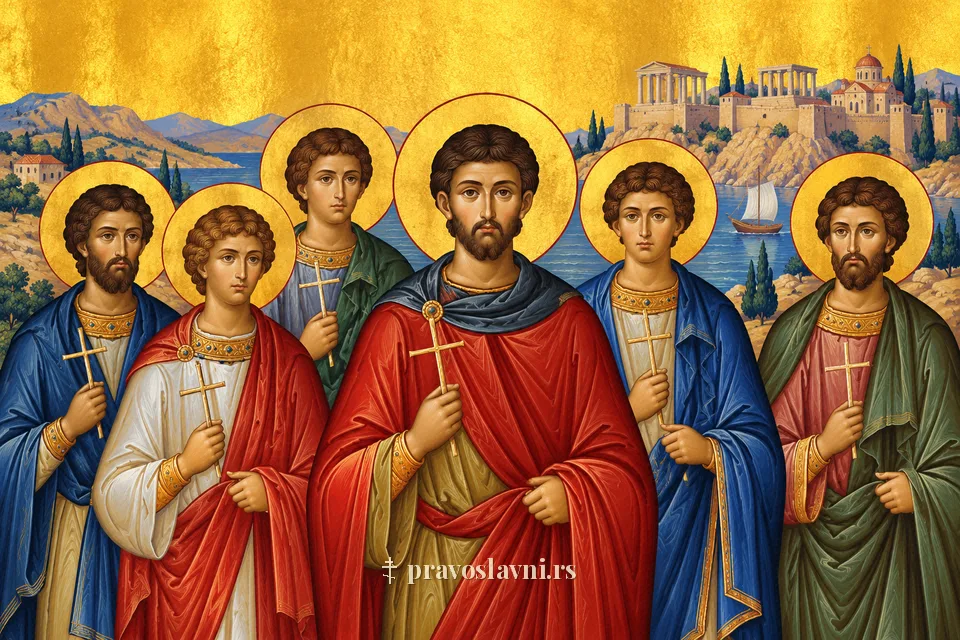
Holy Martyr Quadratus of Corinth and those with him
What happenedA boy whom God had reared in the wilderness became a physician and the leader of the Christians of Corinth, with whom he was beheaded for Christ outside Corinth.
“Now the time of struggle is beginning” — with these words, as his Life records, St Quadratus encouraged his companions in the prison at Corinth, before the torments to which the governor Jason subjected them in the time of the Emperor Decius.
He was born in the wilderness, where his mother was hiding from the persecution and where she died a few days after giving birth. The Prologue says that the child's guardian angel was his protector and the one who fed him, and both sources mention the dew that God sent down to him from a cloud to drink. His Life compares him with John the Baptist, who also lived in the wilderness. He came among people as a boy of twelve, according to the Prologue, and as a young man, according to his Life.
When he had learned the art of medicine, he helped the sick with medicines too, but above all with prayer and grace. Even so, his Life says that he always went back to the solitude of the wilderness. Around him gathered Cyprian, Dionysius, Anectus, Paul and Crescens.
When Jason arrested them, Quadratus confessed before the court his faith in God the Creator and in Christ, the God who became man and conquered death. Jason rejected this. To the governor's mockery he answered: “It is not fitting for godless men to examine the mysteries of the faith.” Quadratus was tortured with iron and fire, and after him, one after another, his companions as well. The wild beasts to which they were thrown, according to his Life, did not touch them. They were dragged through the streets, and the pagans beat them with sticks and stones.
Outside the city the six martyrs were beheaded in the year 250. On the spot where they fell, water sprang up out of the earth; the Prologue says that this spring is named after Quadratus. And so the desert-dweller, raised on the dew of heaven, left Corinth a spring of water. His Life adds that later, under other governors, many other martyrs also suffered in Corinth, and it mentions seven women martyrs by name and many others with them.
Quadratus reminds us that one whom God has guarded from the first day of his life can also lead others to God. The courage of one man became the strength of the whole company.
Full Life
A Child of the Wilderness
St Quadratus was born in the wilderness. At a time of persecution of Christians his mother went into hiding — his Life says that her name was Rufina and that she fled into the wilderness while with child. There she gave birth to him and after a few days she died. The newborn was left alone, but not abandoned. The Prologue records that his guardian angel protected him, fed him and guided him, and so he grew up in nature and in solitude. His thirst, as both the Prologue and his Life record, was quenched by a sweet dew that God sent him from the clouds — the same God Who fed the Israelites in the wilderness with manna. His Life compares him with John the Baptist, who also lived in the wilderness.
The sources differ as to how he came among people. The Prologue says that at the age of twelve he came to a certain city, where good people brought him up; according to his Life, Christians found him as a young man and took him to the city.
Physician of Body and Soul
Quadratus studied medicine. He knew how to apply remedies from nature, but he helped the sick most of all by prayer and by the grace of God. The city, however, did not bind him to itself: his Life records that he loved the solitude of the wilderness more and that he returned to it after every stay among people.
Companions in the faith gathered around him: Cyprian, Dionysius, Anectus, Paul and Crescens. With them he shared both the faith and, later, his fate.
Before the Governor's Court
In the time of the Emperor Decius the governor Jason came to Corinth to persecute the Christians. He threw Quadratus, his companions and many others into prison. Before the court Quadratus, according to his Life, confessed the whole faith: he spoke of the creation of the world, of the Word and Son, of the Holy Spirit, of the fall of man, of the Incarnation and the birth from the Virgin, and of Christ's victory over death and hades. Jason rejected all of this and mocked the teaching that Christ is God Who became man. Quadratus answered him: “It is not fitting for godless men to pry into the mysteries of the faith.”
The governor then subjected him to harsh tortures with iron and fire, but Quadratus did not give way. His Life records that Quadratus encouraged his fellow sufferers with the words: “Now the time of struggle is coming.” After him Cyprian, Dionysius, Anectus, Paul and Crescens were tortured. They were condemned to be torn apart by wild beasts, but the beasts, according to his Life, did not even touch them. Then they were dragged, with their feet bound, through the streets of the city, and the pagans, most of them children, showered them with blows and stones.
A Spring outside the City
The last prayer of the six martyrs was spoken outside the walls of Corinth; there, in the year 250, the sword put them to death. On the place of their death a spring of water appeared; his Life says, there where their heads fell. The Prologue records that this spring bears the name of Quadratus to this day, and his Life calls it a memorial for Corinth. The desert-dweller who grew up on heavenly dew left a spring of water to the city in which he suffered.
Those Who Followed Them
His Life says that the story of the martyrs of Corinth did not end there. Later, under the governor Tertius, other Corinthians suffered too, among them another Dionysius; one was beheaded, one was thrown into the sea, and one went into the fire by himself. Under the governor Venustus, Leonidas was tortured and drowned in the sea. His Life also mentions seven women martyrs by name and many others with them; some were beheaded, and some were drowned.
Thus one boy, whom God had nourished in the wilderness, led a whole company of martyrs after him. From their struggle his Life draws the lesson that faith in Christ outweighs earthly life, that those who suffer for the truth receive eternal glory, and that their courage is an example to others.