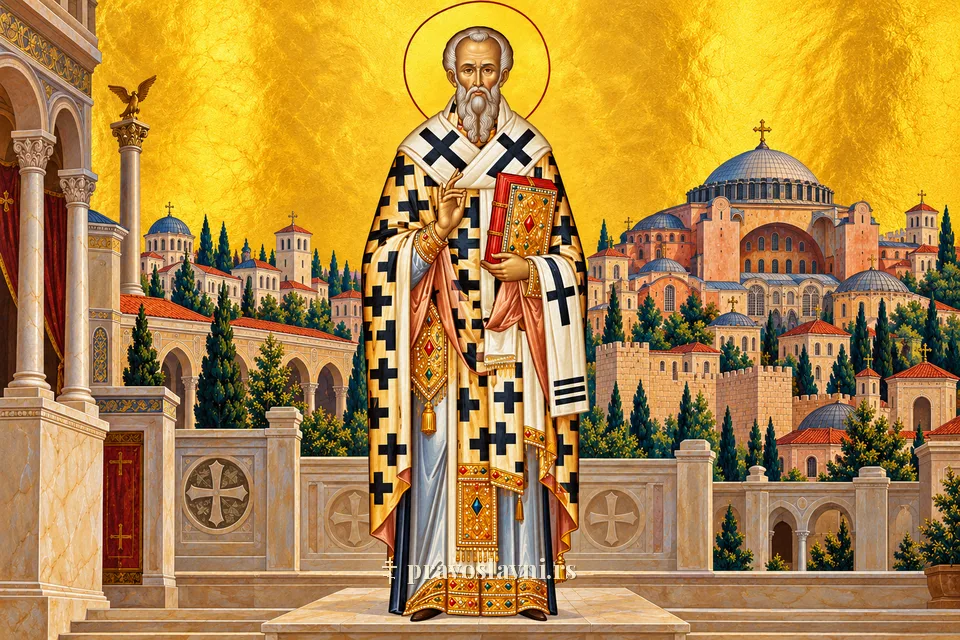
The Translation of the Relics of St Nicephorus is a feast of a Church that puts an injustice right. The patriarch who was exiled for the sake of the holy icons returned to Constantinople only after his death, incorrupt, and, as the Prologue and his Life record, on the very same day of the year on which he had been exiled.
Exile was the price of his faithfulness. The Prologue remembers him as a wise and zealous shepherd, who did not give way to the iconoclast Emperor Leo the Armenian, but first counselled him and then rebuked him. On the island of Proconnesus, to which he was banished, he spent thirteen years in want and there he died; the Prologue gives 827 as the year of his death, and his Life 828.
A new age brought the correction. When Theodora came to rule the empire with the little Michael, and the Church, after a line of iconoclast false patriarchs, received Methodius as patriarch, the new patriarch, according to the Life, said to the empress: “We shall not escape sin if we leave him in confinement.” He compared the translation with the bones of Joseph that were carried out of Egypt.
The translation itself was a celebration of the whole Church. His Life records that in the year 846 Methodius came to the island with the clergy, the monks and a multitude of people, and that the body in the opened tomb was found incorrupt and fragrant; after a vigil and the Liturgy the patriarch went into the tomb and kissed the relics. Constantinople welcomed the relics with candles and chanting, and they were laid first in Hagia Sophia, from where Nicephorus had once been driven out, and then in the Church of the Holy Apostles.
This feast reminds us that the truth which the world persecutes does not remain in exile for ever. God glorifies those who remain faithful to Him, and not only during their lifetime but after death as well.
Full Life
A Return on the Same Day
There are feasts that remind us that God does not forget those who have suffered for Him. The Translation of the Relics of St Nicephorus is such a feast. The Patriarch whom the Emperor drove out of Constantinople because of the holy icons returned to his city after death — incorrupt, in glory, and that, as the Prologue and his Life record, on the same day of the year on which he had been banished.
This day is not the main feast of St Nicephorus. The Prologue explains that what is celebrated then is the finding and translation of his incorrupt relics.
The Patriarch Who Did Not Give Way
The Prologue says that Nicephorus, as Patriarch of Constantinople, governed the Church wisely and zealously. When the Emperor Leo the Armenian set out against the holy icons, he met with the Patriarch's resistance — first in the form of gentle counsel, and then of sharp words. The Emperor deposed him from his throne and banished him to the island of Proconnesus.
There he was received by the monastery of the holy martyr Theodore, of which he himself was the ktetor (founder), and that place became his last refuge. There, as a confessor of the Orthodox faith, he lived for thirteen years — his Life says, in poverty and want. There death also found him, and his grave, according to his Life, was beside Theodore's church. The sources give the year of his death differently: the Prologue 827, and his Life 828.
A Sin That Must Be Put Right
The iconoclast emperors, one after another, died; among them his Life names Leo the Armenian and two more who reigned after him, a father and a son. The Empress Theodora came to rule the Empire with her young son Michael, and Methodius became Patriarch. His Life records that before Methodius the throne was held by four iconoclast false patriarchs, the last of whom, whom his Life calls a sorcerer, was deposed as uncanonical.
According to his Life, in the year 846 Methodius persuaded the Empress to bring the relics of St Nicephorus back to Constantinople. His reason was simple: if they leave the confessor in exile, it will appear that he was justly banished, and the sin will remain. He said: “We shall not escape sin, if we leave him in confinement.” Methodius compared that translation with the carrying of Joseph's bones out of Egypt, and the Empress agreed.
A Tomb Opened after Nineteen Years
His Life says that Methodius went to Proconnesus with clergy, monks and a multitude of people. Nineteen years after the burial the tomb was opened. The body in it had not decayed: it was whole and gave off a sweet fragrance. Methodius first kept vigil all night with everyone and served the Liturgy, and only then went down into the tomb, embraced the relics and addressed Nicephorus as one living, comparing him with St John Chrysostom.
The holy relics were moved into a new reliquary, and the faithful carried them on their shoulders to the ship that took them across to Constantinople. In the harbour, according to his Life, they were met by the Empress Theodora, Michael, the Senate, the clergy and the people, with candles, censers and chanting.
To the Place from Which He Was Driven Out
The first destination of the relics, as the Prologue and his Life record, was in the year 846 the Church of Hagia Sophia — the very one from which Nicephorus had once been driven out. Later, on the following day according to his Life, they were translated to the Church of the Holy Apostles, where his main feast was also established.
The Church does not forget her confessors, and God glorifies perseverance in the faith even after death.