Saints of the day
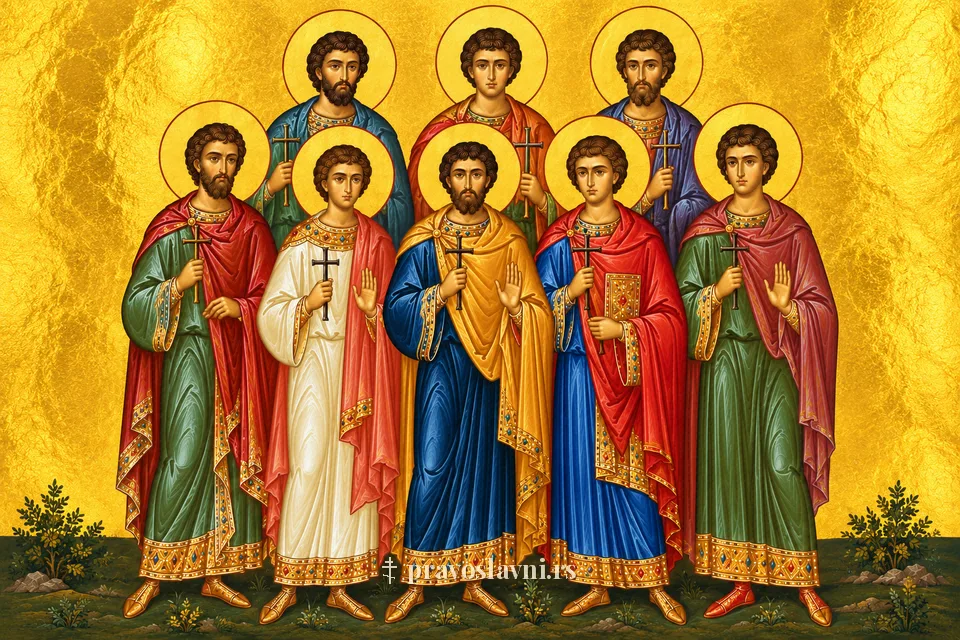
Holy Martyrs Agapius, Publius and those with them
What happenedYoung men in Caesarea in Palestine bound their own hands, went before the governor and said that they too were Christians.
Read the LifeOrthodox Calendar · 15 March according to the Julian calendar
Saturday, 28 March 202615 March (according to the Julian calendar)What happenedYoung men in Caesarea in Palestine bound their own hands, went before the governor and said that they too were Christians.
Read the Life
No meat, dairy products, eggs or fish — oil and wine are allowed.
This is a recommendation — for your own fast, consult your priest or spiritual father.Prayer of St Ephraim the Syrian →More about the fast →
Today the Church keeps the commemoration of a saint · Fifth week of Great Lent.
More about the feast →
“Therefore we also, since we are surrounded by so great a cloud of witnesses, let us lay aside every weight, and the sin which so easily ensnares us, and let us run with endurance the race that is set before us.”
— Heb 12:1“We too are Christians!” — with these words a group of young men in Caesarea in Palestine came out before the governor Urban, having bound their own hands. It was in the time of Diocletian's persecution, when Christians, by imperial order, had to offer sacrifice to the idols. Among them were Publius, Timolaus, Romulus, two Alexanders and Dionysius.
The Prologue says that the young men watched how Christians were being burned, hanged and thrown to the wild beasts, and that they marvelled at their patience. Although they had not yet been baptised, they decided to share their fate. They bound their hands behind their backs, to show that they were ready for torments.
Urban tried for a long time to persuade them and threatened them, but in vain, and so he shut them up in prison. They were joined by Agapius, a respected Christian from Gaza, who had already suffered for Christ before. The Prologue records that he strengthened their faith and their love for the Lord. The Life also mentions his servant Dionysius, who was arrested together with him.
After a long imprisonment and many tortures not one of them denied Christ. They were all beheaded in the year 303. The Prologue says that they were baptised in their own blood and that they entered the courts of the Heavenly King, and the Life that in heaven they received crowns of victory.
Their courage reminds us that faith is not hidden when things are hardest, but that it is then that it is confessed most clearly.
“We too are Christians!” Those words, as the Prologue and the Life remember, were spoken by young men who came of their own accord before the governor Urban in Caesarea of Palestine. Their hands were already bound, and that by their own will, as a sign that they consented to suffering. This is what Publius, Timolaus, Romulus, two men named Alexander and one Dionysius did.
The Life also gives their origins. Timolaus had come from Pontus, Romulus was a subdeacon of the church in Diospolis in Palestine, and Publius and both Alexanders were from Egypt. Urban tried for a long time to win them over with kind words, and then with threats as well, demanding that they offer sacrifice to the gods. Since he achieved nothing, he shut them up in prison.
This was part of the persecution under the Emperor Diocletian, whose decree, the Life says, obliged Christians to bow down to idols. The Life records that a great pagan festival was then being held in the city, and the torture of Christians was staged for the crowds as a spectacle. The Prologue records that among the onlookers there were also young men who had not yet been baptised. They saw the martyrs perishing in various ways, and they were filled with wonder at their endurance. From that wonder their confession was born.
Agapius of Gaza, a respected Christian, was not new to confessing the faith: he had borne witness to Christ before as well, and had already suffered for it. The Life says that he was arrested a few days after the young men, together with his servant Dionysius the Egyptian, so that there were eight confessors in the prison. According to the Prologue, there were seven young men, and Agapius was their support, so that beside him they grew stronger in faith and in devotion to the Lord.
The imprisonment dragged on, the interrogations and tortures were repeated, but the Life testifies that not one of them denied Christ. In the end, all of them were beheaded in the year 303.
Their martyrdom, according to the Prologue, took the place of the baptism which they had never received in water. Thus, as the Prologue says, they passed over into the Kingdom of Heaven. The Life says that they gave their lives for Christ, the Head of the Church, and received crowns of victory in heaven. And the hymn in the Prologue reminds us that the Lord gathers martyrs from every walk of life and that they now sing in heaven.
Faith in Christ is confessed openly, before everyone, even when it costs one's life. The young men who came to Christ by watching the endurance of others, while still unbaptised, received baptism by martyrdom and the crown of victory.


