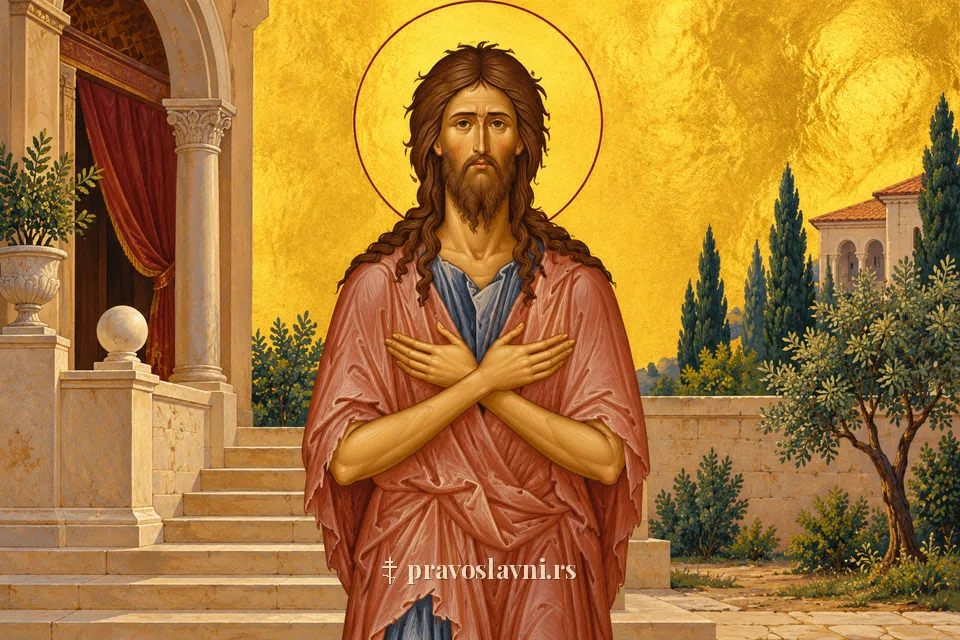
Saint of the day
Venerable Alexis the Man of God
What happenedThe son of a wealthy Roman left home on his wedding night and for seventeen years lived unrecognised as a beggar under his father's roof.
Read the LifeOrthodox Calendar · 17 March according to the Julian calendar
Monday, 30 March 202617 March (according to the Julian calendar)Save your slava — you'll get a reminder a week and a day before.
Send a greeting card →What happenedThe son of a wealthy Roman left home on his wedding night and for seventeen years lived unrecognised as a beggar under his father's roof.
Read the Life
No meat, dairy products, eggs, fish or oil — food cooked in water.
This is a recommendation — for your own fast, consult your priest or spiritual father.Prayer of St Ephraim the Syrian →More about the fast →
Many families celebrate their Krsna slava (family patron saint's day) today
More about the feast →
“So Jesus answered and said, ”Assuredly, I say to you, there is no one who has left house or brothers or sisters or father or mother or wife or children or lands, for My sake and the gospel’s, who shall not receive a hundredfold now in this time—houses and brothers and sisters and mothers and children and lands, with persecutions—and in the age to come, eternal life.”“
— Mk 10:29–30On his wedding night the young Roman Alexis left his bride and his father's house. He was the son of Euphemianus, a wealthy dignitary in whose house the poor, widows and strangers were fed, and of Aglais. The Prologue says that he was an only child, and his parents, according to his Life, married him to a girl of imperial lineage. At their parting, as his Life says, he left her a ring and a belt.
He went secretly by ship to Edessa in Mesopotamia. In that city, where the image of Christ not made by hands was kept, he spent seventeen years as a beggar at the church of the Most Holy Theotokos. His Life says that he lived on a little bread and water and gave away the alms that he received. His father's servants who were searching for him, according to his Life, gave him alms without recognising him. When, according to his Life, the Theotokos revealed who he was, he left the city.
The ship on which he set out for Laodicea, according to his Life, was carried by a storm to Rome. Euphemianus did not recognise his son in the beggar and gave him a corner in the courtyard. And so Alexis lived for the same number of years as a stranger among his own, enduring humiliations from the servants. His Life says that he listened to the weeping of his mother and of his bride and that he bore it out of love for God.
Before his death he wrote down who he was. Then the Emperor and the Pope, in the Church of the Holy Apostles, heard a voice from heaven telling them to seek the man of God, and his Life relates that the voice pointed to the house of Euphemianus. They found him dead, with a paper in his hand, and his Life says that the hand let go of the paper only at the request of the Emperor and the Pope. What was written in it revealed to his parents and to his bride whom they had had beside them. His bride had waited for him for thirty-four years, and his Life compares her with Ruth.
The Prologue and his Life record that many sick people recovered when they touched his body and that myrrh flowed from the relics. He reposed in the year 411. The Prologue adds that his head is to be found in the Peloponnese, in the Holy Lavra.
Alexis teaches us that God glorifies those who serve Him in a hidden and humble way.
Who Alexis was, Rome learned only when he was no longer among the living. The Prologue and the Life remember that the Emperor Honorius and the Pope — Innocent, according to the Life — heard in the Church of the Holy Apostles a voice from heaven, which directed them to seek out the man of God. According to the Life, the voice also revealed where: “Seek the man of God in the house of Euphemian.” The master of the house, the wealthy Euphemian, did not even know of whom it was speaking.
In a small room in his courtyard lay a dead beggar, with a sheet of paper in his hand. The Life says that the hand let go of it only at the request of the Emperor and the Pope, and that it was read aloud by the librarian Aetius. From those lines his father, his mother and his bride understood that this was their Alexis. Thirty-four years had passed since his departure.
He lived in Rome, in the time of the Emperors Arcadius and Honorius, in a distinguished and devout household. The Prologue says that he was an only son. His father Euphemian, a powerful man at court, ate once a day, while orphans, widows, strangers and the sick were fed at his tables. According to the Life, his father had three thousand servants and received at his table the monks who happened to pass by. His mother Aglais, according to the Life, was barren and obtained her son from God by prayer. The Life adds that the boy began his studies early, that he knew Holy Scripture and that he secretly wore a hair shirt.
Neither wealth, nor learning, nor a distinguished marriage held him back. His parents, the Life says, married him to a maiden of imperial lineage, yet that very night he left both his bride and his home. According to the Life, he left her a ring and a belt, with the words: “Keep this!” Secretly, in old clothes, he boarded a ship and arrived in Edessa in Mesopotamia. The gold and valuables which he had taken with him he gave away, according to the Life, to the poor.
In Edessa, the city where the Image of Christ Not Made by Hands, sent to Abgar, was kept, he spent seventeen years among the beggars in the narthex of the Church of the Theotokos. The Life says that he ate sparingly, received Holy Communion every week and shared with others whatever he was given. Even his father's servants, who were searching for him, gave him alms, and yet they did not recognise him. When, according to the Life, the Theotokos revealed to the sexton through an icon who that man was, Alexis went away.
The voyage towards Laodicea ended in Rome: the Life mentions a storm, and the Prologue sees in this the hand of God. His father, not knowing whom he was receiving, gave him a corner in the courtyard. Thus Alexis lived for as many years again as a stranger in the house where he was born, enduring the mockery and blows of the servants. The Life says that he listened to his mother and his bride mourning for him, and that he bore this too out of love for God. His bride, who waited for him for thirty-four years, the Life compares to Ruth.
The Life says that God revealed to him the day and the hour of his departure and that towards the end he wrote down his life, with details which only his parents knew, asking their forgiveness for the pain he had caused them.
The Prologue and the Life record that the sick, on touching his body, received healing; the Life mentions the blind, lepers and the possessed. He was laid in a costly coffin, and both sources say that myrrh flowed from his relics. The Life says that there were so many people around the body that money was thrown so that the procession might reach the church, and that the body lay for seven days before the burial. He reposed in the year 411. The Prologue adds that the saint's head is today in the Peloponnese, in the Holy Lavra.
God leads people to Himself by different paths. Alexis placed love for God above family and honours, and God glorified the one who served Him hidden and unknown.


