Saint of the day
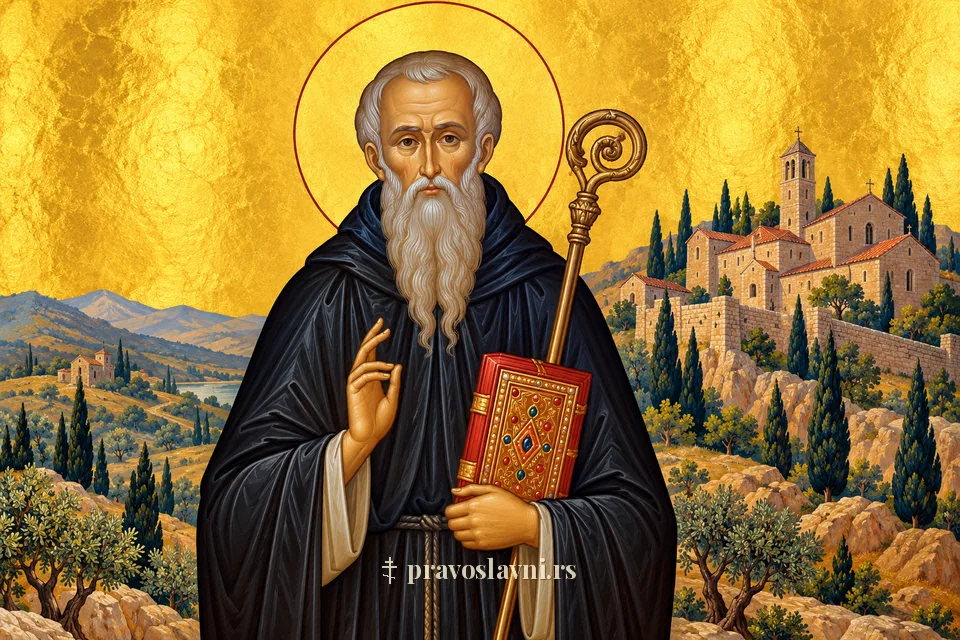
Venerable Benedict of Nursia
What happenedSt Benedict left his schooling and wealth, withdrew to a cave near Subiaco and became the father of many monasteries in the West.
Read the LifeOrthodox Calendar · 14 March according to the Julian calendar
Friday, 27 March 202614 March (according to the Julian calendar)What happenedSt Benedict left his schooling and wealth, withdrew to a cave near Subiaco and became the father of many monasteries in the West.
Read the Life
No meat, dairy products, eggs, fish or oil — food cooked in water.
This is a recommendation — for your own fast, consult your priest or spiritual father.Prayer of St Ephraim the Syrian →More about the fast →
Today the Church keeps the commemoration of a saint · Fifth week of Great Lent; Second Vigil (Akathist to the Theotokos).
More about the feast →
“But Jesus said to him, ”No one, having put his hand to the plow, and looking back, is fit for the kingdom of God.”“
— Lk 9:62St Benedict of Nursia became the father of monasticism in the West. His monastic rule, says his Life, came to have great importance, and the Prologue records that the Benedictine order, which grew out of his monasteries, still exists today in the Roman Catholic Church.
He came from a wealthy and respected family from the region of Nursia in Italy, where he was born in the year 480. In Rome he did not finish his schooling: his Life says that he was repelled by the dissolute life of the students, and the Prologue that he was afraid of losing the understanding of his soul.
His path led him into the wilderness near Subiaco. He was tonsured by the monk Romanus, who for three years lowered bread to him into his cave. Only then, according to his Life, was he found by a certain priest, to whom it had been revealed in a vision that Benedict was fasting. Not even solitude preserved him from temptations, but he overcame the passion of the flesh, as the Prologue and his Life record, by throwing himself into thorns and nettles.
The monks of one monastery took him as their abbot, but his ways did not agree with theirs, and so they poured poison into his wine. The Prologue and his Life say that the cup shattered when he blessed it. Later the envious presbyter Florentius sent him poisoned bread, and his Life says that a raven carried it off into the wilderness.
All the same, his disciples grew more and more numerous. He founded twelve monasteries with twelve monks in each, and on the hill of Cassino in Campania, according to his Life, he built a church of St John the Baptist on the site of a temple of Apollo. The Prologue says that God gave him the gift of clairvoyance and of healing. When little Placidus fell into the river, at Benedict's prayer the disciple Maurus walked across the water and saved him, as both sources remember.
His Life also remembers his sister Scholastica, likewise a nun, whose soul he saw rising up to heaven like a dove.
He had his grave opened six days before the end and left his last counsels to the brethren. According to both sources, his departure was revealed to two monks in one and the same vision of a shining road to heaven. The Prologue gives 543 as the year of his repose, and his Life 547.
His life shows that both temptation and envy are overcome by prayer.
Benedict was born in the year 480 in the region of Nursia in Italy, in a well-to-do and respected family. His parents sent him to Rome to study secular learning, but he did not stay there long. His Life says that he was repelled by the dissolute life of the students, and the Prologue says that he did not want to lose the understanding of the soul for the sake of book learning. The Prologue calls him “an unlearned sage and an understanding ignoramus”.
According to his Life, he left school around the year 496, when his parents were no longer alive, and renounced his inheritance. His former nurse went with him. Then he secretly withdrew into the wilderness.
Near Subiaco, forty miles from Rome, he met the monk Romanus, who tonsured him a monk. For three years he lived in a cave on a steep mountain, and Romanus lowered bread to him on a rope. Then, according to his Life, he was found by a certain priest, to whom it had been revealed in a vision that Benedict was fasting. He brought him food on Pascha, and the hermit did not even know that it was the feast. “For me today is Pascha, since I have been found worthy to see you,” he said to him, and they ate together.
The wilderness did not bring him peace, but struggle. His Life mentions the devil in the form of a black bird, whom he drove away with the sign of the cross. The memory of a certain woman kindled the passion of the flesh in him, and he, as both sources record, quenched it with pain, throwing himself among thorns and nettles.
People tempted him too. The monks of a nearby monastery, left without an abbot, persuaded him to lead them. He agreed reluctantly, and his Life records his warning: “My ways will not agree with your ways.” The disagreement ended with poison in the wine. According to both sources, the cup burst under the sign of the cross, and his Life says that Benedict told the monks to find another abbot and returned to his cave.
The envious presbyter Florentius, according to his Life, first slandered him and tried to poison him with bread, which flew away in a raven's beak, and then wanted to lead the young monks into temptation. Benedict took his disciples to another place. Florentius perished under a collapsed roof, and Benedict mourned him and rebuked Maurus for rejoicing at it.
Disciples gathered around him. He founded twelve monasteries with twelve monks in each. Maurus, the son of Eutychius, and Placidus, the son of Tertullus, were brought to him as boys. When little Placidus fell into the river, Benedict saw it in prayer from afar and sent Maurus. The Prologue and his Life remember what happened then: the teacher's prayer held Maurus up on the water until he had caught hold of the boy, and the rescued Placidus insisted that it was Benedict himself who had lifted him out of the water.
Around the year 529, according to his Life, Benedict pulled down the temple of Apollo on the hill of Cassino in Campania and built a church of St John the Baptist. He wrote a monastic rule which gained great importance in the West. The Prologue records that the Benedictine order, which grew out of his monasteries, still exists today in the Roman Catholic Church.
The Prologue says that God gave him the gift of clairvoyance and of healing, power over demons, and even the power to raise the dead. His Life gives many examples. Not even Totila, the king of the Goths, managed to deceive him: Benedict recognised Riggo, whom Totila had dressed up as the king, and to the king himself he revealed what awaited him — the conquest of Rome, a journey across the sea and death in the tenth year of his reign.
When in a time of famine the monastery was left with five loaves, he called on the brethren to trust in God, and his Life says that a day later two hundred measures of flour were waiting for them at the monastery.
His sister Scholastica was also a nun and attained great spiritual perfection. According to his Life, they saw each other once a year. The last time, her prayer raised a storm that would not let him leave, and so the night passed in conversation. Three days afterwards he beheld her soul, in the likeness of a dove, on its way to heaven.
Six days before the end his grave had already been opened at his wish, and the assembled monks listened to his last instructions. Both sources say that his departure was revealed to two monks in the same vision, although they were not together: they saw a shining path to heaven, and a radiant man told them for whom it was meant. As the year of his repose the Prologue gives 543, and his Life 547.
Benedict left learning and wealth for the sake of God, and overcame temptation and envy by prayer. That is why he became the father of many who sought God after him.


