Saint of the day
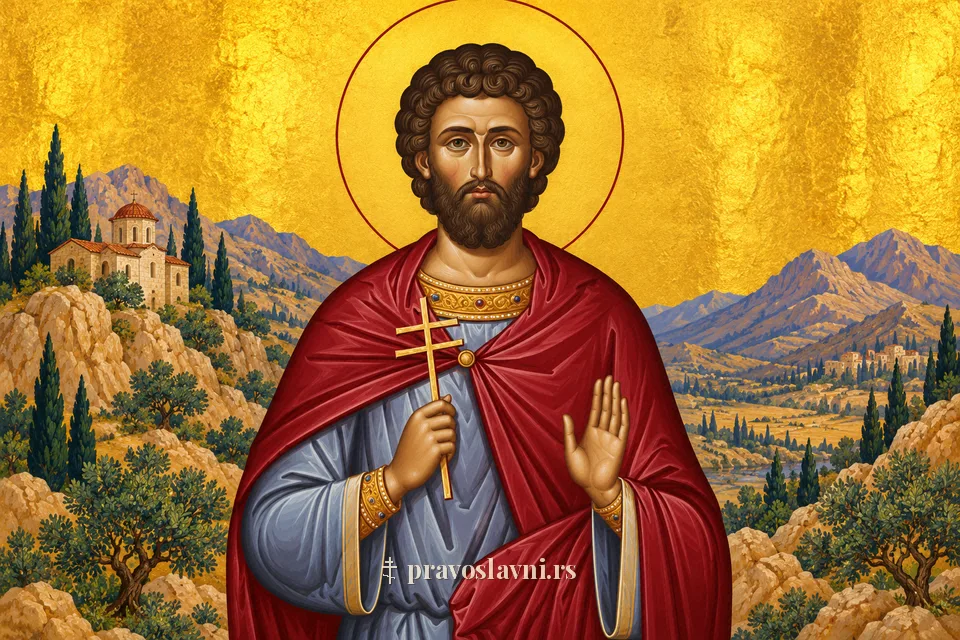
Holy Martyr Conon of Isauria
What happenedOn his wedding night Conon lit a candle and asked his bride: “Which is better, light or darkness?” — and so he brought her to the faith.
Read the LifeOrthodox Calendar · 5 March according to the Julian calendar
Wednesday, 18 March 20265 March (according to the Julian calendar)What happenedOn his wedding night Conon lit a candle and asked his bride: “Which is better, light or darkness?” — and so he brought her to the faith.
Read the Life
No meat, dairy products, eggs, fish or oil — food cooked in water.
This is a recommendation — for your own fast, consult your priest or spiritual father.Prayer of St Ephraim the Syrian →More about the fast →
Today the Church keeps the commemoration of a saint · Fourth week of Great Lent.
More about the feast →
“Nevertheless do not rejoice in this, that the spirits are subject to you, but rather rejoice because your names are written in heaven.”
— Lk 10:20When St Conon, wounded, was carried home, the only thing he regretted, according to the Life, was that his martyrdom had not been completed. His body, according to the Prologue, had been stabbed all over with knives; the Life adds that the Isaurians rose in revolt and that the governor Magdon fled.
Conon lived in the second century in Isauria. Both the Prologue and the Life say that he was taught the faith and baptised by the Archangel Michael himself — in a river, the Life says — who, according to the Prologue, accompanied him until his death. When his parents had him married, Conon brought his bride to the faith with a question about light and darkness; she chose the light, and they lived as brother and sister. He brought his parents to Christ as well. His father, according to the Life, was later killed by idolaters, because he opposed them. Soon they all died, and Conon withdrew into prayer and fasting.
God granted him to work great miracles. Both the Prologue and the Life say that unclean spirits had to work for him. The Life tells how at his word the idol of Apollo, which the Isaurians worshipped in a cave, fell and was shattered, and how he drove out a demon which attacked travellers and cattle. When gold was stolen from a rich man, and innocent people were thrown into prison, Michael showed him where the gold was hidden, and the innocent were released. The demons of pestilence, even of smallpox, he shut up in vessels and buried them beneath his house. Many turned to Christ through him, and according to the Prologue his very blood brought healing to those who were ill.
After his torture he lived for two more years. The Life records that he was buried beside his parents and his wife, and that his house was later enlarged into a church, under which, says the Life, the vessels with the demons are buried to this day.
Conon teaches that what is heavenly is worth more than what is earthly, and that one faithful man can bring to Christ both his own household and many others.
St Conon lived and suffered in the second century, in Isauria. His Life recalls that this land had already been taught the faith by the Apostle Paul, who preached there and converted some. Conon, according to his Life, was born in a village close to the city of Isauria, and his parents were Nestor and Nada.
It was not a man who taught him the Christian faith. Both the Prologue and his Life record that he was instructed and baptised in the name of the Holy Trinity by the Archangel Michael himself; his Life adds that the Archangel baptised him in a river, before his wedding, and gave him Holy Communion. The Prologue says that the Archangel accompanied him right up to his death, and his Life says that Michael came to his aid many times. Filled with the grace of the Holy Spirit, Conon, according to the Prologue, longed in his heart only for the things of heaven.
His parents married him off all the same; his Life says that his bride was Anna. On the first night of their marriage Conon lit a candle — the Prologue adds that he placed it under a vessel — and asked his bride: “which is better, light or darkness?” She answered: light. Then he instructed her in the faith and explained to her that the spiritual life is better than the life of the flesh. They lived as brother and sister.
After that he brought his parents to Christ as well. His Life says that his father Nestor was later killed by idol-worshippers, because he opposed them. His parents and his wife soon died — according to his Life, Nada and then Anna, in the faith — and Conon buried them in a single grave. Left alone, he withdrew into prayer, fasting and contemplation.
God gave him the gift of great miracles, and many were converted to Christ through him. His Life tells of this at length. Every year the Isaurians venerated an idol of Apollo in a remote cave. Conon proposed a race to the cave: whoever's god won, that one was the true God. He, according to his Life, was carried there by Michael, while the horsemen and those on foot lost their way or fell down; the next day they went back on their word. When Conon commanded the idol in the name of Christ, it fell and, as his Life records, spoke: “The only true God is Christ, Whom you preach.” Then it shattered, and many were baptised.
The Prologue and his Life record that Conon forced unclean spirits to serve him; according to his Life, the bound demons worked in his house and in the field. When robbers attacked the house, the demons beat them, and Conon revived them and let them go. His Life also tells of a demon from a cave near another village, which attacked travellers and cattle and appeared as a crippled old woman; Conon drove it out, and many pagans came to believe. When gold was stolen from a certain rich man and innocent people were thrown into prison, Conon prayed, Michael showed him the gold under a stone in the wilderness, and the accused were released. Beneath his house, his Life says, thirty vessels of baked clay were buried: in them he shut up the demons that spread diseases, especially smallpox, and sealed them with lead and with the cross.
During the persecution Conon was seized and tortured; the Prologue says that he was stabbed all over with knives. His Life records that the governor Magdon killed Onesius near the village of Usorova and tortured Conon, but the Isaurians rose in revolt and the governor fled. The wounded Conon was carried home, and he, according to his Life, grieved that he had not died under torture. The Prologue says that the sick were anointed with his blood and recovered.
He lived for two more years and reposed in the Lord; his Life says that he was buried beside his parents and Anna. When his house was being enlarged into a church, the workmen, according to his Life, broke one of the vessels; the demons flew out like smoke and raised a storm, which was calmed only by Conon's prayer. The other twenty-nine vessels, his Life says, are under the church to this day.
Conon's life bears witness that the things of heaven are worth more than the things of earth, and that a faithful witness leads both his own household and many others to God. His Life adds that his prayers protect the faithful from evil spirits, to the glory of the Father and of the Son and of the Holy Spirit.
Venerable Mark the Ascetic is known as a wonderworker and as a writer. He began the monastic path late, in his fortieth year, and he was brought into monasticism by St John Chrysostom, whose disciple he was. His Life also mentions a monastery near Ancyra in Galatia, but he spent the greater part of his life, six decades, in the desert. There, according to the Prologue, with fasting and prayer, he wrote. Of his works, which Patriarch Photius valued highly, the best known are his teachings on repentance, on watchfulness and on the spiritual law. The Life also preserves his saying “Conscience is nature's book”, and the fathers, according to the Life, held his book to be a treasure worth more than any possession. He carried Holy Scripture in his memory from beginning to end. His mercy knew no boundary between man and animal, and so he wept even over the troubles of wild beasts. Thus, as the Prologue and his Life record, by prayer he restored the sight of a blind hyena cub, and turned the hyena herself away from slaughtering the sheep that belonged to the poor. An angel, according to both sources, used to give him Holy Communion. He died in the middle of the fifth century, as the Life states.
Separate page: Venerable Mark the Ascetic →
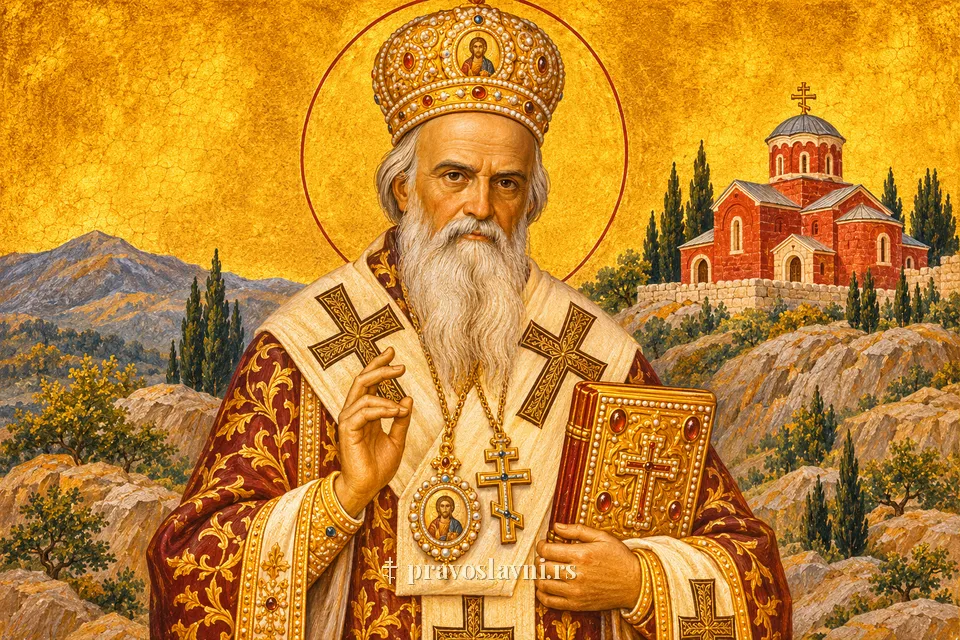
St Nikolaj of Žiča, Nikola at his baptism, was a native of the village of Lelić near Valjevo, on the slopes of Mount Povlen, from the poor and devout family of Dragomir and Katarina. He was baptised in the Monastery of Ćelije, at that time the parish church of Lelić, and it was there that he started school. A medical board did not accept him for the Military Academy, and so he completed the Seminary in Belgrade, and then the Church chose him to be educated abroad at the expense of the state: in Bern he gained a doctorate in theology, and he defended a doctorate in philosophy, on Berkeley, in Geneva. His Life says that in 1909 he fell gravely ill and vowed that, if he recovered, he would become a monk, and in that same year he was tonsured a monk at Rakovica. As a preacher and lecturer he travelled all over Serbia, in the wars from 1912 to 1918 he helped the wounded and the poor and made over his salary to the state, and from 1915 he was on a mission in America and England. He was elected Bishop of Žiča in 1919, afterwards he served in the Diocese of Ohrid, and in 1934 he returned to Žiča; in Bitola and other towns he founded or supported shelters for poor children. The Germans arrested him in 1941 and held him at Ljubostinja and Vojlovica, and in 1944 they took him, together with Patriarch Gavrilo, to the Dachau camp, from which they were liberated in 1945 After the war he moved to America, where he taught at the Serbian seminary in Libertyville and at Russian seminaries. Among his many works are “The Prologue of Ohrid”, “Missionary Letters” and “Sermons under the Mount”. He reposed peacefully in the Lord on 18 March 1956, at prayer, in the Russian Monastery of St Tikhon in Pennsylvania, and he was buried in the Monastery of St Sava in Libertyville. The Life records that it was his wish to be brought back to his homeland and buried at Ćelije, where he had gone to school, and that immediately after his death the people began to pray to him as a saint.


