Saint of the day
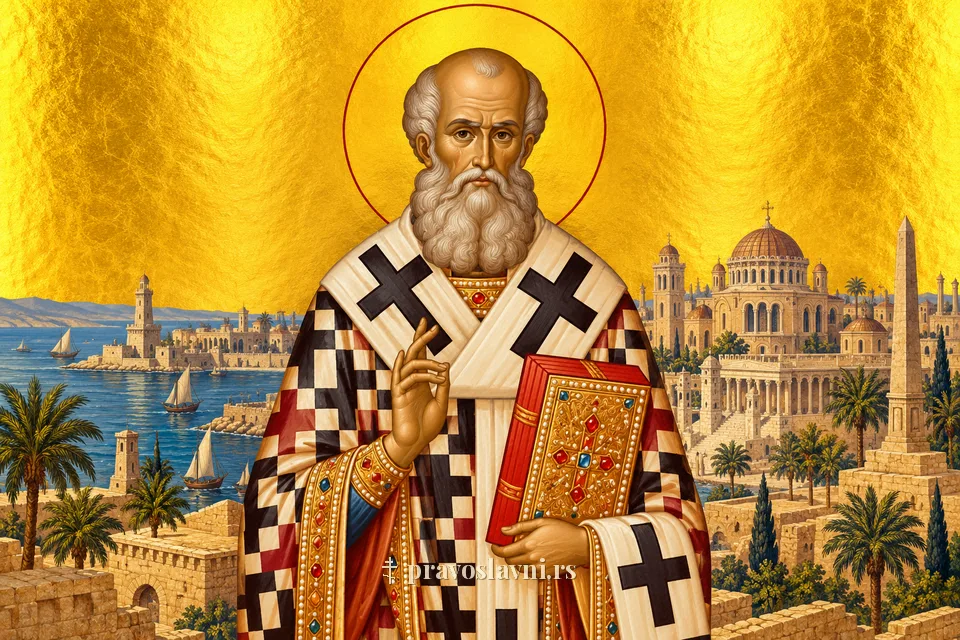
St Athanasius the Great
What happenedToday the Church celebrates the translation of the relics of St Athanasius the Great, the archbishop who defended the true faith through slanders, exiles and times in hiding.
Read the LifeOrthodox Calendar · 2 May according to the Julian calendar
Friday, 15 May 20262 May (according to the Julian calendar)What happenedToday the Church celebrates the translation of the relics of St Athanasius the Great, the archbishop who defended the true faith through slanders, exiles and times in hiding.
Read the Life
No meat, dairy products, eggs or fish — oil and wine are allowed.
This is a recommendation — for your own fast, consult your priest or spiritual father.More about the fast →
Today the Church keeps the commemoration of a saint · not a Red Letter day.
More about the feast →
“For in Him dwells all the fullness of the Godhead bodily.”
— Col 2:9When the Arians accused Archbishop Athanasius of having cut off the hand of a certain Arsenius for the purposes of sorcery, he asked in front of his accusers, as his Life tells: “Which of you knows Arsenius well?” — and brought Arsenius out before them alive, with both his hands. There were many slanders of this kind in his life.
Today the translation of the relics of St Athanasius the Great is commemorated, together with the miracles that came from them, while his life is celebrated on 18 January by the old calendar, that is, on 31 January by the new calendar.
He was born in Alexandria, according to his Life in a Christian family. The Life records that as a boy, at play on the seashore, he acted as a bishop and baptised the other children, and that Archbishop Alexander recognised those baptisms and asked that the boy be given schooling. He studied the sciences, philosophy and Holy Scripture and entered the clergy. The Prologue says that as a deacon he was with Alexander at the First Ecumenical Council in Nicaea, where he contributed greatly to the defeat of the heresy of Arius and wrote the Symbol of Faith. After Alexander's death he was chosen as Archbishop of Alexandria.
From then on, as the Prologue and his Life record, he was persecuted for almost his whole life — by the Arians, and according to the Prologue most of all by the Emperors Constantius, Julian and Valens. According to the Life, the council at Tyre deposed him. He took refuge wherever he could: with the faithful in their houses, in a tomb, in a well, and according to the Prologue in the desert too; he also fled to Rome. The Life says that it was precisely while in hiding that he wrote many books against the heretics. Comfort and counsel, according to the Prologue, he sought from Anthony the Great, his spiritual father.
Only at the end did he find some respite: according to the Life, Valens left him on his throne, and the Prologue says that he spent some time in peace with the people who loved him. He was archbishop for more than forty years and reposed in the year 373.
Athanasius teaches steadfastness in the faith through slanders, exiles and times of hiding. His life shows that God scatters the designs of false accusers, and that the truth which a man patiently defends is vindicated in the end.
On this day the Church remembers the translation of the relics of St Athanasius the Great, Archbishop of Alexandria, and the miracles that took place through them. His life is commemorated on 18 January (according to the Julian calendar), that is, on 31 January by the new calendar. Still, today's commemoration is hard to understand without the man whose relics are venerated — a shepherd who spent almost his whole life persecuted for the faith.
Athanasius was born in Alexandria, according to the Prologue in the year 296, and his Life says of devout Christian parents. The Prologue records that from early childhood he was drawn to a spiritual calling. The Life tells an unusual story about this. Some children were playing on the seashore and in their game appointed Athanasius as their bishop. As he played, he appointed priests and deacons and baptised the children of pagans with sea water, saying the words he had heard in church. Archbishop Alexander, who saw this, questioned the children, took counsel with his clergy and recognised those baptisms as valid, and so he anointed the children with chrism. He told the parents to have the boy educated. Athanasius studied the sciences and philosophy, and most of all the Holy Scriptures, and Alexander received him into the clergy.
The Prologue records that, as the deacon of Archbishop Alexander, he went with him to the First Ecumenical Council in Nicaea and there showed himself to be a learned and zealous champion of Orthodoxy. According to the Prologue, he contributed greatly to the defeat of the heresy of Arius and wrote the Symbol of Faith which the Council adopted. The Life says that the Council condemned Arius, and when Arius was later received back, through the influence of Eusebius of Nicomedia at court, Athanasius, by then archdeacon, opposed it. After the death of Alexander he was elected Archbishop of Alexandria — according to the Life, unanimously by the Orthodox.
From then on begins a life marked by persecution. The Prologue states that he was persecuted by Arius and his followers, by Eusebius of Nicomedia, and most of all by the Emperors Constantius, Julian and Valens. The Life records that Eusebius and the Arians bribed false accusers. They accused him of imposing a tax on the Egyptians, of not honouring the emperor, of being a lover of money, and said that at his order a certain presbyter had overturned an altar and broken a chalice. They also claimed that he had cut off the hand of a certain Arsenius for the sake of sorcery. Before his accusers Athanasius asked: “Which of you knows Arsenius well?” — and brought out Arsenius alive, with both his hands. The Life also mentions a woman who falsely accused him, and whose lie was exposed by the presbyter Timothy. The council in Tyre deposed him all the same, and he went to Constantinople to make his complaint in person.
Constantine, according to the Life, sent him for a time to Gaul. He fled to Rome — the Prologue says twice, and the Life records that he spent three years there, honoured by Pope Julius and the Emperor Constans. He hid in a well, according to the Life a dried-up one, in a tomb — according to the Life for four months under Valens — in the houses of the faithful, according to the Life for years in the home of a consecrated maiden, and according to the Prologue in the deserts as well. The Life adds that, while he was in hiding, he wrote many books against the heretics and that he escaped from Julian's soldiers by boat along the Nile. According to the Prologue, he found support in Anthony the Great, to whom he often came for counsel and comfort and whom he regarded as his father in the spirit.
In the end, according to the Life, Valens allowed him to remain on his throne, and according to the Prologue his last years brought him a time of peace among his faithful people, who loved him. He spent, according to the Prologue, more than four decades on the archbishop's throne, and according to the Life 47 years, but not without interruption. He reposed in the year 373, and was succeeded by Peter, as the Life records.
Athanasius teaches steadfastness in the faith through a whole lifetime of slanders, exiles and hiding. The truth that he patiently defended was vindicated in the end, and God scattered the designs of the false accusers. In one of his writings against the Arians he summed up the faith for which he had endured everything: “The Son of God became man, that He might make men sons of God.”
St Michael, the Bulgarian ruler Boris, was already a monk when he had to come out of the monastery in order to defend the faith of his people. When his elder son Vladimir took power, the faith in the land was once again in danger, because he set himself against everything his father had introduced. Michael removed Vladimir, handed power to his younger son Simeon and went back to the monastic life, in which he died in the year 906. He came to Christianity from paganism, in which he had been born and brought up, and the impulse was given to him by his uncle Boyan and by his sister. At baptism he received the name Michael; his Life gives the year 864 for this. The priests sent by Photius, Patriarch of Constantinople, baptised the people step by step, and some of the nobles resisted, until the faith prevailed. According to the Life, Michael built numerous churches. The faith was strengthened by the work of the Five Disciples of Ohrid, the disciples of Cyril and Methodius, whose preaching to both Bulgarians and Serbs was in the Slavic language. St Michael thus remains an example of a ruler who guarded the faith of his people both from the throne and from a monk's cell.


