Saint of the day
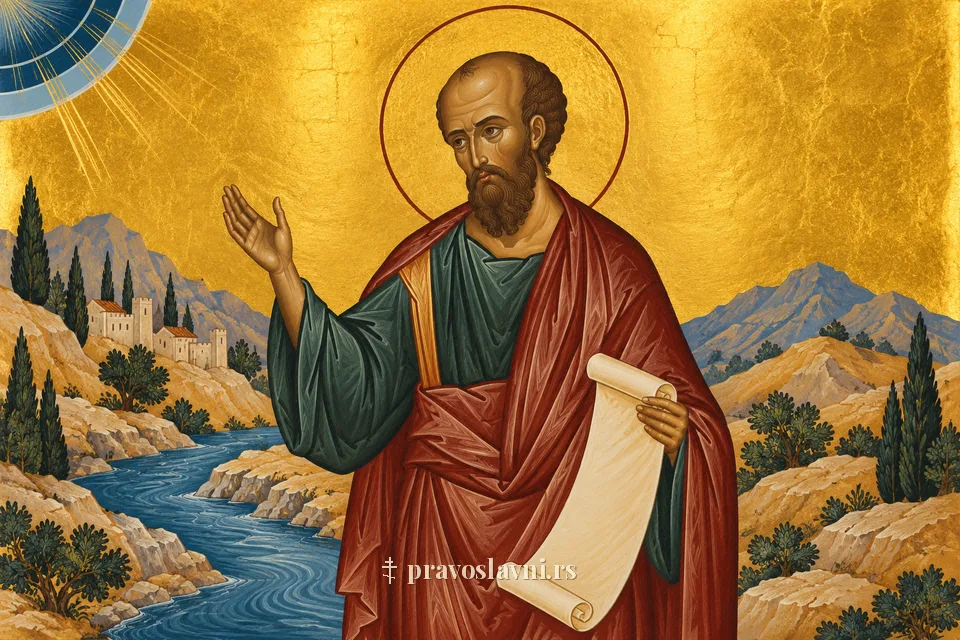
Holy Prophet Elisha
What happenedThe Prophet Elisha received a double portion of the spirit of the Prophet Elijah, and with Elijah's mantle parted the waters of the Jordan.
Read the LifeOrthodox Calendar · 14 June according to the Julian calendar
Saturday, 27 June 202614 June (according to the Julian calendar)What happenedThe Prophet Elisha received a double portion of the spirit of the Prophet Elijah, and with Elijah's mantle parted the waters of the Jordan.
Read the Life
Fish, oil and wine are allowed — no meat, dairy products or eggs.
This is a recommendation — for your own fast, consult your priest or spiritual father.More about the fast →
Today the Church keeps the commemoration of a saint · not a Red Letter day.
More about the feast →
“And many lepers were in Israel in the time of Elisha the prophet, and none of them was cleansed except Naaman the Syrian.”
— Lk 4:27The Syrian commander Naaman was a leper, and the Prophet Elisha sent word to him to bathe seven times in the Jordan. Naaman obeyed and was made well. Elisha would not accept anything for this, and when his servant Gehazi secretly took Naaman's gifts, leprosy fell upon him. The Prologue, in its verses on this event, teaches that obedience and humility bring healing.
Elisha, the son of Shaphat, of the tribe of Reuben, lived, according to the Prologue, about nine hundred years before Christ. His Life remembers that at his birth the golden calf in Shiloh cried out so loudly that it was heard in Jerusalem, and a certain priest said that a great prophet had been born. According to the Life, he lived in virginity. He was ploughing a field when the Prophet Elijah threw his mantle over him, and he left his home and followed him. When Elijah was taken up in a whirlwind, Elisha received a double portion of his spirit and with Elijah's mantle parted the Jordan.
The Prologue and the Life also record his miracles for people in need. He made the bad water in Jericho fit to drink, multiplied the oil of a poor widow so that she could repay her debts, and to the woman of Shunem he first promised a son and later brought him back from the dead. With twenty loaves he fed a hundred men. According to the Life, at Gilgal in a time of famine he made a poisonous stew harmless, and the lost iron head of an axe floated up in the Jordan. He struck the Syrian army with blindness, and the Life adds that he then led it to Samaria, where the soldiers were fed and sent home. The Life also records his prophecy that Hazael would come to rule over Syria.
He reposed in deep old age. The Life says that even on his deathbed he gave a sign to King Joash, who was weeping over him: at his word Joash struck the ground three times, and for that reason he was to have only three victories. The Life also adds that a dead man thrown into his tomb came to life as soon as he touched his bones.
Through the life of the Prophet Elisha the God of Israel was glorified, and his example teaches that God heals the humble and the obedient.
The holy prophet Elisha was the son of Shaphat, of the tribe of Reuben, a native of Abel Meholah. The Prologue says that he lived about nine hundred years before Christ. His Life also remembers a sign at his birth: the golden calf in Shiloh bellowed so loudly that it was heard in Jerusalem, and a certain priest said that a great prophet had been born. According to the Life, he lived in virginity.
The call found him in the field. The Prophet Elijah threw his mantle upon him while he was ploughing — the Life says with twelve yoke of oxen (3 Kgs 19:15–21). Elisha left his home and followed Elijah. According to the Life, he took leave of his parents, slaughtered the oxen and fed the people.
When Elijah was taken up in a chariot of fire, in a whirlwind, Elisha asked for a double portion of his spirit and received it (4 Kgs 2:1–15). With Elijah's mantle he parted the waters of the Jordan.
Many of Elisha's miracles, which both the Prologue and the Life record, were worked for ordinary people. In Jericho he made the bad water fit to drink — according to the Life, by throwing salt into the spring. For a poor widow he multiplied the oil so that she could repay her debts. To the woman of Shunem he promised a son, and when the boy later died, he brought him back to life. In Gilgal, in a time of famine, he made a poisonous stew harmless by adding flour, as the Life records (4 Kgs 4:38–41). With twenty barley loaves he fed a hundred men, and there was still some left over (4 Kgs 4:42–44). According to the Life, he also made the lost iron head of an axe float up to the surface of the Jordan (4 Kgs 6:1–7).
Both sources also remember the healing of a foreigner. He freed the Syrian commander Naaman from leprosy by sending him to bathe seven times in the Jordan (4 Kgs 5). He refused the gifts which Naaman offered him, but his servant Gehazi took them in secret and was struck with leprosy.
When the Syrian army came to seize him, Elisha struck it with blindness. The Life says that this happened in Dothan and that he led the soldiers to Samaria, where they were fed and sent back to their homes (4 Kgs 6:8–23). According to the Life, while Ben-Hadad was besieging Samaria, he foretold abundance for the following day (4 Kgs 6:24 – 7:20). The Life adds that he also foretold that Hazael would become king of Syria, and that he sent one of the prophets to anoint Jehu.
Elisha reposed in deep old age, and the Life says that he was buried with honour. Before his death, according to the Life, King Joash came to him and wept: “My father! My father!” Elisha told him to shoot an arrow and to strike the ground. Joash struck three times, and therefore, according to the prophet's word, he was to have only three victories (4 Kgs 13:14–19).
The Life also records a miracle after his death: a dead man thrown into his tomb came back to life as soon as he touched the bones of Elisha.
In its verses on the healing of Naaman the Prologue stresses that obedience and humility bring healing, and that through the miracles of the Prophet Elisha the God of Israel was glorified.
St Methodius was born in Sicily, according to the Prologue in Syracuse, and became a monk early in life. He served Patriarch Nicephorus; his Life says that the Patriarch sent him as an envoy to Rome, where he remained in the time of the iconoclast Emperor Leo the Armenian. He defended the veneration of the holy icons against the iconoclast emperors. According to his Life, Michael the Stammerer imprisoned him on account of the icons. The Emperor Theophilus threw him into a prison on an island: the Prologue says that he spent seven years in darkness and hunger with two criminals, and his Life that, after being tortured, he was shut up in an underground tomb. Under the Empress Theodora and her son Michael he was set free and made Patriarch, and his Life states that this was in the year 843, when a council restored the veneration of icons. This had been foretold to him beforehand by St Joannicius the Great. His opponents bribed a woman to accuse him falsely of sin with her, but before the court he showed that his body did not allow him this, and the woman confessed that she had been paid. According to his Life, he translated to Constantinople the relics of St Theodore the Studite and of Patriarch Nicephorus. He reposed in peace, and his Life records that he was Patriarch for four years and three months.


