Great feast
Transfiguration
Transfiguration of the Lord
What happenedThe Lord Jesus Christ was transfigured on Mount Tabor before the Apostles Peter, James and John, and showed them His divine glory before His Passion.
Read the LifeOrthodox Calendar · 6 August according to the Julian calendar
Wednesday, 19 August 20266 August (according to the Julian calendar)What happenedThe Lord Jesus Christ was transfigured on Mount Tabor before the Apostles Peter, James and John, and showed them His divine glory before His Passion.
Read the Life
Fish, oil and wine are allowed — no meat, dairy products or eggs.
This is a recommendation — for your own fast, consult your priest or spiritual father.More about the fast →
Red Letter day — great feast; by custom, no work is done
More about the feast →
“Now after six days Jesus took Peter, James, and John, and led them up on a high mountain apart by themselves; and He was transfigured before them.”
— Mk 9:2The Transfiguration of the Lord is one of the twelve great feasts. On that day the Church remembers how the Lord Jesus Christ, after foretelling His passion to the disciples, took the apostles Peter, James and John up Mount Tabor to pray.
On this feast grapes are blessed and sanctified in the churches and then distributed to the faithful. In this way thanks are given to God for the fruits by which man lives.
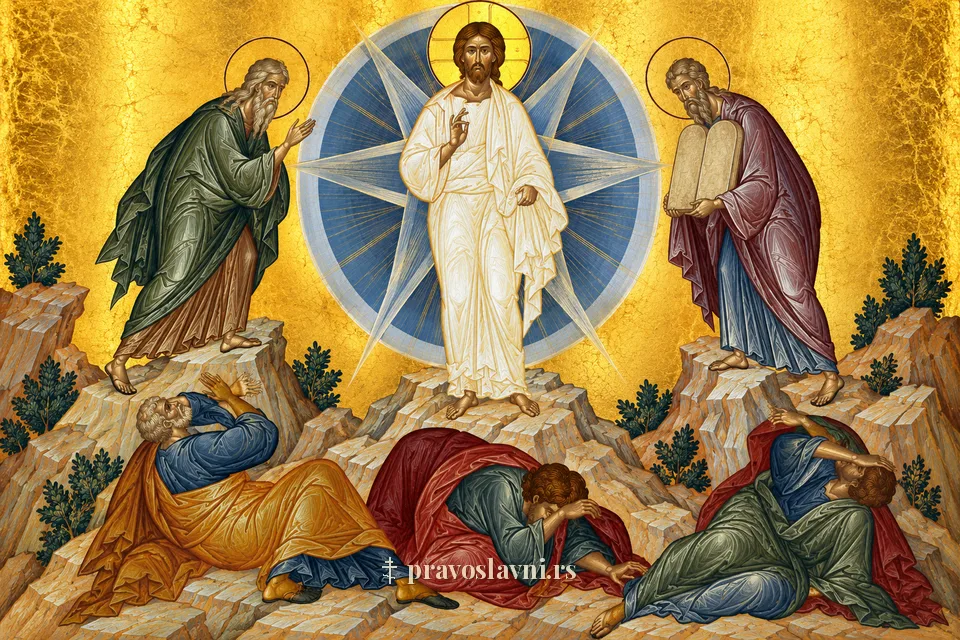
The Transfiguration took place on Mount Tabor. Christ took with Him only Peter, James and John, and with them He went up the mountain by night to pray. Before them He shone with divine light: His face shone like the sun, and His clothing became white as snow. Beside Him there appeared Moses and Elijah, and then a bright cloud overshadowed them, and out of it a voice was heard which called Him the beloved Son and commanded them to hear Him. When the disciples lifted up their eyes, according to the Life, they saw Jesus only, and He commanded them to keep silent about what they had seen until He had risen from the dead.
Why at that very time? As the Life says, in the third year of His preaching Christ foretold to His disciples more and more often that suffering awaited Him in Jerusalem. Both sources say that He revealed His glory to them beforehand, so that their faith would not waver when they watched Him suffer.
Nor was the choice of witnesses accidental. The Law requires two or three witnesses, and so three were called. Judas was not among them, because a betrayer did not deserve to see that glory. In Peter, James and John both sources recognise faith, hope and love. According to the Life, Peter confessed Christ, James was the first of the Twelve to give his life for Him, and to John the Mother of God was entrusted. Moses and Elijah, who, according to the Life, came the one from the dead and the other from paradise, show that the prophets are servants, and Christ is their Lord.
Both the mountain and the night carry a lesson. The mountain reminds us that God is not approached without effort: whoever sets out upward learns to love labour, and whoever rises enters into the contemplation of God. The silence of the night is suited to prayer, and the starry sky lifts the mind towards God. In Tabor, where Barak once defeated Sisera, the Life sees a foreshadowing of Christ's victory over the devil, and it reminds us that at the general resurrection Christ will transfigure our body too.
According to the Life, the light of Tabor was not needed by Christ, but by the disciples. It is also a call to all who seek God by labour and prayer.
In the third year of His preaching Christ, according to the Life, spoke to His disciples more and more often about the suffering that awaited Him in Jerusalem. This was after Peter's confession near Caesarea Philippi. Peter objected to the words about suffering and was rebuked, and the Lord said that some of those standing there would not taste death until they saw the Son of Man coming in His Kingdom.
After six days He took Peter, James and John up Mount Tabor to pray, while the other disciples remained at the foot of the mountain. Both sources say that they climbed by night. The Life says that Tabor is in Galilee and notes that the three disciples were heavy with sleep.
Before them He was transfigured: His face shone like the sun, and His garments became as white as snow. Beside Him there appeared Moses and Elijah. According to the Life, Moses came from the dead and Elijah from Paradise, and they spoke with Him about His departure, which was to take place in Jerusalem.
Peter said that it was good for them to be there and offered to make three tabernacles: one for Christ, one for Moses and one for Elijah. Then a bright cloud overshadowed them, and a voice from the cloud declared that He is the beloved Son and commanded them to hear Him. The disciples fell on their faces in fear. Jesus came to them, touched them and told them to arise and not to be afraid. When they lifted up their eyes, according to the Life, they saw only Jesus. He commanded them to tell no one of what they had seen until He had risen from the dead, and they kept silent.
Both sources say that before His Passion Christ showed His divine glory so that the disciples would not lose their faith when they saw Him suffering. The Life stresses that He was not transfigured for His own sake but for the sake of the disciples, for nothing needed to be added to the divine light.
Christ did not take Judas with Him: one who had already set out on the path of betrayal, both sources say, did not deserve to be a witness of that glory. Here the Life cites the thought of Theophylact and John of Damascus. It also adds that the Lord, being patient with him, did not expose him before the others, so as not to push him still further into evil.
The three were also called because the Law requires two or three witnesses. The Life adds that Moses bore witness for the dead, Elijah for those in Paradise, and the apostles for the living. Moses and Elijah show that Christ is not merely one of the prophets, but the Lord over the prophets, whom they serve.
In Peter, James and John both sources see three virtues: faith, hope and love. The Life explains: Peter confessed Christ; James was the first of the Twelve to suffer for Him; John is the beloved disciple, to whom the Mother of God was entrusted. The Apostle Paul calls them pillars. The Life also interprets them more broadly: Peter signifies those who love God, James the martyrs, among whom are also those who die daily to sin, and John virginity and purity.
According to both sources, the night-time too carries a lesson: the stillness of the night is fitting for prayer, and the starry sky that is seen then lifts the mind to God. The Life teaches that whoever desires a heavenly revelation must rise above earthly attachments. According to the Life, God reveals Himself more clearly in quiet solitude, as He does to the desert-dwellers; according to Holy Scripture, that is how He revealed Himself to Elijah on Horeb as well. The Life interprets the name Tabor as a palace of purity and light: whoever seeks the glory of God must first of all have a clean conscience.
On Tabor Barak once defeated Sisera, and the Life sees in the Transfiguration a foreshadowing of the victory over the devil. It also reminds us that at the general resurrection Christ will transfigure our lowly body. The light that the three saw on the mountain is a promise for us too: whoever rises above what is earthly through labour and prayer will be able to see the glory of God.


