Saturday29August 202616 August (according to the Julian calendar)‹›
Illustration
Feast of the day
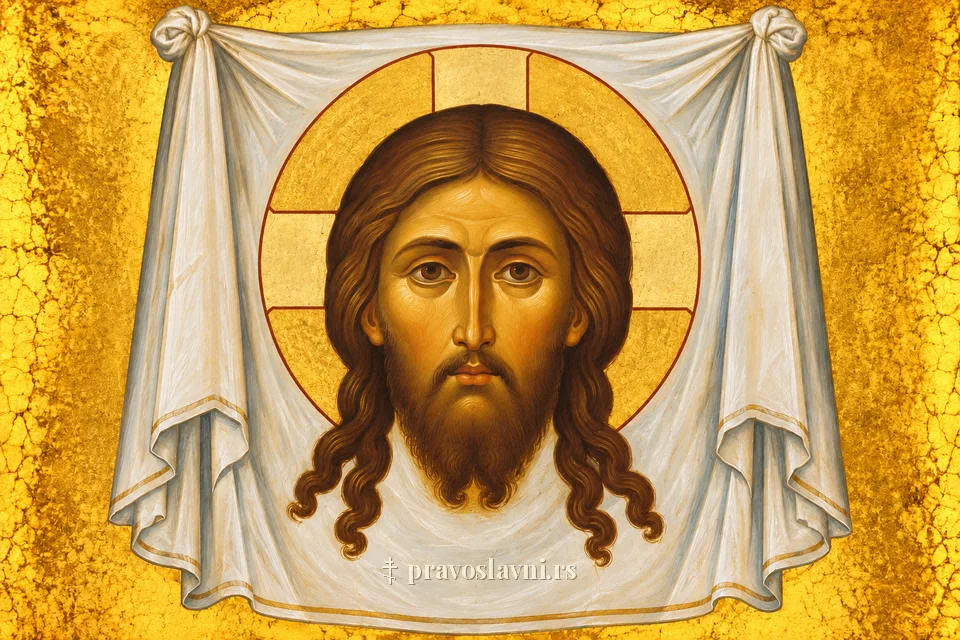
Image of the Lord Jesus Christ Not Made by Hands
What happenedThe translation of the Image Not Made by Hands from Edessa to Constantinople is commemorated — the cloth on which Christ imprinted His face for the sick ruler Abgar.
Abgar, the prince of Edessa, was suffering from leprosy and had heard of Christ's healings. He sent the painter Ananias with a letter, asking Christ to come or to let His face be painted. Christ did not set out for Edessa, because His Passion was near, but He pressed His face onto a cloth, and the linen kept His likeness. According to the Life, He sent word to Abgar: “Blessed are you, Abgar, for you have believed in Me without having seen Me”.
Abgar recovered as soon as he kissed the linen, but not entirely: until the coming of the promised disciple some leprosy remained on his face — according to the Life, one small spot. The Apostle Thaddeus came to Edessa, healed him completely and baptised him. Abgar pulled down the idol above the city gate, and in its place he set the image of Christ, with the inscription: “O Christ God, no one who hopes in You will be put to shame”.
When Abgar's great-grandson went back to idolatry, the bishop walled up the image by night, and the place was forgotten. When the Persian ruler Chosroes besieged Edessa, Bishop Eulabius learned in a vision where the image was. They found it undamaged, and the Persian army was defeated.
According to the Life, in the 10th century the image, together with Christ's letter, was translated to Constantinople, and that translation is celebrated on 16 August by the old calendar. Abgar believed without having seen, and the image of the incarnate Lord bears witness that God truly became man.
Full Life
Faith without seeing
Prince Abgar of Edessa, whose city lay beyond the Euphrates, was suffering from leprosy. When he heard what kinds of illnesses Christ was healing, he sent Him a letter by the painter Ananias — according to the Prologue to Palestine, according to the Life to Judea. He begged the Lord to come to Edessa and, if that was not possible, asked that Ananias might at least paint His face. The Life says that the painter did not succeed in this, because the face of Christ shone with divine glory; Christ Himself called him by name and took the letter.
Christ did not set out for Edessa, because His Passion was near. According to the Life, He answered Abgar with a letter: “Blessed are you, Abgar, because you have believed in Me without having seen Me,” promising that after the Ascension He would send him a disciple who would heal him and give him life.
The face that no hand painted
Instead of a painting, Ananias carried back a towel on which Christ had imprinted His face — according to the Life, after He had first washed it. The cloth kept His likeness. Abgar recovered as soon as he kissed the cloth, but not completely: until the coming of the promised disciple some leprosy remained on his face — according to the Life, one small spot. The Apostle Thaddeus, one of the Seventy, came, healed the prince completely and baptised him; according to the Life, his household and the whole city were baptised after him.
The guardian of the city
Abgar pulled down the idol from the city gate, and in its place he set the image of Christ, adorned with costly ornaments. Beneath it stood the inscription: “O Christ God, no one who hopes in You will be put to shame.” According to the Life, a law that was kept from generation to generation required passers-by to bow down before the image.
When Abgar's great-grandson returned to the idols, the bishop, according to the Life on the basis of a revelation, walled up the image in the gate by night and, as the Life says, left a lamp burning before it. In time it was forgotten where it was hidden.
The image was found again when the Persian ruler Chosroes was besieging Edessa. The place was shown to Bishop Eulabius, according to the Prologue, by the Most Holy Theotokos, and according to the Life by a radiant woman. The image was found whole; the Life adds that the lamp was still burning and that the likeness had also passed onto the tile that covered it. The Persians were defeated — according to the Life, they withdrew when the bishop went round the walls with the image.
The journey to Constantinople
According to the Life, in the 10th century, when Edessa was in Saracen hands, the Byzantine emperors ransomed the image and the letter of Christ with silver and Saracen prisoners. The translation to Constantinople was accompanied by healings, and the feast of 16 August (according to the Julian calendar) remembers that very day. In Constantinople the image, according to the Life, first stood in the church of the Theotokos at Blachernae, and then in the church of the Theotokos of the Pharos, as a protection for the city, and in the year 967 Emperor Nicephorus Phocas brought the tile with the likeness from Edessa as well.
To Abgar, faith without seeing brought healing, baptism and life. The image of the incarnate Lord, kept through the centuries, bears witness that God truly became man.
Other saints of the day
St Eustathius II, Archbishop of Serbia
St Eustathius II was Archbishop of Serbia after Archbishop Jakov, from 1292 to 1309. In his personal life he was a great ascetic, and his biographer, Archbishop Danilo, describes him as a diligent shepherd of his flock. During the time of his rule three new dioceses were founded: that of Zvečan, also called the diocese of Banjska or of Lipljan, with its seat at Banjska, then that of the Lim, with its seat in the Monastery of the Holy Apostles Peter and Paul on the Lim, and that of Skopje. He reposed peacefully in the Lord on 16 August 1309 (according to the Julian calendar). Immediately after his death everyone venerated him as a saint.
Venerable Roman lived about two hundred years before the Nemanjić dynasty; exact information about his life has not been preserved. The Monastery of St Roman, in which his relics lie, is situated in a wooded valley beside the road from Ražanj to Đunis, not far from the South Morava river. He is remembered as a great saint, the enlightener of that Serbian region and a great wonderworker. The monastery was built by the holy Prince Lazar. The sick come there, especially the mentally ill and those who are tormented by evil spirits, seeking healing, and the people of that region swear by his name.
Over the grave of Venerable Rafailo of Banat, south-east of the altar of the church of the Entry of the Most Holy Theotokos into the Temple in Zrenjanin, there stands a chapel built soon after his death, and later renewed and enlarged; the sick are brought into it to spend the night with prayers that are read over them. Rafailo was a Serb and a hieromonk of Hilandar; he lived in the 16th or 17th century, and the exact years are not known. At Hilandar he lived the ascetic life for a long time in strict prayer and fasting, and then the brotherhood sent him on an obedience to the monastery's dependency (metochion) in Banat, on the site of present-day Zrenjanin. The dependency was probably acquired in the time of Despot Stefan Lazarević, to whom the Hungarian King Sigismund had given Bečkerek. He lived in a modest hut on the site of the present-day church of the Entry, where he also ended his life. The miraculous power that God granted him was shown most of all after his repose, and so the people have visited his grave from the very beginning; the veneration grew especially after the migration of the Serbs in 1690, when more Serbs settled in that region. Testimony about him is also kept by an older icon in the altar of the main church of Hilandar: on its reverse it is written that he was a Serb, a hieromonk of Hilandar sent to Banat, that he reposed there and that miracles from his relics made him known.