Saints of the day
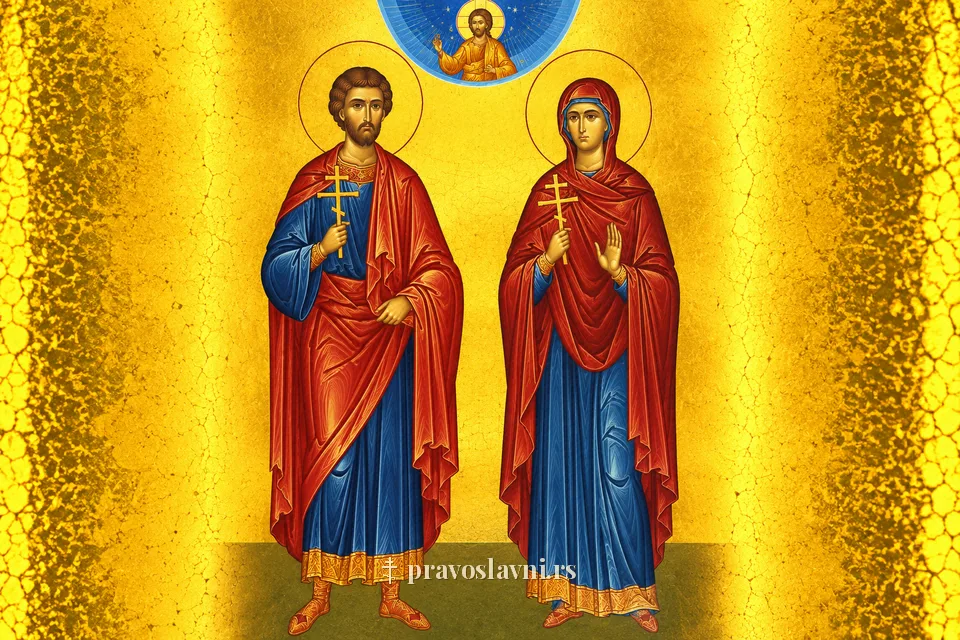
Holy Martyrs Adrian and Natalia
What happenedThe pagan official Adrian, seeing the patience of the tortured Christians, asked that his name too be written down with theirs.
Read the LifeOrthodox Calendar · 26 August according to the Julian calendar
Tuesday, 8 September 202626 August (according to the Julian calendar)What happenedThe pagan official Adrian, seeing the patience of the tortured Christians, asked that his name too be written down with theirs.
Read the Life
You may eat meat, eggs, milk and dairy products, as well as any other food — but try to be moderate.
More about the fast →
Today the Church keeps the commemoration of a saint · not a Red Letter day.
More about the feast →
“But he said, ”I am not mad, most noble Festus, but speak the words of truth and reason.”“
— Acts 26:25When Emperor Maximian asked him whether he had lost his reason, Adrian, a high imperial official in Nicomedia, answered, according to the Prologue: “I have not gone out of my mind, but have come to my mind”. Until that moment he had been a pagan.
According to the Life, Adrian was then twenty-eight years old. He and Natalia came from a distinguished and wealthy family and had been married for only thirteen months. Natalia was a Christian, but she kept her faith hidden. When, by the emperor's order, twenty-three Christians were seized, beaten and thrown into prison, Adrian watched their patience and asked them what they expected from their God. Their answer spoke of the joy that awaits the righteous with God. Then he too desired to be numbered among them and declared himself a Christian. He was put in chains and imprisoned together with them.
Natalia rejoiced. She used to come to the prison, kiss the chains of her husband and of the other martyrs, encourage them and bind up their wounds. The Life says that when women were forbidden to enter, she cut off her hair and put on men's clothing, so that she could go on serving them.
In the end, by the emperor's order, Adrian and the twenty-three martyrs suffered. The relics were translated to Constantinople and buried with honour — according to the Prologue, Natalia herself translated them, and according to the Life the Christians did, by ship. The Life also remembers that Natalia kept her husband's hand and later laid it beside his body. According to the Life, when a certain tribune wanted to take her as his wife, she sailed away to the place where the relics were, and on the way Adrian himself protected her. She too did not live long after him: her husband came for her bathed in light and called her to God, and she died in peace. The Life numbers her among the martyrs, although her blood was not shed.
Her faith and love sustained her husband to the end, and his conversion shows that the patience of martyrs can open the eyes even of those who until yesterday were persecuting them.
In Nicomedia there lived Adrian and Natalia, a married couple from a respected and rich family, as the Prologue records. They had been married for only thirteen months; the Life says that Adrian was then twenty-eight years old. He was a high imperial official — the Prologue calls him the head of the praetorium — and a pagan. Natalia, however, was a Christian, but she kept it hidden; according to the Life, she was the daughter of believing parents and out of fear did not reveal her faith.
Emperor Maximian, who was then staying in Nicomedia, ordered that the Christians be seized. Twenty-three Christians who were hiding in a cave were betrayed, beaten and thrown into prison. Adrian watched how they endured and asked them what they expected from their God. The answer was that blessedness in the Kingdom of God awaits the righteous; the Life says that they quoted the words of the Apostle Paul (1 Cor 2:9).
Those words changed him. To the scribes, according to the Life, he said: “Write down my name too with these saints” — and he confessed himself a Christian. When the Emperor asked him whether he had gone mad, Adrian, according to the Prologue, answered: “I have not gone out of my mind, but have come to my mind.” He was put in chains and thrown into prison together with the martyrs.
Natalia rejoiced when she heard what her husband had done. She came to the prison, kissed his chains and the chains of the others and encouraged him to persevere. The Life adds this as well: the martyrs let Adrian go home, on his promise that he would bring Natalia to be with them at the end. At first she would not open the door to him, because she thought that he had denied Christ.
Natalia served the prisoners and bound up their wounds; the Life says, for seven days. When women were forbidden to enter the prison, according to the Life she cut her hair and dressed as a man in order to go on serving, and other women followed her as well.
In the end the Emperor ordered that the martyrs be put to death, and so Adrian and the twenty-three confessors suffered. The Life says that Adrian asked Natalia to hold his hand at that hour, and that the others breathed their last while praying. The Emperor ordered that the bodies be burned, but, according to the Life, a storm with thunder and rain came up and put out the fire, so that the bodies were taken out undamaged. Natalia, according to the Life, secretly kept Adrian's hand, anointed it and wrapped it in purple cloth.
The relics of the martyrs were translated to Constantinople — the Life says, to Byzantium — and buried there with honour. The Prologue says that Natalia translated them, and the Life that Christians carried them over by ship, while Natalia came later.
According to the Life, a certain tribune wanted Natalia for his wife. She asked for three days, she prayed, and in a dream one of the martyrs told her to sail to the place where the relics were. On the way, according to the Life, the devil, disguised as a helmsman, tried to steer the ship in the wrong direction, but Adrian appeared and told them to keep their course, while the storm drove the tribune's ship back. Towards the end of the voyage, according to the Life, she cried out: “There is my lord!” She laid Adrian's hand beside his body and prayed. His Life records that her husband said to her in a dream: “It is good that you have come here.”
Not much time passed before Adrian appeared to Natalia in light and called her; soon she too quietly reposed. The Life says that she died in her sleep and it numbers her among the martyrs, although her blood was not shed.
The faith and love of a wife supported her husband to the end, and a pagan official became a confessor by watching the patience of the martyrs.
The Vladimir Icon of the Mother of God, according to tradition, comes from the Evangelist Luke. The account says that it was taken from Jerusalem to Constantinople, and from there to Kiev and Vyshgorod. Prince Andrew took it with him to the north, and near Vladimir the horses would not go any further; after prayer the icon remained in that city, in the Dormition church, and it received its name from it. When Tamerlane set out against Moscow with a countless army, the wonderworking icon was brought from Vladimir to Moscow, according to the account in the year 1395. Tamerlane saw the Most Holy Theotokos in a dream, and she commanded him to leave the Russian land. His army withdrew without any visible reason, and Moscow was spared. The Church celebrates the memory of that deliverance on this day.