Saint of the day
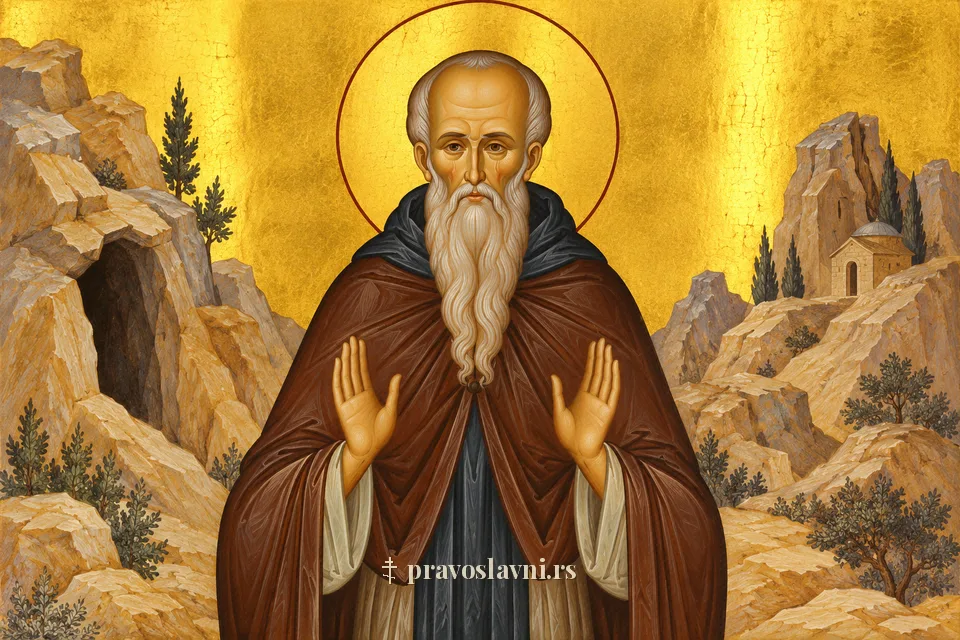
Venerable Poemen the Great
What happenedSt Poemen did not open the door to his mother, but asked her whether she wished to see her sons here or in eternity.
Read the LifeOrthodox Calendar · 27 August according to the Julian calendar
Wednesday, 9 September 202627 August (according to the Julian calendar)What happenedSt Poemen did not open the door to his mother, but asked her whether she wished to see her sons here or in eternity.
Read the Life
No meat, dairy products, eggs, fish or oil — food cooked in water.
This is a recommendation — for your own fast, consult your priest or spiritual father.More about the fast →
Today the Church keeps the commemoration of a saint · not a Red Letter day.
More about the feast →
“While we do not look at the things which are seen, but at the things which are not seen. For the things which are seen are temporary, but the things which are not seen are eternal.”
— 2 Cor 4:18“You will never overcome evil with evil” — this saying, which his Life attributes to St Poemen the Great, sums up the life of one of the greatest ascetics of the Egyptian desert.
Poemen was an Egyptian and, according to the Prologue, lived in the fifth century. The Prologue says that while still a boy he sought out the renowned elders and learned from each of them. He became a monk together with his two brothers and lived with them according to a strict rule, in labour, prayer, silence and great abstinence. Even to their mother, when she came, the brothers did not open the door; Poemen asked her whether she wished to see them now, on earth, or afterwards, before God, and she chose the latter and went home in peace.
Nor did he give way before the authorities. A governor who wished to see him put his nephew in prison, so as to bring him in that way. Poemen did not come, but wrote that the young man's guilt should be justly examined and that he should be punished only according to the law. Amazed, the governor released the young man and paid his respects to the elder.
According to his Life, he was a spiritual father to many monks. He taught them humility, moderation in food, which he called the royal way, and repentance from the heart. He held that a monk should remain at peace both when he is put to shame and when he is praised. He reposed in deep old age.
St Poemen teaches that the steep path is walked without looking back and that righteousness without partiality wins respect.
Poemen the Egyptian is numbered among the greatest ascetics of the Egyptian desert, and the Prologue places his life in the 5th century. According to the Prologue, he began to gather wisdom while still a boy: he would go to renowned elders and from each he carried away something of his experience. One of them, the elder Paul, at the boy's request took him to St Paisius. Paisius, as the Prologue records, said of the child that the hand of God was upon him and that he would lead many to salvation.
Later, according to the Life, after many years of wandering Poemen came again to the Egyptian desert, and many monks found a spiritual father in him.
He entered the monastic life together with two brothers, according to the Life younger than he was. The Prologue describes their life with the eldest brother, Abba Anoub, as a life by a firm order: the night was divided between handiwork, sleep and psalms, the day between work, prayer and reading, and for food there was a single evening dish of greens. Whatever was given to them, that they ate, asking for nothing more, and they lived in silence and peace.
That order did not give way even before those closest to them. Their mother, already a widow, came to see her sons, but the door was not opened to her. Poemen asked her where she would rather look upon them, in this life or in the eternal one. The mother chose the eternal one and returned home.
He held to the same line before the authorities too. A certain governor wished to see him, and Poemen was not willing; the Life explains that he feared the crowd that would come after the governor and disturb his humility and quiet. In order to force him to come, the governor arrested Poemen's nephew, according to the Life the son of his sister. Not even his sister's reproaches, which the Life mentions, moved him. To the governor he sent only a letter: let the young man's guilt be examined according to justice, and let the punishment be set as the law requires. The nephew was released, and Poemen gained the governor's respect.
The Life remembers Poemen as a teacher of humility, who fled from worldly glory. He did not praise extreme fasting: it is better, he used to say, to eat a little every day, and he called this the royal way. He required a monk to remain the same both when he is insulted and when he is praised, so that neither anger nor pride should move him. He taught that God accepts even a repentance that lasts only three days, if it is sincere and if it is accompanied by the resolve not to repeat the sin. In front of visitors he preferred to keep silent rather than say what would not profit the soul.
The Life preserves some of his words exactly: “If we cover the sins of the brethren, God will cover ours as well.” And again: “The chief thing for a man is these three: to fear God, to pray often, and to do good to his neighbour.” Among the shortest is: “You will never overcome evil with evil.”
He lived to a deep old age and ended his life in peace.
The ascetic, the Prologue teaches, goes forward and does not turn his gaze back to what he has left. And justice without partiality, such as Poemen's was, wins respect even among those who opposed him.
The time of the life and suffering of St Phanourius, according to his Life, has remained unknown. People learned of him only in the 14th century, on the island of Rhodes: while they were digging beside the city walls, they found an old church and in it a beautiful icon of the saint. On it he was shown as a young man and as one who had suffered much for Christ. The church was restored by Nilus, the Metropolitan of Rhodes, who also composed a service to the saint and gave his icon to the faithful for veneration. According to his Life, St Phanourius has since that time worked many miracles for those who call upon him with faith in their troubles.