Feast of the day
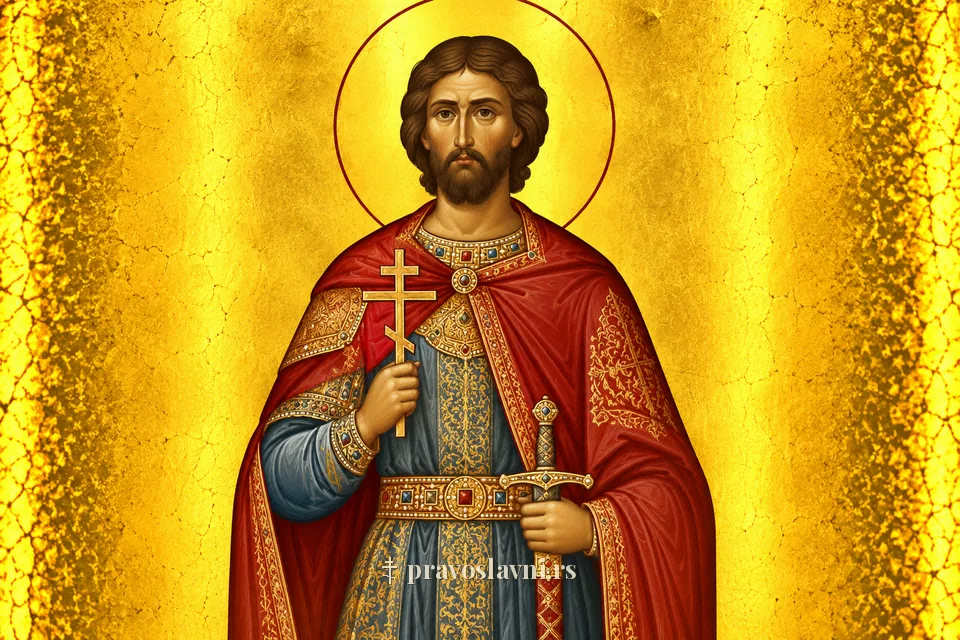
Translation of the Relics of St Alexander Nevsky
What happenedBy order of Peter the Great the relics of St Alexander Nevsky were translated to St Petersburg, to the Alexander Nevsky Lavra, in the year 1724.
Read the LifeOrthodox Calendar · 30 August according to the Julian calendar
Saturday, 12 September 202630 August (according to the Julian calendar)What happenedBy order of Peter the Great the relics of St Alexander Nevsky were translated to St Petersburg, to the Alexander Nevsky Lavra, in the year 1724.
Read the Life
You may eat meat, eggs, milk and dairy products, as well as any other food — but try to be moderate.
More about the fast →

“So he answered and said to me: ”This is the word of the LORD to Zerubbabel: “Not by might nor by power, but by My Spirit,” Says the LORD of hosts.”“
— Zech 4:6When in 1724, by order of Peter the Great, the relics of St Alexander Nevsky were translated to St Petersburg, to the Alexander Nevsky Lavra, their long journey came to an end. It is this translation that the Church celebrates on this day.
Alexander, the son of Prince Yaroslav, loved prayer and vigil from his youth and was merciful. As Prince of Novgorod he defeated the Swedes on the River Neva, after which he was named Nevsky, and in that battle he trusted more in God than in his army. According to his Life, before that battle Sts Boris and Gleb, kinsmen of the prince, appeared in a vision to one of the prince's men, with the promise that they would help him. Later, as Grand Prince of Vladimir, he raised up the land that had suffered under the Tatars. Not even in the Golden Horde did he consent to bow down to idols; he told Khan Batu that he worshipped God and not created things, and the khan respected him for that very reason.
He built churches and gave alms. Before his death he became a monk with the name Alexius. He was buried in Vladimir, and in 1381 his relics were found and placed in the cathedral church of the monastery. At his burial, according to his Life, a miracle took place: the prince received in his hand the letter of absolution that the metropolitan held out to him, as though he were alive. Later, in the time of Tsar Ivan IV, a service was composed for him.
St Alexander teaches that the strength of a ruler lies not in force, but in justice and faith in God.
St Alexander was the son of Prince Yaroslav. His Life says that from his youth he was devoted to Christ: he loved vigil and secret prayer, was merciful towards others and indifferent to worldly vanity. In the year 1236 he became Prince of Novgorod.
In the year 1240 he defeated the Swedes on the River Neva, and from that victory he received the name Nevsky. He trusted more in God's help than in his own army; his Life remembers that before the battle he said to his soldiers: “God is not in might but in truth.” His Life also tells of a vision before the fight: one of the prince's men saw Sts Boris and Gleb, who promised their kinsman the prince that they would help him.
In the year 1250 he became Grand Prince of Vladimir, and he strove to raise up the Russian land, which was suffering under the Tatars. In the Golden Horde he was required to pay honour to the idols and to pass through the fire, but he refused to do so. To Khan Batu, according to his Life, he said: “I am a Christian, and I do not bow down to what is created,” for he bows down to God and not to creatures. The khan respected him for this.
He did not fight with the sword alone: he built many churches and gave away much in alms. When he felt that his end was drawing near, he received the monastic tonsure with the name Alexis and partook of Holy Communion, and then he reposed quietly and peacefully. He was buried in the Monastery of the Nativity of the Most Holy Theotokos in Vladimir, in the city whose grand prince he had been. His Life also records a miracle at the funeral service: the dead prince, as though he were alive, himself took into his hand the prayer of absolution which the metropolitan held out to him.
In the year 1381 his relics were found and placed in the cathedral church of that monastery. In the time of Tsar Ivan IV, in the year 1547, a service was composed in his honour. In the year 1724, by order of Peter the Great, the relics were translated from Vladimir to St Petersburg, to the Alexander Nevsky Lavra, where they rest to this day. It is this translation that the Church celebrates on this day.
St Alexander was a ruler who trusted more in God than in his army and would not bow down to idols. His strength was not in the sword, but in truth.
Sts Kirilo, Nikon and Makarije are numbered among the Serbian archbishops and patriarchs whom the Church glorifies together at the Synaxis of the Serbian Enlighteners and Teachers. Nikon and Makarije are mentioned by name in the Prologue's commemoration, and Kirilo in the list of the Synaxis in the Life. Of the three, the most is known about Makarije. His name is linked with the renewal of old holy places and with the church books which, through his care, were printed in Skadar, Venice, Belgrade and other cities; at Peć a refectory was built thanks to him. He reposed in 1574.
Separate page: Sts Kirilo, Nikon and Makarije, Patriarchs of Serbia →