Saint of the day
Holy Martyr Mamas
What happenedAn orphan born in prison, St Mamas confessed Christ before the Emperor Aurelian when he was only fifteen years old.
Read the LifeOrthodox Calendar · 2 September according to the Julian calendar
Tuesday, 15 September 20262 September (according to the Julian calendar)What happenedAn orphan born in prison, St Mamas confessed Christ before the Emperor Aurelian when he was only fifteen years old.
Read the Life
You may eat meat, eggs, milk and dairy products, as well as any other food — but try to be moderate.
More about the fast →
Today the Church keeps the commemoration of a saint · not a Red Letter day.
More about the feast →
“For you shall have a covenant with the stones of the field, And the beasts of the field shall be at peace with you.”
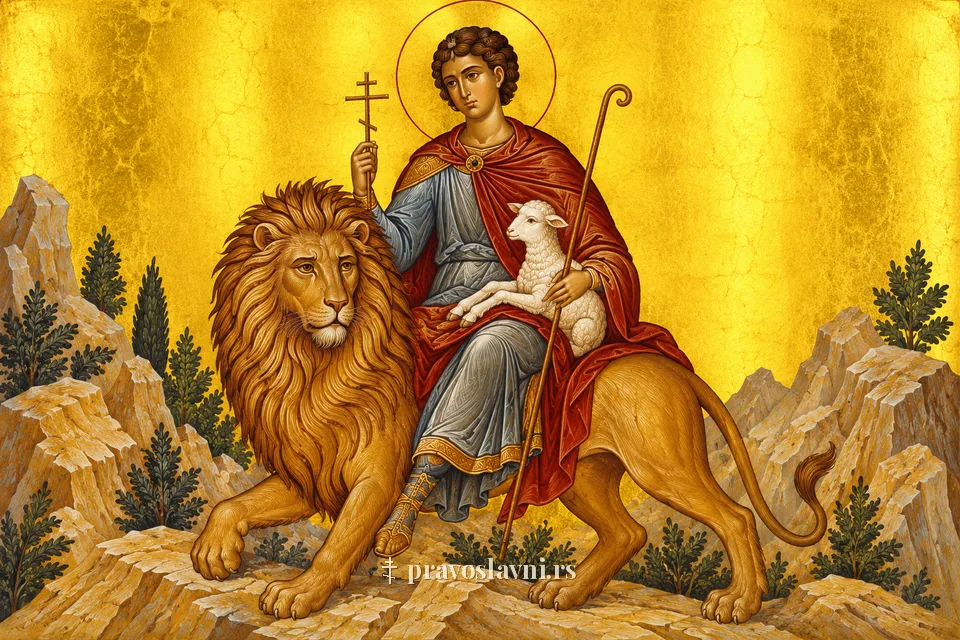
— Job 5:23Wild beasts could do no harm to St Mamas. They became tame beside him on the mountain near Caesarea in Cappadocia, where an angel had led him after delivering him from death in the sea, and later, when he was thrown to the beasts, not one of them hurt him.
While still a boy of fifteen he confessed Christ before the Emperor Aurelian, who demanded that he deny Him at least in words: “neither with my heart nor with my lips will I deny my God and King, Jesus Christ.” For this he was tortured. Among his companions at school, too, he said openly that idols have no power at all.
The providence of God followed him from his birth. He was born in the prison in which his parents, the Paphlagonian Christians Theodotus and Rufina, were held for the sake of Christ, and he was left without them both. The widow Ammia, moved by an angel, buried them and brought up the boy. He received his name from the first word that he spoke at the age of five — “mama”.
According to his Life, a dove fed him in the prison, and in the furnace he remained unharmed. His life ended when a pagan priest pierced him with a trident. At his relics many have been healed, and his Life records that the building which Julian the Apostate tried to raise over his tomb collapsed every night.
God cares for the weak, and to those who stand firm He gives strength.
St Mamas came from Paphlagonia. His parents were Christians, Theodotus and Rufina; his Life says that they were of distinguished and wealthy families and that they brought many to Christ. Because of their faith they were thrown into prison. According to his Life, Theodotus was sent to the governor Faustus in Caesarea of Cappadocia, and Rufina, who was with child, went after him. The father died in prison, and the mother, after giving birth to a son before her time, passed away herself as well. His Life records her prayer before death: “Be You his father and mother and the guardian of his life!” The newborn child was left lying between the bodies of his parents.
Through an angel God moved the distinguished widow Ammia to ask the governor for the bodies. She buried the bodies, according to his Life in her own garden, and brought up the orphan as her own child. He did not speak until his fifth year, and then with the word “mama”, after which he was named Mamas. At school he stood out for his understanding, and before the other children he openly confessed Christ, teaching them that the idols are powerless. His Life says that Ammia, as she was dying, left him her estate.
In the time of Emperor Aurelian, at fifteen years of age, he was brought before the emperor; his Life says that the governor Democritus sent him in fetters to Aegae. The emperor tried to persuade him to renounce Christ at least with his lips. Mamas, as the Prologue records, answered: “neither with my heart nor with my lips will I renounce my God and King, Jesus Christ”. His Life also ascribes to him the words: “death for Christ is dearer to me than every honour and gain”. He was tortured and condemned to be drowned in the sea.
An angel delivered him and led him to a high mountain near Caesarea. There, far from people, he spent his days in prayer, and the wild beasts grew tame beside him. His Life tells that he fasted for forty days, received the Gospel, built a small church and made cheese from the milk of wild animals, of which he gave a great deal to the poor of Caesarea.
When the new governor of Cappadocia, Alexander, sent soldiers, Mamas, according to his Life, received them, fed them and went with them of his own free will, and a lion accompanied him as far as the city gates. In prison, according to his Life, a dove fed him, and in the furnace he remained unharmed for three days, so that many who saw it came to believe. He was thrown to the wild beasts, but they did nothing to him. At last a pagan priest pierced him with a trident, and Mamas gave up his soul to God.
At his relics many of the sick were healed. His Life says that St Basil the Great preached about the miracles at his tomb. His Life says that Julian the Apostate tried to raise a building over his tomb, but every night it fell down.
An orphan born in prison, raised by God's providence, remained unshaken in confessing Christ from childhood until death. God cares for the weak and gives strength to those who stand firm.
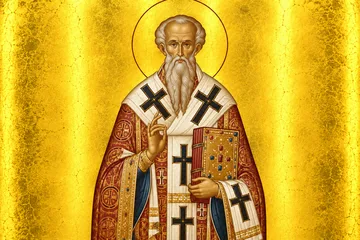
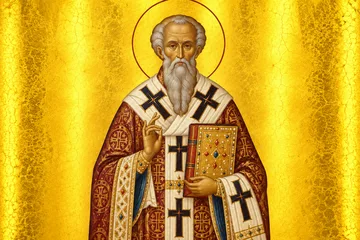
St John the Faster was born in Constantinople and lived, according to his Life, in the time of the Emperors Justin, Tiberius and Maurice. Before he entered the service of the Church he was a goldsmith, devout, merciful to the poor and hospitable. Once, when the monk Eusebius from Palestine was walking beside him, on his right-hand side, he heard an invisible voice which told him not to walk on the right-hand side of the great John — a sign of the great ministry that awaited John. Soon he received holy orders, and after Patriarch Eutychius he was elected Patriarch of Constantinople, to which he agreed only after a fearful vision. His Life says that he fasted for six days and on the seventh ate only a little fruit, and that he slept little, sitting up. According to his Life, by prayer and the sign of the Cross he calmed a storm at sea and healed many who were sick and possessed, and to a blind man from Gaza he said: “May He Who healed the man blind from birth heal you also!” — and he gave him back his sight. When a great plague struck Constantinople, he prayed and foretold its end, and the dying ceased on the seventh day. His Life also records that he forbade the horse races on a certain great feast, and when they began all the same, a storm with hail scattered everyone. He was a father to orphans and a protector of the oppressed. The Prologue says that he reposed in the year 595 and that after him only a wooden spoon, a linen shirt and an old garment were found. He was buried, as his Life says, in the altar of the church of the Holy Apostles, and the Prologue mentions his writings on repentance and confession.
Separate page: St John the Faster, Patriarch of Constantinople →