Saint of the day
Church New Year (Beginning of the Indiction)
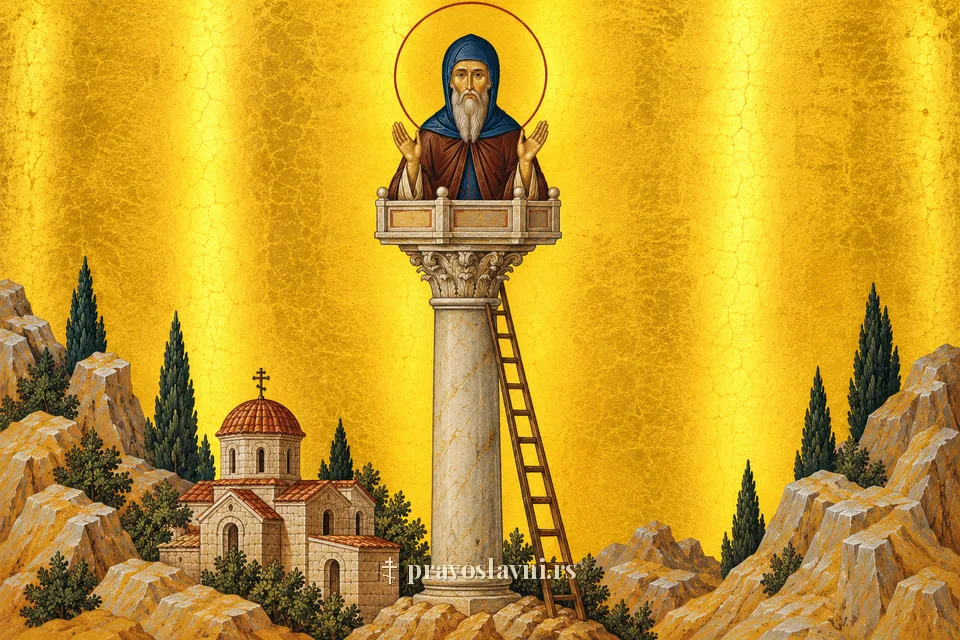
Venerable Simeon the Stylite
What happenedTo escape the crowds of people and to pray without ceasing, St Simeon went up onto a pillar and became the first stylite.
Read the LifeOrthodox Calendar · 1 September according to the Julian calendar
Monday, 14 September 20261 September (according to the Julian calendar)What happenedTo escape the crowds of people and to pray without ceasing, St Simeon went up onto a pillar and became the first stylite.
Read the Life
You may eat meat, eggs, milk and dairy products, as well as any other food — but try to be moderate.
More about the fast →
Church New Year (Beginning of the Indiction).
More about the feast →
“Continue earnestly in prayer, being vigilant in it with thanksgiving.”
— Col 4:2The Church New Year is the day on which the church year begins, and in the Prologue it is called the beginning of the Indiction. With it begins the cycle of fixed feasts, so in Liturgics September is called the first month of the Church's liturgical year, and the service of that day bears the name “Indiction”. According to the Prologue, it was the First Ecumenical Council that determined that the church year should begin in September, and so it has remained to this day. On the same day the Church also celebrates Venerable Simeon the Stylite.
An indiction is a period of fifteen years. The word comes from the Latin expression for a tax, because in the Roman Empire the tax was set every fifteen years. According to one interpretation, this is connected with Constantine's shortening of military service to fifteen years. Christians accepted this way of reckoning time when, in the days of Constantine the Great, the persecutions of the Church ceased: the years are counted from the first to the fifteenth indiction, and then the counting begins anew.
The Prologue reminds us that the Jews, too, began their civil year in September: the harvest was gathered then and thanks were offered to God for its fruits. In Christian lands as well, the secular year began in September for centuries, until its beginning was later moved to January.
St Simeon was the first stylite — an ascetic who, in order to escape the crowds and to pray without ceasing, stood on a pillar. The pillar was raised gradually, up to forty cubits.
A long road led him to this. He was born into a simple Christian family, according to the Prologue in Syria. His Life says that as a boy, on hearing the Beatitudes in church, he resolved to leave everything for the sake of God. In a vision he was digging a foundation, and a voice kept telling him to dig deeper, because without labour there is nothing. He ran away from his parents and at the age of eighteen became a monk.
His ascetic struggle was severe. At times he would spend forty days without food, and his Life says that he kept such a fast every year. According to his Life, because of his excessive severity the brethren sent him away from the monastery, fearing that others might begin to imitate him. Later the desert fathers wished to bring him down from the pillar, but when he obeyed at once, they saw that his struggle was from God and left him on the pillar.
Not even his mother Martha, when she came, did he receive, but after her death, as his Life says, he remembered her daily in prayer.
People from many lands came to him. He healed the sick and asked them to glorify God, and not him. He comforted, taught and brought back to Orthodoxy those who had gone astray; he turned the Empress Eudocia away from heresy, and the Emperor Marcian, according to his Life, came to him in secret for counsel. He overcame the temptations of the devil by prayer. His Life says that through his prayer a spring flowed in a waterless place and that the repentant robber Jonathan found refuge by the pillar and died in peace. He lived in the time of the Emperors Theodosius the Younger, Marcian and Leo the Great.
According to the Prologue, he lived for one hundred and three years. His relics were translated to Antioch — his Life says that the people of Antioch would not give them to Constantinople — and a church and a monastery were built around his pillar.
His life teaches that nothing is achieved without labour and that an ascetic struggle borne in humility and obedience is from God.
Venerable Simeon the Stylite was the first to begin living the ascetic life standing on a pillar. He decided upon this in order to withdraw from the multitude that kept coming to him and so that he might pray without ceasing. The pillar was not high all at once: the Prologue records that it grew from six, through twelve, twenty-two and thirty-six, up to forty cubits. The desert fathers, says his Life, sent men to order him to come down. As soon as he moved to obey, they allowed him to remain, for in his obedience they recognised that his ascetic labour was from God.
He was born into a simple Christian family; the Prologue says a peasant one, in Syria, while his Life calls his parents Susotion and Martha. According to his Life, as a boy he tended a flock, and at about thirteen years of age the reading of the Beatitudes in church led him to ask an elder for an explanation and to resolve to leave everything for the sake of God. To the elder he then said: “You are my father and mother, the teacher of good works and the guide of my salvation.” At prayer he had a vision: he was digging a foundation, and a voice urged him to go ever deeper and taught him that nothing comes without toil.
He ran away from his parents and at the age of eighteen received the monastic tonsure; according to his Life, before that he lay for seven days in front of the gate of the monastery of Abbot Timothy, asking to be a servant to all. His Life lists his ascetic labours in the monastery: he knew the whole Psalter by heart, fasted for seven days at a time, and bound his body so tightly with a rope of palm fibre that he wounded himself. According to his Life, the brethren became afraid that others would imitate him, and so they sent him away from the monastery; the abbot later, after a vision, found him in a dry well, but Simeon went away again in secret.
The Prologue and his Life record that he sometimes remained without food for as long as forty days. According to his Life, Bishop Bassus left him for forty days in a walled-up cell, and when he opened it, he found the bread and water which Simeon had not even touched; from then on he fasted in this way every year. For some time he kept his leg bound by a chain to a rock, until Meletius, Patriarch of Antioch, taught him that a man binds himself by will and reason; then he took the chain off.
He did not ascribe miracles to himself: he healed the sick and asked that God be glorified for it. He treated everyone alike, meekly and humbly; he comforted, taught and brought heretics back to Orthodoxy. His day, according to his Life, he divided between prayer, teaching, the petitions of the people, healing and the reconciling of those who had quarrelled. His Life says that after his prayer a spring flowed forth in a waterless place, and that the repentant robber Jonathan of Antioch, to whom he gave protection, died peacefully after seven days of prayer. The devil, who, according to his Life, appeared to him as an angel in a fiery chariot offering to take him up like Elijah, he drove away with the sign of the Cross.
He did not receive even his mother when she came, twice according to the Prologue, but answered her: “Do not trouble me now, my mother.” His Life adds that she died before the door and that after that he remembered her in prayer every day.
He lived under the Emperors Theodosius the Younger, Marcian and Leo the Great. He turned the Empress Eudocia away from the heresy of Eutyches; according to his Life, he rebuked Theodosius by letter for a wrong decision and the emperor begged him for forgiveness, while Marcian came to him in secret for counsel.
According to the Prologue, he lived for one hundred and three years and reposed in the year 459. His disciple Anthony, says his Life, found him on the pillar without life, his head bowed, amid a sweet fragrance, and cried out: “To whom are you leaving me, father?” The relics were translated to Antioch, and his Life records that the people of Antioch would not give them up to Constantinople, because the saint was to be a rampart for them. Around the pillar a church and a great monastery were later built, where the miracles continued.
From his life the Prologue draws the lesson that the soul is the only thing we carry with us and that it must be made firm by labour, and not superficially.
The Church does not begin her year in January, but in September, as the First Ecumenical Council laid down. Several events are linked with that beginning. The first is from the life of Christ: at that time of year the Lord read the Prophet Isaiah in the synagogue of Nazareth, where it speaks of the Spirit of the Lord being upon Him and of the acceptable year of the Lord (Lk 4:18–19; Is 61:1–2). The second is from Old Testament life: in September the Jews began their civil year, gathered in the harvest and brought gifts to God in thanksgiving (Ex 23:16). The third is from the history of the Church: in September Constantine the Great won his victory over Maxentius, and Christians were afterwards allowed to confess their faith freely throughout the Roman Empire. For a long time the Christian world also counted its civil year from September. The West was the first to change over to January, after it Russia in the time of Peter the Great, and the account adds other Orthodox lands as well. That is why the Church still opens the year today with thanksgiving to God for His gifts.
Separate page: Church New Year (Beginning of the Indiction) →