Saturday19September 20266 September (according to the Julian calendar)‹›
Illustration
Feast of the day
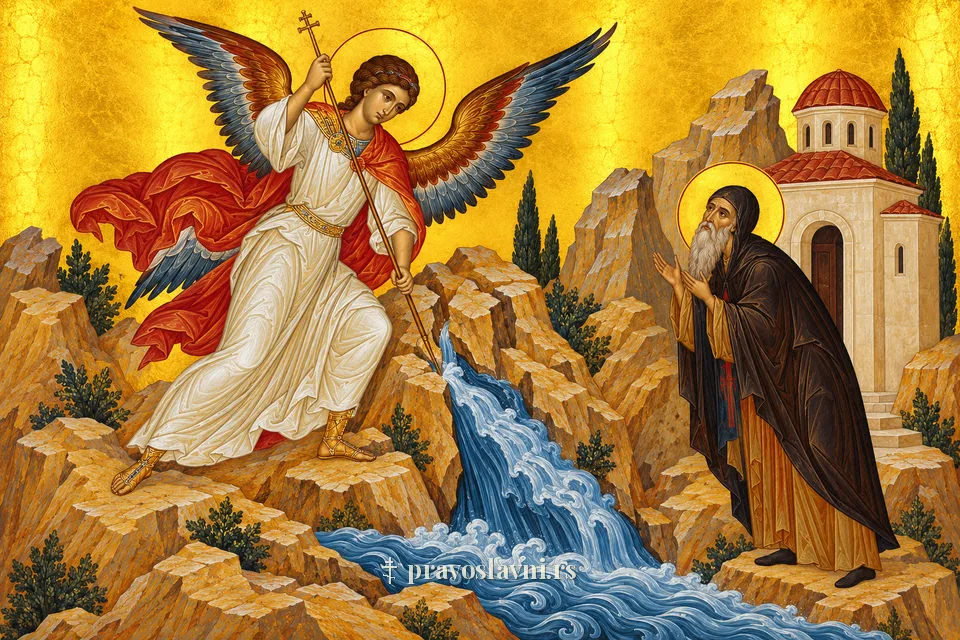
Miracle of the Holy Archangel Michael at Colossae (Chonae)
What happenedAt the prayer of the ascetic Archippus the Archangel Michael opened a cleft in the rock, and the water which the pagans had turned against his church disappeared into it.
“Then he said to me, ”Do not fear, Daniel, for from the first day that you set your heart to understand, and to humble yourself before your God, your words were heard; and I have come because of your words.”“
The miracle of the Archangel Michael at Chonae is remembered as a victory of prayer over malice. Beside the church built over a healing spring there lived the ascetic Archippus, who had come there while still a boy and spent his life in fasting and prayer. It troubled the pagans that so many people came to the spring and that healings took place there, and so they planned to turn the water against the church, so that both the holy place and the spring would vanish beneath it.
Archippus did not flee. He remained in the church and prayed, and at his prayer the Archangel Michael opened a cleft in the rock beside the church, and the water went down into it. According to the Life, the Archangel appeared as a radiant man, held back the water with his hand as with a wall, and struck the rock with the sign of the cross. Hence the name Chonae, which means a plunging.
The spring itself had its own story too. The Apostle John the Theologian, while he was preaching with Philip in Hierapolis, foretold that water which heals would flow there and that the Archangel would visit that place. Later a certain pagan from Laodicea, to whom it was revealed in a dream that he should bring his mute daughter to the spring, on the advice of Christians called upon the Archangel in the name of the Father and of the Son and of the Holy Spirit. The girl spoke, and the father was baptised with his whole household and built a church over the spring.
Archippus lived there until his seventieth year and reposed in peace. The Life also relates the miracles of the Archangel at Mount Gargano and in the Monastery of Dochiariou on the Holy Mountain.
The Prologue glorifies Michael as the commander of the army of God, whom Satan fears, who stands for truth and justice and shelters the faithful. And Archippus bears witness that steadfast prayer guards what is holy.
Full Life
The spring that was foretold
The miracle took place at Chonae in Phrygia, not far from Hierapolis. As early as apostolic times John the Theologian, who preached in Hierapolis together with Philip, foretold that healing water would one day flow forth there and that the Archangel Michael would visit it. The Life says that the water flowed forth soon after the apostles had departed and that it healed everyone who came with faith, at any time.
The father who did not believe
A certain pagan from Laodicea had a daughter who had been mute from birth. In a dream it was revealed to him that he should bring her to the spring. There the Christians, as the Prologue records, told him that “in the name of the Father and of the Son and of the Holy Spirit one must pray to the Archangel Michael”. The Life also preserves his prayer: “Holy Michael, servant of God, help and heal my daughter!” He gave the girl some water from the spring and she began to speak. The father was baptised with his whole household and built a church to the Archangel Michael over the spring.
Archippus, guardian of the holy place
Beside that church lived Archippus, who had come there while still a boy. The Life says that he was the son of Christian parents from Hierapolis and that he served as the sexton of the church. He lived in fasting and prayer: according to the Life, he ate only wild plants, once a week, without bread, wine or salt, and he slept on a stone. It troubled the pagans that healings were taking place at the spring and that the people were gathering there. The Life says that they ill-treated Archippus and tried to fill in the spring with earth, but they did not succeed.
The water that vanished into the rock
At last they resolved to turn the water onto the church, so that both the holy place and the healing spring would disappear beneath it. Archippus prayed and would not leave the church; according to the Life, he said that he would not abandon it even if he perished. Then the Archangel, at his prayer, opened a cleft in the rock beside the church, and the water went away into it. The Life describes this vividly: the Archangel appeared as a radiant man and said to Archippus: “Do not be afraid! Arise and come here to me and you will see the power of God upon these waters.” With his hand he stopped the water as though with a wall, struck the rock with the sign of the Cross and commanded the water to enter the chasm. Hence the name Chonae, which means plunging, because the water plunged down into the rock. Archippus lived there until his seventieth year and reposed in peace.
Miracles after Chonae as well
The Life says that a feast was established in memory of this miracle, and it gives two more miracles of the Archangel. At Sipontum, beside Mount Gargano, he appeared to the bishop, chose a cave as a place of worship, helped the city against the pagan Neapolitans, who later became Christians, and left behind a cave church with a healing spring. On the Holy Mountain (Mount Athos), in the Monastery of Docheiariou, he saved a young man whom two monks had thrown into the sea with a stone, in order to take from him the gold which he had found. The young man was found beside the altar, the church was dedicated to the Archangel, and he became a monk and later the abbot.
The Prologue sings of Michael as the commander of God's army, who stands before God and is victorious wherever he goes, whom Satan fears, who stands for truth and justice, drives out what is unclean and shelters the faithful. And the steadfast prayer of Archippus preserved the holy place.
Other saints of the day
Holy Martyr Eudoxius
Eudoxius was a commander in the Roman army and suffered for Christ in the time of Diocletian. His Life says that when the order against the Christians arrived, he went into hiding with his wife and children, but he was reported to the governor and soldiers were sent to fetch him. He met them on the road, received them hospitably and only then told them who he was. The soldiers wanted to let him go, but he answered that God was calling him to martyrdom. He told his wife not to grieve, but to rejoice on the day of his death, put on his military dress and went to the governor of his own accord. He refused to offer sacrifice to the gods, called them wood and stone and threw down his officer's belt. He brought to Christ 1,104 soldiers, who, according to his Life, were secret Christians and who then also cast away their insignia. He suffered together with them, and his friends Zeno and Macarius also suffered for Christ. According to his Life, on the way to execution he comforted Zeno with the words “Dear Zeno, do not weep!”, and Zeno confessed: “I am a Christian! I confess Christ and I wish to die for Him!” According to his Life, his wife Basilissa buried his body in secret. After his death Eudoxius appeared to her, and the Prologue records that she kept the faith to the end and reposed in peace.