Saint of the day
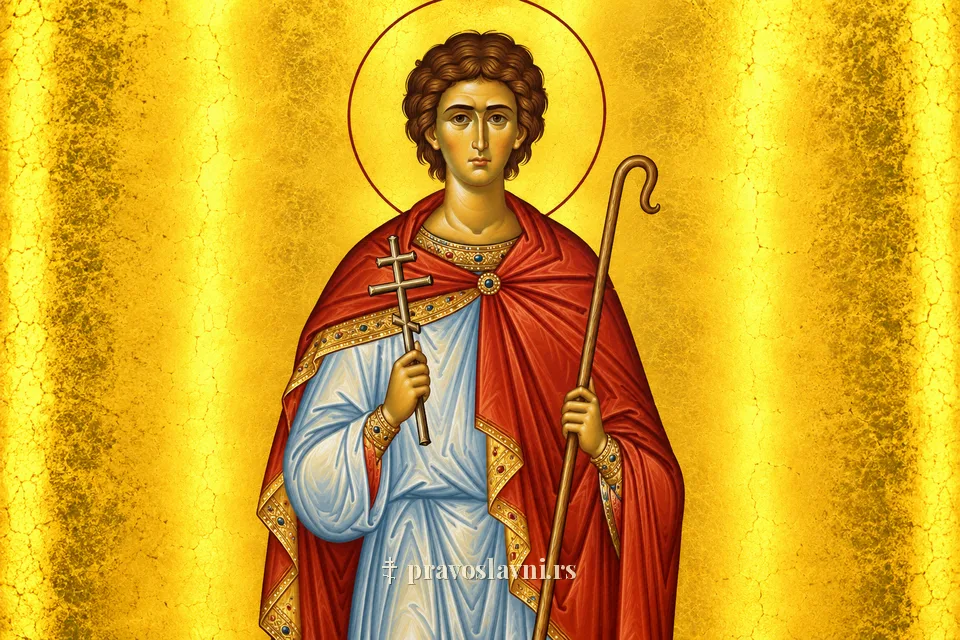
Holy Martyr Sozon
What happenedThe shepherd Sozon broke off the hand of a golden idol, gave the gold away to the poor and gave himself up to the governor, so that no innocent person would suffer in his place.
Read the LifeOrthodox Calendar · 7 September according to the Julian calendar
Sunday, 20 September 20267 September (according to the Julian calendar)What happenedThe shepherd Sozon broke off the hand of a golden idol, gave the gold away to the poor and gave himself up to the governor, so that no innocent person would suffer in his place.
Read the Life
You may eat meat, eggs, milk and dairy products, as well as any other food — but try to be moderate.
More about the fast →
Today the Church keeps the commemoration of a saint · Sunday — a festive day · 16th Sunday after Pentecost – Sunday before the Exaltation of the Cross. Tone 7. Forefeast of the Nativity of the Theotokos..
More about the feast →
“Therefore, since we are the offspring of God, we ought not to think that the Divine Nature is like gold or silver or stone, something shaped by art and man’s devising.”
— Acts 17:29When an uproar arose in Pompeiopolis over a damaged golden idol, the culprit did not hide. The shepherd Sozon came of his own accord before Maximian, the governor of Cilicia, and said that he was a Christian and that it was he who had damaged the idol, and that he had given the gold from its hand to the poor. He did this so that no one else should suffer on his account.
Sozon was a native of Lycaonia. He kept flocks, lived according to the law of God and taught his companions the faith; his Life says that he also baptised many of them. In a vision it was revealed to him that he would suffer for Christ, and according to his Life he then entrusted his sheep to others. In nearby Pompeiopolis the governor was at that time persecuting the Christians.
Before the governor, according to his Life, he explained that an idol does not feel, does not speak and cannot defend itself, and therefore is not a god. He was tortured and suffered for Christ; the Prologue records that this was around the year 304.
According to his Life, a heavenly light shone upon his relics in the middle of the night, and the faithful buried them with honour. The relics worked miracles, and a church was built in his name; according to his Life, healings also took place at a certain spring.
The Prologue in its hymn praises his fearlessness, his mind gathered in God and his blood shed for the truth. Sozon gave himself up so that an innocent man would not suffer in his place.
Sozon was a shepherd, a native of Lycaonia. He lived according to God's law and instructed his companions in the faith; his Life says that he taught people about the one God and that he baptised many. In a vision he learnt that he would suffer for Christ. According to his Life, this was revealed to him while he was sleeping beside a spring under a great oak, and he was told then that this place would bring salvation to many. His Life adds that he handed his flock over to other shepherds, and that on that spot, as a memorial, there remained his likeness and three of his arrows.
In nearby Pompeiopolis the governor of Cilicia, Maximian, was persecuting the Christians; according to his Life, he also held a festival at that time in honour of a golden idol. Sozon went into the temple and took the hand off the golden idol, and the gold from it he distributed to the poor. The city was in an uproar and a search for the culprit began.
Sozon did not want anyone else to suffer because of his deed. Therefore he went to the governor himself and confessed that he was a Christian and that it was he who had done it. His Life records his words: “I took the hand of your god, broke it into pieces and divided the gold among the needy.” He explained to the governor that the idol does not feel, does not speak and cannot defend itself, and so it is no god. “And how could it have resisted, when it is mute and dead?” — he asked, as his Life relates.
Sozon was tortured, and his Life says that they led him through the city while he glorified Christ. He suffered, as the Prologue records, about the year 304.
His Life records that in the middle of the night a heavenly light shone upon his relics, and the faithful then buried them with honour. The relics worked miracles and a church was built in his name. His Life says that healings also took place at the spring under the oak, at the place where it had once been revealed to him that he would suffer.
The Prologue in its hymn praises his fearlessness before the unbelieving governor, his mind gathered in God, his mockery of the lifeless idol and his blood shed for the truth. He chose to give himself up, so that an innocent man would not suffer in his place. The shepherd who had guarded flocks thus guarded to the end the people around him as well.


