Great feast
Krstovdan — Exaltation of the Cross
Exaltation of the Precious Cross
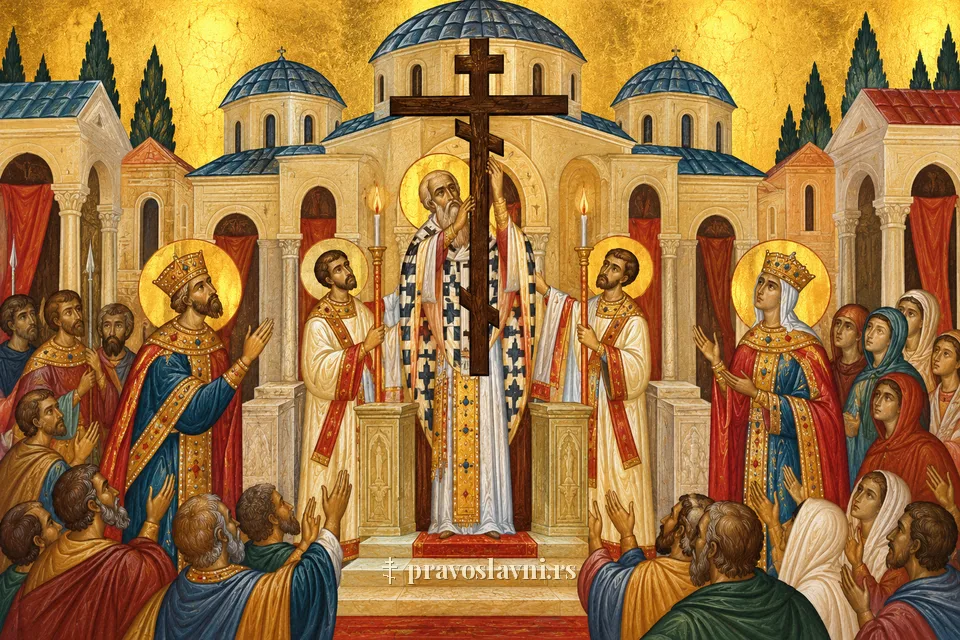
What happenedThe Empress Helen found the Cross of the Lord in Jerusalem, and Patriarch Macarius lifted it up on high so that all the people could see it.
Read the LifeOrthodox Calendar · 14 September according to the Julian calendar
Sunday, 27 September 202614 September (according to the Julian calendar)What happenedThe Empress Helen found the Cross of the Lord in Jerusalem, and Patriarch Macarius lifted it up on high so that all the people could see it.
Read the Life
No meat, dairy products, eggs or fish — oil and wine are allowed.
This is a recommendation — for your own fast, consult your priest or spiritual father.More about the fast →
Red Letter day — great feast; by custom, no work is done
More about the feast →
“And as Moses lifted up the serpent in the wilderness, even so must the Son of Man be lifted up.”
— Jn 3:14Krstovdan is the folk name of the Exaltation of the Precious and Life-giving Cross, a feast of the Lord and one of the twelve great feasts. Exaltation means lifting up: when Patriarch Macarius of Jerusalem lifted up the newly found Cross before the people, they all cried out: Lord, have mercy.
In church the priest carries out on his head the Cross adorned with basil or other flowers and places it in the middle of the church, and the faithful bow down before it and kiss it. The Exaltation is a fasting day, kept as a fast with oil and without fish, because on it the Church remembers Christ's suffering on the Cross. By folk custom, the autumn sowing begins around Krstovdan, and the other work in the fields is brought to a close.
At the gate of Jerusalem the Emperor Heraclius suddenly could not take a single step. On his back he was carrying the Cross of the Lord, brought back from Persia, and he was wearing his imperial robes. Patriarch Zacharias saw an angel closing to the emperor the road along which Christ had once passed without shoes and in humiliation. Only when he was left without his imperial dress and his shoes, in humble clothing, was Heraclius able to go on to Golgotha, where the Cross was placed in the church of the Resurrection. The Cross had been in Persia for fourteen years since King Chosroes carried it off, and according to the Prologue it returned to Jerusalem in the year 628. Before that Heraclius, according to the Life, had called the people to prayer and repentance and, with the Cross as his banner, had defeated Chosroes.
This is one of the two events which the feast of the Exaltation, Krstovdan (the Exaltation of the Cross), celebrates. The other is the finding of the Cross. The Empress Helen went to Jerusalem in order to find it. Only an old Jew named Judas knew the place, and he showed it only at the demand of the empress. The Cross lay beneath the temple of Venus, which the Emperor Hadrian had built on Golgotha. When the temple was torn down, three crosses were found. On the advice of Patriarch Macarius, the crosses were laid upon a dead man who was being carried to his burial, and the third brought him back to life. The Prologue adds that a sick woman was also healed by the Cross.
Helen venerated the Cross with a kiss, and the patriarch lifted it up high before the people, who wept and cried out: “Lord, have mercy!” The feast takes its name from that lifting up. The empress ordered a silver casket to be made for the Cross. The Life says that she built the church of the Resurrection over the Tomb and the place of the Cross and that she took a part of the wood and the nails to Constantinople. Judas, according to the Life, came to believe, was baptised and took the name Cyriacus.
The Life also recalls her son Constantine, who before the battle with Maxentius saw in the sky a cross of stars and the words: “By this conquer!” He conquered with the sign of the cross on the weapons of his army, came to believe in Christ and was baptised together with his mother.
The Cross conquers evil, and before the Crucified Christ even an emperor humbles himself.
The Exaltation of the Precious Cross, known among the people as Krstovdan, is the commemoration of two events, as the Prologue records: the finding of the Cross on Golgotha and its return from Persia to Jerusalem. The name of the feast comes from the moment when the Cross was lifted up before the people.
The Life begins the story with the Emperor Constantine. Before his campaign against Maxentius, the master of Rome, Constantine prayed to the one God, and at noon he saw in the sky a cross made of stars, brighter than the sun, with the words: “By this conquer!” The army saw it too, and among the soldiers, according to the Life, was the commander Artemius, later a martyr under Julian. That night Christ appeared to the Emperor in a dream and commanded him to make that sign and to carry it before the army. Constantine had a cross made of gold and precious stones, and the soldiers put the sign of the cross on their weapons, helmets and shields.
Maxentius was defeated; as he was fleeing, the bridge collapsed and he drowned. Constantine entered Rome in triumph and raised a cross on a high pillar, with the inscription: “By this saving sign this city was set free from the yoke of the tyrant.” The Life says that the cross of stars appeared two more times: in the war against the people of Byzantium, after two defeats, when the Emperor once again received the promise of victory by that sign and took Byzantium, and on the Danube, in the war with the Scythians. Constantine came to believe in Christ as the one true God and was baptised, and Helen with him.
The Empress Helen went to Jerusalem determined to find the Cross of the Lord. According to the Life, Patriarch Macarius welcomed her, and she set about removing the idols from the holy places. The spot where the Cross was hidden was known only to an old Jew named Judas, and he revealed it only under pressure from the Empress; the Life adds that before this he was kept for some time in a deep pit.
The Cross lay beneath the temple of Venus, which the Emperor Hadrian had built on Golgotha, and Helen ordered the temple to be pulled down. The Life says that, at the prayer of Macarius, the place was filled with a sweet fragrance, and from beneath the ruins Golgotha and the Tomb of the Lord appeared. Three crosses were found, and the Life says the nails as well. In order to know which one was Christ's, on the advice of Macarius the crosses were laid in turn on a dead man who was being carried to his burial, and when they touched him with the third, the dead man came to life. The Prologue adds that the Cross was also laid on a certain sick woman, who recovered.
The Empress kissed the Cross, and the Patriarch lifted it up high, so that everyone could see it. The people wept and cried out: “Lord, have mercy!” It is from that lifting up, or exaltation, that the feast received its name.
Judas, according to the Life, came to believe and was baptised together with many Jews, taking the name Cyriacus; later he became Patriarch of Jerusalem and suffered under Julian. Helen had a silver case made for the Cross, and according to the Life she also built the church of the Resurrection over the Tomb and the place of the Cross. She took a part of the wood and the nails to Constantinople; according to the Life, she threw one nail into the Adriatic Sea in order to calm a storm, and Constantine put one on his helmet and another on the bridle of his horse (Zech 14:20).
Later the Persian King Chosroes captured Jerusalem, led many people away into slavery and carried the Cross off to Persia; the Life says that this happened in the time of the Emperor Phocas. The Emperor Heraclius, according to the Life, after a defeat called the people to prayer and repentance, set out to war with the Cross as his banner and defeated Chosroes. Chosroes, according to the Life, was killed by his elder son Siroes, who asked for peace and returned the Cross. The Cross was in Persia for fourteen years, and according to the Prologue Heraclius solemnly brought it back to Jerusalem in the year 628.
The Emperor carried the Cross on his back, in his imperial clothing, according to the Life in the purple and wearing his crown. At the gate he suddenly could not take a single step. Patriarch Zacharias saw the reason: an angel had barred the Emperor's way along the road that Christ had once walked, barefoot and in humiliation, and not in splendour. When he had cast aside his imperial splendour, taken off his shoes and dressed himself in plain clothing, the Emperor continued on his way, and so the Cross reached Golgotha and found its place in the church of the Resurrection. The Life says that the faithful rejoiced like Israel when the ark of the covenant returned from the Philistines.
The Cross is the power of victory over evil and violence. Before it even an emperor lays aside his dignity, for the crucified Christ, the one true God, is approached in humility.


