Saint of the day
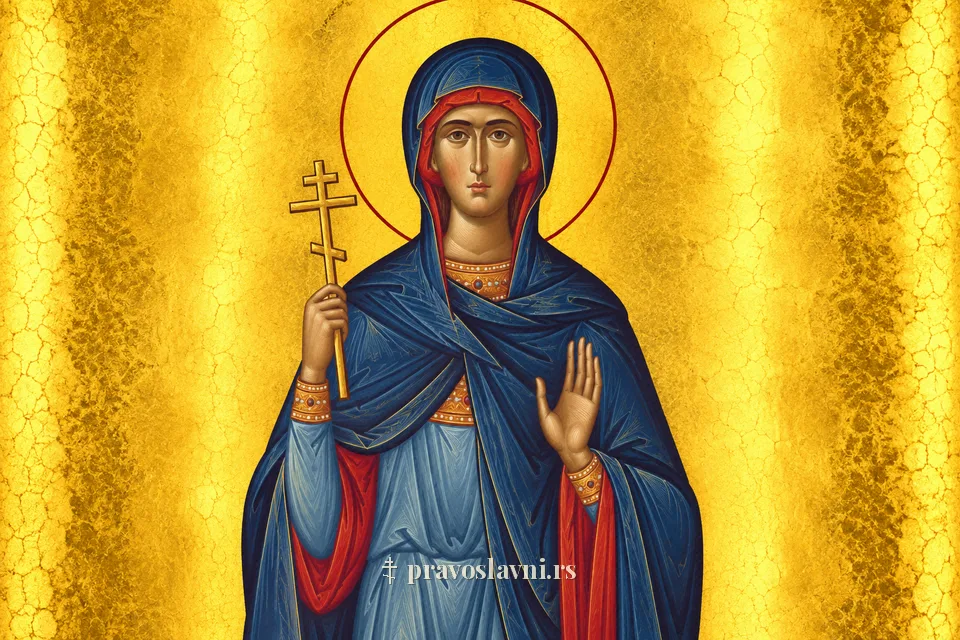
Great Martyr Euphemia the All-praised
What happenedSt Euphemia of Chalcedon refused to bow down to idols and, preserved by the power of God through many tortures, gave up her soul to God in the arena.
Read the LifeOrthodox Calendar · 16 September according to the Julian calendar
Tuesday, 29 September 202616 September (according to the Julian calendar)What happenedSt Euphemia of Chalcedon refused to bow down to idols and, preserved by the power of God through many tortures, gave up her soul to God in the arena.
Read the Life
You may eat meat, eggs, milk and dairy products, as well as any other food — but try to be moderate.
More about the fast →
Today the Church keeps the commemoration of a saint · not a Red Letter day.
More about the feast →
“When you pass through the waters, I will be with you; And through the rivers, they shall not overflow you. When you walk through the fire, you shall not be burned, Nor shall the flame scorch you.”
— Is 43:2The Christians of Chalcedon who did not appear at the festival with sacrifices to Ares told the proconsul Priscus that they would obey the authorities only so long as their orders did not rise up against God in heaven. There were forty-nine of them, and among them was Euphemia, the daughter of the senator Philophron and of Theodosia, devout Christians. They were found in a hiding place, where they were praying in secret, and for nineteen days they were tortured every day. Her Life says that they refused the gifts and honours of Priscus and said to him: “Do not hope, proconsul, that you will turn us aside from the right path!”
After nineteen days the proconsul set Euphemia apart and tried to win her over by flattery. Since he did not succeed, the tortures began. The wheel on which they placed her was broken by an angel of God. In the fiery furnace the power of God preserved her. The soldiers Victor and Sosthenes, who, according to her Life, saw angels in the fire, came to believe in Christ and suffered death from wild beasts. The soldiers Caesar and Varius, who threw her into the furnace, were, according to her Life, killed by the flame. From a pit of water full of venomous creatures she came out unharmed, after making the sign of the cross over the water. Over a hidden pit which Priscus had prepared for her she passed, according to her Life, in safety. Her Life says that through all this she kept calling: “My Light, Jesus Christ!”, and that she laughed at the new flatteries of Priscus.
In the end she was given to the wild beasts in the arena. According to her Life, the lions and bears licked her feet. She gave thanks to God in prayer and gave up her spirit, and her Life records that the city was then shaken by an earthquake from which walls and temples fell. Her parents, according to her Life, buried her near the city, thanking God that He had given them such a daughter. The Prologue says that she suffered in the year 304, in the time of the Emperor Diocletian.
The power of God is shown in human weakness, and obedience to God outweighs every unjust command.
Euphemia was from Chalcedon, the daughter of the senator Philophron and of Theodosia, both of them devout Christians. In the time of the Emperor Diocletian the proconsul Priscus ordered that everyone from the surrounding towns and villages should gather in Chalcedon for a festival with sacrifices to Ares, under threat of torture. Forty-nine Christians, Euphemia among them, hid themselves and prayed in secret. They were found and brought before Priscus. To the proconsul, who demanded that they explain their disobedience, they said that they would obey the ruler as long as his orders did not rise up against God in heaven; here her Life cites Christ's words about rendering to Caesar the things that are Caesar's, and to God the things that are God's (Mt 22:21).
Her Life says that they refused the gifts and honours that Priscus offered them, and it records their words: “Do not hope, proconsul, that you will turn us aside from the right path!” For nineteen days they were tortured every day, and according to her Life they also endured hunger and thirst.
When the nineteen days had passed, the proconsul separated Euphemia from the group and tried by flattery, and according to her Life also by gifts and promises, to draw her to the idols. When she refused, he ordered her to be tortured. They put her on the wheel; she prayed, and an angel of God broke the wheel, and according to her Life he also set her free and healed her wounds. The onlookers said that it was sorcery.
Then she was thrown into a fiery furnace, but the power of God preserved her. Her Life says that an angel refreshed her with dew and that she prayed like the three youths in the furnace. The soldiers Victor and Sosthenes, who, according to her Life, saw angels in the fire and refused to throw her in, came to believe in Christ. They were thrown to the wild beasts and died; her Life records that before their death they prayed, that a voice from heaven called them to their rest, and that the faithful buried them in secret. The soldiers Caesar and Barius, who did throw her into the furnace, were killed by the flames, according to her Life.
She was also thrown into a pit of water full of venomous creatures. She made the sign of the cross over the water and remained unharmed; her Life says that the creatures themselves carried her out. Her Life also remembers a hidden pit that Priscus had ordered to be prepared: Euphemia passed over it safely, while some pagans who did not know about it fell into it. Through all the further tortures she remained unharmed, and she mocked Priscus's fresh flatteries. In her prayer, according to her Life, she called out: “My Light, Jesus Christ!”
In the end she was given to the wild beasts in the arena. The beasts, according to her Life, licked her feet; only a she-bear gave her a slight wound. Euphemia thanked God in prayer and gave up her spirit; according to her Life, a voice from heaven called her. Her Life records that at the hour of her death the city was shaken by an earthquake, that walls and temples were falling down and that everyone was terrified.
Her parents buried her body, according to her Life near the city, thanking God that He had given them such a daughter. According to the Prologue, she suffered in the year 304.
Faith is kept even in the greatest suffering, for the strength of God, as the Apostle Paul teaches, is made perfect in weakness (2 Cor 12:9). Obedience to God stands above the commands of unjust rulers.
When his disciple Palladius, later Bishop of Helenopolis, asked him why in his old age he tormented his body so much, the Venerable Dorotheus answered him: “It torments me, and I shall torment it.” Palladius wrote about this Egyptian desert-dweller in the Lausiac History, and the Life says that for a time he was his disciple. The Prologue places Dorotheus in the fourth century, while the Life states that he was from the Thebaid and lived the ascetic life in the Cells (Kellia), a desert settlement in the neighbourhood of Alexandria. In the same cell, which the Life calls a cave, he spent sixty years. By day he built cells for others — according to the Prologue for new monks, and according to the Life for those who could not do it themselves — and for this, as the Life says, he gathered stones even in the greatest heat. He spent his nights weaving baskets, according to the Life from palm branches, and by this he made his living. According to the Life, he ate dry bread and a few greens, drank water sparingly, and slept only briefly, at his work or while eating, never stretched out on a bed. When they begged him to lie down, he would answer: “If you persuade the angels to fall asleep some time, then you will persuade the zealous ascetic too.” The Prologue remembers that he never ceased saying prayers and psalms and that he was known for his love of labour and for his miracles. Once Palladius was frightened by an asp which he saw in the well, but Dorotheus, smiling, drew some water, made the sign of the cross over it and was the first to drink. The Life also records his teaching that the sign of the cross takes away the power of satanic malice.
Separate page: Venerable Dorotheus →
The wonderworking relics of St Cyprian, Metropolitan of Kiev, are in the Dormition Cathedral in Moscow. He reposed in 1406, according to his Life at a very great age, and over his grave a letter was read in which he took leave of his flock. He came from Tarnovo, and his Life says that he was a Bulgarian; the Prologue and his Life call him a pupil of the Serbs, because he grew to maturity on the Holy Mountain (Mount Athos) among Serbs. Philotheus, Patriarch of Constantinople, came to know him on Athos and kept him at his side, and later entrusted to him the metropolitanate of Kiev. Devoted to books, he translated and copied them — service books, according to his Life — and the Life adds that he also wrote works of his own and was a very learned man. According to his Life, he was a zealous man of prayer and a preacher. He guided his flock wisely and built a church dedicated to Basil the Great, Gregory the Theologian and John Chrysostom. His service as metropolitan brought him many sorrows and difficulties, which he bore patiently — with a good heart, as the Prologue says. He served the Russian Church for nearly thirty years and did her much good.


