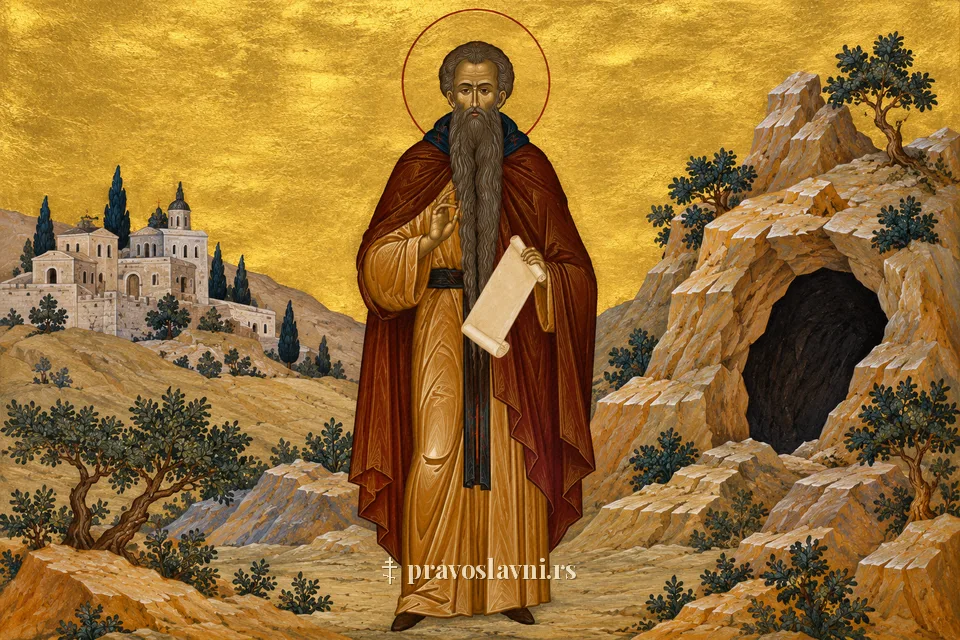
Cyriacus was born in the fifth century in Corinth, the son of the priest John and of Eudocia. While still a boy he became a reader in the cathedral church. According to his Life, Holy Scripture was the book he loved best, and the righteous people he read about became his models.
One Sunday in church he heard the call of Christ: “If anyone desires to come after Me, let him deny himself, and take up his cross.” From that hour he no longer wavered. His Life says that he left at once, without saying goodbye, by ship for Palestine. He was eighteen years old.
He received the schema from St Euthymius the Great, who then recommended him to St Gerasimus. Gerasimus set the young monk to serve in the kitchen. Cyriacus worked without rest, prayed and fasted, so that a day with a meagre meal was followed by a day without food. He spent nine years with Gerasimus, and then, among the monks of Euthymius, he kept silence in his cell for a whole decade. Later, in Chariton's Lavra of Souka, he began again as a novice, and in time he became a priest and canonarch. The Prologue especially praises his restraint in food and his meekness.
At the age of seventy he withdrew to the desert of Natoufa, where, according to his Life, bitter herbs became fit to eat at his prayer. Many sick people recovered when he made the sign of the cross over them and prayed for them, but he fled from fame ever further away. When the Church was troubled by a false teaching that had sprung from the writings of Origen, he came to the cave of Chariton, and the Prologue remembers him as a zealot for Orthodoxy who stood against that teaching.
On the threshold of his hundredth year he moved to the most remote desert of all, Sousakim. There he was visited by his disciple Cyril, who bears witness that the elder had an unusual neighbour — a lion. Towards the end of his life the elder returned to the brethren in the cave of Chariton and, having left them his last blessing, departed peacefully to the Lord. He reposed, according to the Prologue, in the year 557, in the one hundred and ninth year of his life.
Cyriacus shows us that the Gospel is not only for the ears: whoever hears in Christ's words a call to himself must get up, set out and walk that road to the end.
Full Life
A word addressed to him
Cyriacus was born in the fifth century in Corinth, in the house of the priest John and his wife Eudocia. They were related to Peter, the Bishop of Corinth, and while still young the boy became a reader in the cathedral church. He could count on peaceful days in his native city.
But something else was drawing him. According to his Life, the Holy Scriptures were his favourite reading. From them he learned how God cares for people down the centuries and how He does not forget those who are faithful to Him. What touched him most deeply was the mystery of the Nativity of Christ. Slowly there grew in him the desire to live, he too, like the righteous ones about whom he read.
One Sunday, during the service, the words of Christ reached him: “If anyone desires to come after Me, let him deny himself, and take up his cross.” From that moment there was no more wavering for him. His Life says that he did not even wait for the next day. He did not tell even his parents where he was going. In the harbour he found a ship bound for Palestine and sailed away. He was eighteen years old.
A disciple of great elders
He spent his first winter in Jerusalem with the elder Eustorgius, in his monastery, and then set out into the desert to St Euthymius the Great. Euthymius, according to the Prologue, saw at once how much spiritual strength there was in this young man. From him Cyriacus received the schema, and with it a direction for the way ahead: to go to St Gerasimus.
To Gerasimus the newcomer seemed not yet ready for solitude, and so he kept him in the monastery, under obedience in the kitchen. That meant hard work from morning till evening, and the night Cyriacus gave to prayer. For him a day with a meagre meal alternated with a day without any food at all. The elder came to love such a disciple, and during Great Lent he would take him along with him far into the desert.
Nine years later Gerasimus reposed, and Cyriacus went back to the monks of Euthymius. There he kept silence for a whole decade, shut up in his cell.
A beginner for the second time
When two neighbouring monasteries fell out with each other, Cyriacus withdrew from the quarrel. He moved to the Lavra of Souka, Chariton's monastery, where, although an experienced monk, he started again from the novitiate. He worked as a baker and as an infirmarian, later he was ordained a priest, and for years he was the canonarch, the one who leads the church singing. The Prologue especially praises his restraint in food and his meekness.
A seventy-year-old in the desert
At an age when others look for rest, Cyriacus looked for a still harder ascetic labour. At the age of seventy he withdrew with one disciple into the desert of Natoufa. According to his Life, bitter herbs grew there which could not be eaten, but at the elder's prayer God made them edible. When the disciple once prepared those herbs on his own initiative, they were bitter again. The elder taught him: a miracle is a gift of God for real need, and not something to be used up lightly.
Many sick people recovered when he made the sign of the cross over them and prayed for them, but he did not want glory and kept withdrawing deeper and deeper into the desert. Yet when the faith had to be defended, he did not step aside. A false teaching that had sprung from the writings of Origen was spreading. The monks of the Lavra of Souka called on him for help, and he came to Chariton's cave. The Prologue remembers him as a zealot for Orthodoxy who stood up against that teaching. His Life adds that he said in advance that two leaders of that teaching would soon die, and so it came to pass.
An elder of one hundred and nine years
On the threshold of his hundredth year he moved to the most remote desert, Sousakim. There he was visited by his disciple Cyril, who later wrote his Life. According to Cyril's testimony, the elder had an unusual neighbour in the desert — a lion. When one summer the water that the elder collected dried up, God sent rain at his prayer.
When he entered his one hundred and seventh year, the brethren begged him to come among them, to Chariton's cave, because they did not want him to die far away. He agreed. He took leave of the brethren and, having left them his last blessing, peacefully departed to the Lord. The Prologue records that he reposed in the year 557, in the one hundred and ninth year of his life.
Cyriacus shows us that the Gospel is not only for the ears. Whoever hears in Christ's words a call addressed to himself should get up and go — and follow that road to the end.