Saint of the day
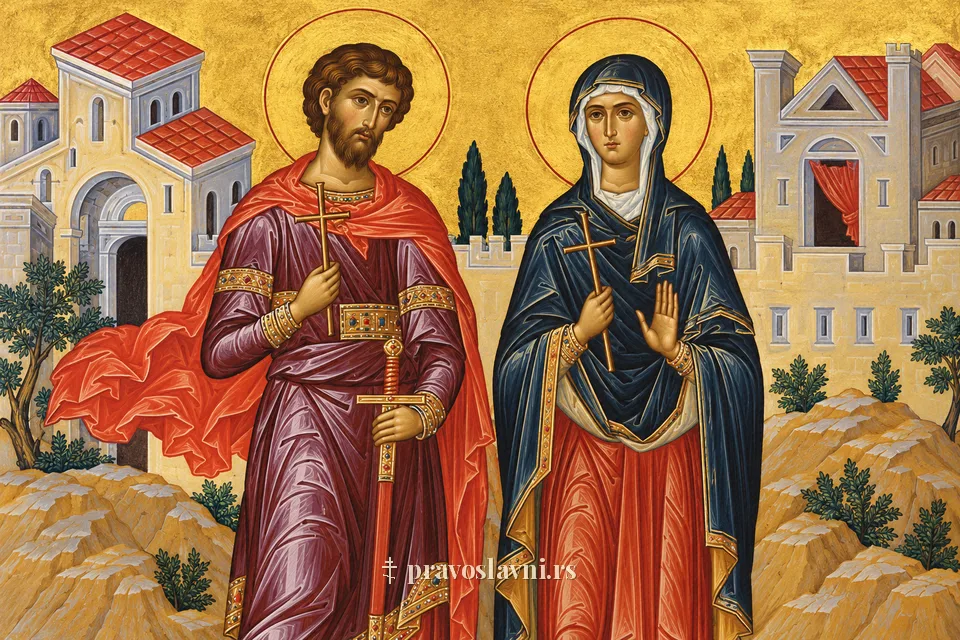
Holy Martyrs Eulampius and Eulampia
What happenedA brother and sister from Nicomedia: he tore up the imperial edict against the Christians, and she ran to him of her own accord to suffer with him.
Read the LifeOrthodox Calendar · 10 October according to the Julian calendar
Friday, 23 October 202610 October (according to the Julian calendar)What happenedA brother and sister from Nicomedia: he tore up the imperial edict against the Christians, and she ran to him of her own accord to suffer with him.
Read the Life
No meat, dairy products, eggs, fish or oil — food cooked in water.
This is a recommendation — for your own fast, consult your priest or spiritual father.More about the fast →
Today the Church keeps the commemoration of a saint · not a Red Letter day.
More about the feast →
“Behold, how good and how pleasant it is For brethren to dwell together in unity!”
— Ps 133:1In Nicomedia, in the time of the Emperor Maximian, the Prologue says that one of the most terrible persecutions of Christians arose. Many of the faithful hid outside the city. Among them was the young Eulampius. His Life says that he was of high birth and handsome, a Christian in faith and in deeds. One day they sent him into the city to buy bread and bring it secretly to those who were in hiding.
At the entrance to the city he caught sight of the imperial decree on the persecution and killing of Christians. His Life says that he laughed at the madness of an emperor who does not rise up against the enemies of the fatherland, but against innocent people in his own land. And then, says the Prologue, he took the decree down and tore it up. He was seized at once and brought before the judge.
The judge first tried with fair words. His Life records how he told him that, if he bowed down to the gods, he would receive imperial gifts, a high position and happy days. Eulampius replied that such promises were empty. The Prologue says that he then began to advise the judge to renounce the false idols and acknowledge Christ as the only living God.
Then the tortures began. His Life records that he bore everything calmly and that God, in the hardest hour, raised him up healthy. Then, says his Life, he pretended that he was ready to offer sacrifice. They led him to the idols' temple. There he stood before the idol of Mars and in the name of Jesus Christ commanded it to fall. The idol crashed down and was shattered. The people cried out: “The one God of the Christians is great and mighty!” Many believed.
Eulampius had a sister, the virgin Eulampia. The Prologue says that, when she heard that her brother was suffering, she came running to accept torments for Christ together with him. Her Life records that she said to the judge: “Let all the torturers know that I am a Christian, and that I am ready to die for Christ!” Her brother encouraged her with the words of Christ, that they should not fear those who kill the body but cannot kill the soul.
The Prologue says that they were then thrown into boiling pitch. Their Life records that the young sister stopped, frightened, and her brother called to her: “Do not be afraid, sister! Be bold and come here!” She went in, and, as the Life says, the power of the fire vanished. Seeing this miracle, two hundred people believed. They declared that they were Christians and were beheaded.
The martyrs were then thrown into a red-hot furnace. The Prologue says that by the power of the sign of the cross and of the name of Christ they made the fire harmless. At last the judge condemned them to death by the sword. The Prologue says that Eulampius was beheaded, and that Eulampia breathed her last before the beheading.
Brother and sister, born of the same mother, departed together. Sts Eulampius and Eulampia teach us that the courage of one can strengthen another, and that the faith which brothers and sisters share can be stronger than fear.
The Prologue remembers Nicomedia in the time of Emperor Maximian for one of the hardest persecutions that Christians ever endured. In those days faith could cost a person his head. Whoever could, left the city. The Life says that the faithful scattered to hiding places, far away from people. Among them was Eulampius, a young man from a respected house, as the Life writes.
The people in hiding had to eat something, and someone had to take the risk and go down into the city. That task fell to Eulampius. As soon as he arrived, he was met by the imperial edict: Christians were to be arrested and put to death. The Prologue says that it was posted on a wall, and the Life that it hung above the city gate. Instead of fear, according to the Life, a smile appeared on his face. It was not defiance, but the peace of a man who knows to whom he belongs. The Prologue adds what he did next — he tore the edict down and ripped it to pieces. Not much time passed before he was already standing before the judge.
The judge, according to the Life, first tried kindness and tempted him with a reward, if only he would renounce his faith. This did not shake Eulampius. What is more, according to the Prologue, the roles were reversed: now it was he who was teaching, and the judge was listening to a call to turn to Christ, for He alone is the living God. The accused spoke, and the man of power had to listen.
Then the tortures began. The Prologue says that they lasted a long time and that they were severe. The Life speaks of something else about those same days: Eulampius bore them calmly, and God raised him to his feet again and again.
Then, according to the Life, he thought of something unexpected. He let the torturers believe that he had given in and that he would offer sacrifice. The pagans joyfully led him to the temple. But before the statue of Mars, instead of sacrificing, he spoke the name of Jesus Christ and commanded the idol to fall — and the statue came crashing down. Many of those who saw it, the Life records, confessed that the true God is the One to whom the Christians pray. The one they had wanted to show as defeated became a witness before the whole city.
Eulampius had a sister, still a young maiden, whose name was Eulampia. No one was looking for her, and she could have stayed out of it. The news of her brother's tortures did not frighten her. According to the Prologue, she came of her own free will, because she wished to be where he was. The Life writes that she even reproached him for having wanted to go that way alone. Love for her brother and love for Christ were one and the same in her. Before the judge she called herself a Christian without hesitation.
She too was handed over to the torturers. Her brother encouraged her with the Lord's words that one should not fear those who can kill only the body (Mt 10:28).
The Prologue records that both of them were thrown into boiling pitch. At this point the Life does not hide that even the saints are not without fear: Eulampia stopped. Her brother called to her and assured her that God would help her, and she went down after him. The pitch did them no harm. According to the Life, two hundred people who were watching this came to believe in Christ and suffered for Him that same day. The courage of two young people passed over to those who until yesterday had been only spectators.
After the pitch the Prologue also mentions a furnace, but not even the fire overcame those whom God was guarding.
At last the sentence came: death by the sword. The sword took the brother's life. The executioner did not even approach the sister: the Prologue says that she was already dead.
Eulampia was afraid, and yet she did not turn back, because beside her was someone who was calling her forward. In the same way we too can be courage for one another. The faith that we share is stronger than the fear that divides us.
Before becoming a monk he was called Aleksandr Mikhailovich Grenkov, and he was born in 1812 in the Tambov province, in the village of Bolshaya Lipovitsa, in a household of church servers. He attended the theological seminary, and as a seminarian he fell gravely ill and made a vow to God: if he recovered, he would withdraw to a monastery. The illness passed, but he fulfilled the vow only after four years. Elder Hilarion, whom he visited in 1839, said to him: “Go to Optina. You are needed there.” That very autumn Aleksandr arrived at the Optina Hermitage, and in 1842 he received the monastic tonsure and the name Ambrose. He was ordained hierodeacon, then hieromonk, and afterwards he stood beside the great Elder Macarius as his assistant in the spiritual guidance of the brethren. When Macarius reposed, Ambrose took over his eldership. From every part of Russia people of every class and every age flocked to him, for counsel, for comfort, for prayer. In 1884 he founded the Shamordino convent, a women's community for the poor, and in 1890 he moved there and remained there until the end of his life. He reposed on 10 October 1891, according to the old (Julian) calendar. God is also served when a person gives himself entirely to those who knock at his door in their need.


