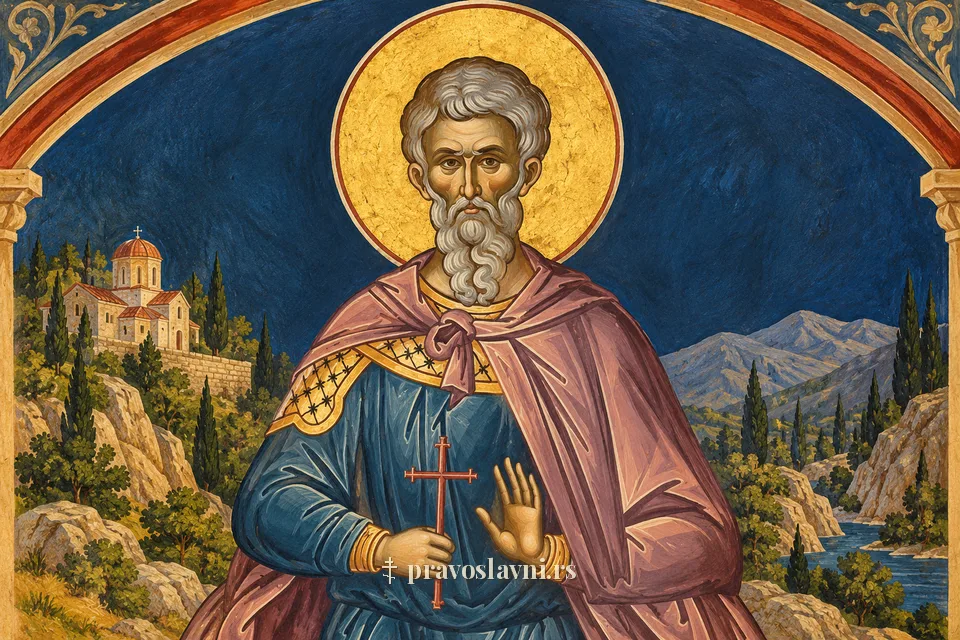
Saint of the day
Great Martyr Arethas
What happenedThe aged Arethas, governor of Christian Najran, was the first to go under the sword, and after him three hundred and forty of his companions.
Read the LifeOrthodox Calendar · 24 October according to the Julian calendar
Friday, 6 November 202624 October (according to the Julian calendar)What happenedThe aged Arethas, governor of Christian Najran, was the first to go under the sword, and after him three hundred and forty of his companions.
Read the Life
No meat, dairy products, eggs, fish or oil — food cooked in water.
This is a recommendation — for your own fast, consult your priest or spiritual father.More about the fast →
Today the Church keeps the commemoration of a saint · not a Red Letter day.
More about the feast →
“Who shall separate us from the love of Christ? Shall tribulation, or distress, or persecution, or famine, or nakedness, or peril, or sword?”
— Rom 8:35At the beginning of the sixth century, in the land of the Homerites, in Southern Arabia, Dunaan came to rule, a Jew by birth and by faith, who persecuted Christians. The Life says that Najran was the only city in which the name of Christ was still honoured. The faith had arrived there with the missionaries sent by Constantius, the son of Constantine the Great. Dunaan besieged the city, but could not take it. Then he offered peace under oath, asking, as he said, only for tribute. The citizens believed him, on condition that he would not force them to renounce Christ, but he, as soon as he had entered, arrested the elders and plundered the city.
Among those arrested was Arethas, according to the Prologue the governor of the city, ninety-five years old. His Life records that before Dunaan he fearlessly defended faith in the divinity of Christ and promised that the Christians would not shrink back before any tortures. When the king led him out with three hundred and forty companions, Arethas encouraged them to remain steadfast and foretold Dunaan's ruin. At the stream Odias he was the first to be beheaded, and after him all the rest. His Life gives his words before death: “Thank You, Lord, for all of this!”
The Prologue says that more than four thousand Christians suffered at that time — priests, monks, nuns, women and children — and gives the year 523. The Life tells of a five-year-old boy who went to his death after his mother, saying: “I love my mother, that is why I have come.”
God's justice was not late. At the call of the Byzantine Emperor Justin, the Ethiopian king Elesbaan raised an army, vowed that he would become a monk if he won, and defeated Dunaan. The Christians of Najran received their freedom once more, and the son of Arethas, according to the Life, became governor of the city. Elesbaan fulfilled his vow: his crown ended up in Jerusalem, and he himself in the monastic life, in which he spent fifteen years.
Arethas and his fellow citizens teach us that faithfulness to Christ is worth more than life, that the oath of a liar is worth nothing, and that God swiftly brings justice upon persecutors.
By the stream of Odias the Christians condemned to death were praying, and the first among them was Arethas, the aged governor of the city of Najran. His Life records his words before the execution: “Thanks be to Thee, O Lord, for all of this!”
It was at the beginning of the sixth century, in the time of the Byzantine Emperor Justin and the devout Ethiopian King Elesbaan. The throne of the Homerites in South Arabia had been seized by Dunaan, a Jew by birth and by faith. He gathered around himself only Jews and pagans, while he persecuted the Christians and drove them towards the Jewish law.
His Life says that Najran was the only city in which the name of Christ was still honoured. The faith had come there with the missionaries whom Constantius, the son of Constantine the Great, sent to the Sabaeans, and the city had churches, monks and monasteries. Dunaan, it is true, had already been defeated once and had had to acknowledge Elesbaan's rule, but he cast off that obligation: he slaughtered the Ethiopian garrisons, and to the Christians he left a choice between renunciation and death.
Beneath the walls of Najran, which he surrounded with trenches, Dunaan demanded that the crosses should fall and that the citizens should renounce the Crucified One. The city held out, because, as the Life records, it had food for a number of years. When he did not succeed by force, he offered an oath: let the gates be opened, and he would be content with tribute and would harm no one. The people of Najran agreed only with a guarantee that they would not have to renounce Christ. Once inside, he broke his word: he took possession of the city, threw the elders, Arethas among them, into chains, and plundered the houses.
The Prologue calls Arethas the governor of the city, and his Life calls him prince and commander. The Prologue says that he was ninety-five years old; in the Life Arethas himself says the same, although the same Life mentions ninety-three in another place.
The Life says that Dunaan then had the body of Bishop Paul burned, who had already been dead for two years, and many priests, monks, nuns and consecrated virgins also suffered in the fire. Among the women martyrs was the wealthy widow Syncletica, who refused the honours offered for renouncing Christ and suffered together with her two daughters.
Dunaan asked Arethas whether God can suffer without a body, appealing to Nestorius. Arethas, according to his Life, answered that the Godhead does not suffer, but that Christ's humanity suffered, that Christ is God and the Son of God, that Nestorius was condemned by the fathers, and that the Christians would endure any torture.
On the next day Dunaan brought him out with three hundred and forty companions, accusing him of rebellion and of teaching people to honour the Crucified One. According to his Life, Arethas answered him openly: he regretted that the city had trusted an oath instead of defending itself, even if with little strength, and to the torturer he foretold ruin, to the Church renewal under a faithful ruler. Before his death he encouraged his companions and arranged what part of his estate would go to the Church, and what to his son, if he survived.
At the stream of Odias Arethas, as the elder, was the first to be beheaded, and after him all three hundred and forty. His Life also tells of a mother condemned to the fire and of her five-year-old son. The boy said to the king: “Martyrdom is this: to die for Christ, and to live with Him again.” Then he ran after his mother, saying: “I love my mother, that is why I came.” According to the Prologue, in the year 523 more than four thousand people suffered with Arethas, from the clergy and monastics to women and children.
The news grieved the Emperor Justin, who sent Elesbaan a letter calling him to avenge them. Elesbaan raised a great army and fitted out ships. Both sources also remember his vow: victory over Dunaan would mean for him the end of his reign and the beginning of the monastic life. The Life adds that before the campaign he took off his crown and royal garments, prayed in a church beside the sea and, disguised as a soldier, visited the hermit Zeno, who had the gift of prophecy.
Elesbaan defeated Dunaan, destroyed his army and put him to death. The Life says that Elesbaan restored the burned church, adorned the tombs of the martyrs and appointed Arethas's surviving son as governor of Najran. According to the Prologue, the restoration was led by the people of Najran themselves: the church of the Holy Trinity was raised again, and for the martyrs, with Arethas at their head, a new church was built.
Elesbaan did not forget his vow: he renounced the crown, which ended up in Jerusalem, and secretly left the court in order to live the next fifteen years in the monastic struggle. The Prologue states that he reposed in peace in the year 555.
Arethas and his fellow citizens — old men, nuns, mothers and little children — remained faithful to Christ at the price of their lives. Their story teaches that the oath of a liar is worth nothing and that God swiftly brings justice upon persecutors, while the humility of the king who exchanged his crown for a monastic cell is worthy of being remembered alongside the martyrs.


