Saturday07November 202625 October (according to the Julian calendar)‹›
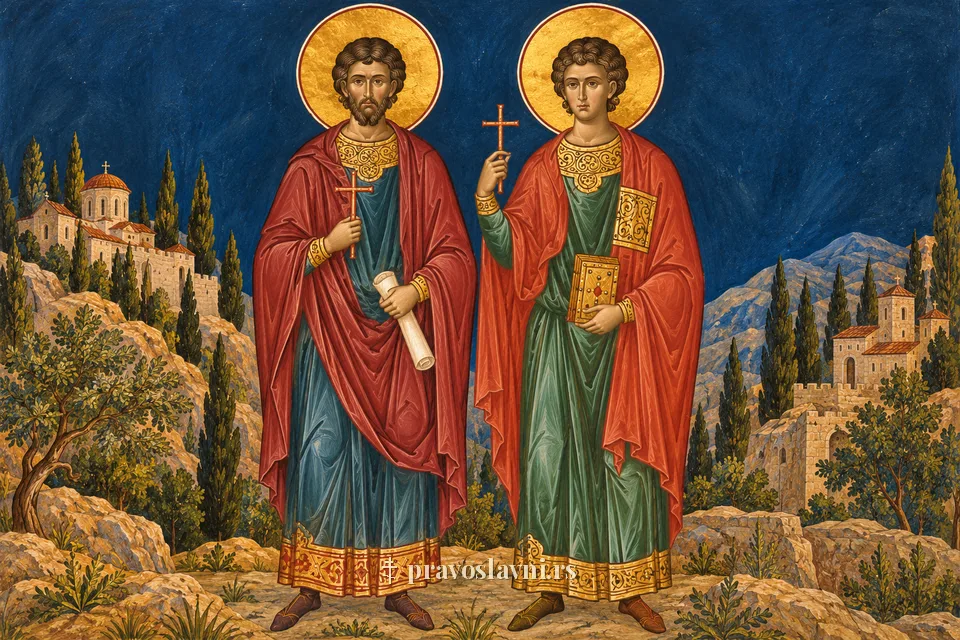
Illustration
Saints of the day
Mitrovske zadušnice — St Demetrius Memorial Saturday
Holy Martyrs Marcian and Martyrius
What happenedMarcian and Martyrius refused the gold, the honours and the archbishops' thrones offered to them by the Arians, and so they were beheaded for their faith in the divinity of Christ.
“I am the resurrection and the life. He who believes in Me, though he may die, he shall live.”
— Jn 11:25
About this day
Mitrovske zadušnice — St Demetrius Memorial Saturday
Mitrovske zadušnice (St Demetrius Memorial Saturday), also called the autumn zadušnice, are served on the Saturday before Mitrovdan, the feast of the holy Great Martyr Demetrius. It is from that feast that they take their name. Zadušnice are days which the Church devotes to prayer and the remembrance of those who have fallen asleep. There are several such days in the year, and all of them fall on a Saturday. Those of Mitrovdan come as the last of them, and after them the yearly cycle turns towards the winter feasts.
Their origin is connected with the Russian prince Dmitry Donskoy. The Church took these zadušnice over from Russian Christians. On that day the faithful come to the Divine Liturgy, after which a parastos (memorial service) is served for all Orthodox Christians who have fallen asleep.
By folk custom, candles, boiled wheat (žito) and red wine are prepared for the parastos, together with a voluntary offering to the church. Along with these a list of departed relatives and friends is also handed in, whose names the priest reads during the service. The boiled wheat, koljivo, is an image of the hope of resurrection: death is not the end, but a passage to new life. At the cemetery the family may ask the priest to read a commemoration and cense the grave. Many then visit the graves of their own, tidy them, adorn them with flowers, light candles and sprinkle them with wine. Whoever cannot go to the grave may pray for his own in the nearest church where a parastos is served. On that day almsgiving is especially stressed, so it is the custom to give to every poor person and to share part of the food that has been brought with others.
The day of the autumn zadušnice is marked in the calendar as a day of no fasting.
Sts Marcian and Martyrius served in the great cathedral church in Constantinople: the first as a reader, the second as a subdeacon. Patriarch Paul took them as his secretaries, to write down what he said and did. By their teaching and by their pen they defended Orthodoxy with great zeal. Their Life says that in debate their opponents had nothing with which to answer them.
They lived after the death of Constantine the Great, when his son Constantius was reigning. Arianism, with the Emperor's favour, had then grown strong again, and so, as the Prologue points out, the struggle of Marcian and Martyrius was a double one: on the one side the pagans, on the other the Arians. Macedonius sat on the throne of Patriarch Paul, whom two Arian noblemen, Eusebius and Philip, had removed to Armenia — and there he was killed.
After Paul's death it was the turn of his secretaries. The Arians offered them everything that money and rank can give — estates, gold, an archbishop's throne, the Emperor's favour — if only they would go over to the heresy. Marcian and Martyrius looked on all this with contempt: their faith was more precious to them than wealth and standing, and for it they were ready to suffer and to die. Then the sentence of death was passed on them.
Before the execution they wished only to pray once more. The Prologue records that in that prayer they gave thanks: “Lord, we rejoice that by such a death we are leaving this life.” They also prayed that God would grant them eternal life. According to their Life, the prayer was longer: in it they say that they are dying for the sake of God, to Whom they also commit their souls. They were beheaded as confessors of the Divinity of Christ, in the year 355 according to the Prologue.
The faithful buried their relics. Later St John Chrysostom built a church in their honour on the place where they lay, and that place became a source of recovery: the Prologue and their Life record that many of the sick found a cure there through their intercession.
The lesson of their life is clear: faith is worth more than gold, than titles, and even than life itself. Whoever confesses Christ can meet even death with thanksgiving and with hope of eternal life.
Full Life
Two notaries of one patriarch
Marcian and Martyrius were neither bishops nor noblemen. The first served in the great cathedral church of Constantinople as a reader, the second as a subdeacon. Patriarch Paul — whom their Life calls Paul the Confessor — chose them as his notaries, and so it fell to them to preserve on paper everything that he taught and did. Out of that service they grew into true defenders of Orthodoxy. They taught and they wrote, and in this way gave strength to the Church at the hour when she needed it most.
Their Life does not spare its praises for them. It also applies to them Christ's promise from the Gospel according to Luke: “He gave them a mouth and wisdom which they were not able to contradict or resist (cf. Lk 21:15)”. In other words, in every dispute with them the Arians were left without a word.
The Church between two adversaries
Their life fell in a hard age. Constantine the Great had died, and power was taken over by his son Constantius. The heresy which the Church had already overcome once grew strong again, this time with the emperor on its side. The Orthodox thus had two persecutors instead of one: alongside the pagans, now the Arians too. For this reason the Prologue describes these two martyrs as fighters against both.
The court had its own Arians: Eusebius and Philip used their influence over the emperor against the Orthodox. The first to come under attack was Patriarch Paul himself. He lost his throne, and his freedom as well, for he was sent as an exile among the Armenians. Not even there did the Arians spare him — they killed him. His place went to Macedonius, a man whom the Prologue calls malicious. According to their Life, Paul was not the only one: other defenders of the true faith also suffered at that time, each in a different way.
The offer they refused
The turn of Paul's notaries, according to their Life, came as soon as the patriarch was gone. It began with promises, not with threats. On offer was everything a man of this world can long for: gold, and estates, and the rank of archbishop, and even the emperor's favour. In return they asked only that they accept the Arian teaching.
For the two clerics such a bargain was worthy only of contempt. Wealth and titles gained at the price of heresy meant nothing to them, and for the sake of the faith they were ready to endure both mockery and torture unto death. The Arians' answer to that refusal was a sentence of death.
The last prayer
The last thing they asked for was a prayer. Here the sources differ as to what they said then. In the prayer handed down by their Life, God is the One Who knows every heart; to Him they entrusted their souls, knowing that they were suffering on account of Him — “for it is for Thy sake that they are killing us”.
The Prologue preserves shorter words, in which there is no sorrow but rather joy: “Lord, we rejoice that by such a death we depart from this life.” And then a petition too: “Make us worthy to be partakers of life eternal, O Thou our Life!”
Then the sword fell. Marcian and Martyrius were executed as confessors of the Divinity of Christ — according to the Prologue, in the year 355.
A church over the relics
The Christians did not abandon their bodies. Their Life states that they buried them in Constantinople, by the Melandesian Gate. In time that grave received a church as well: St John Chrysostom dedicated a church to them at the very place where the relics rested. Both sources testify that the relics proved to be wonderworking and that many who were ill found help there, because the holy martyrs prayed for them. The Church commemorates them on 25 October by the old calendar, that is, 7 November by the new calendar.
Two servants of the Church showed what it means to be faithful to the end. On one side were gold, titles and a quiet life, on the other the confession of the true faith — and they did not hesitate. They met death with thanksgiving, looking towards eternal life, and by their blood they bore witness that Christ is God. And their struggle on two fronts reminds us too that the faith must be guarded both from enemies without and from the errors that are born within the Church herself.