Friday13November 202631 October (according to the Julian calendar)‹›
Illustration
Saints of the day
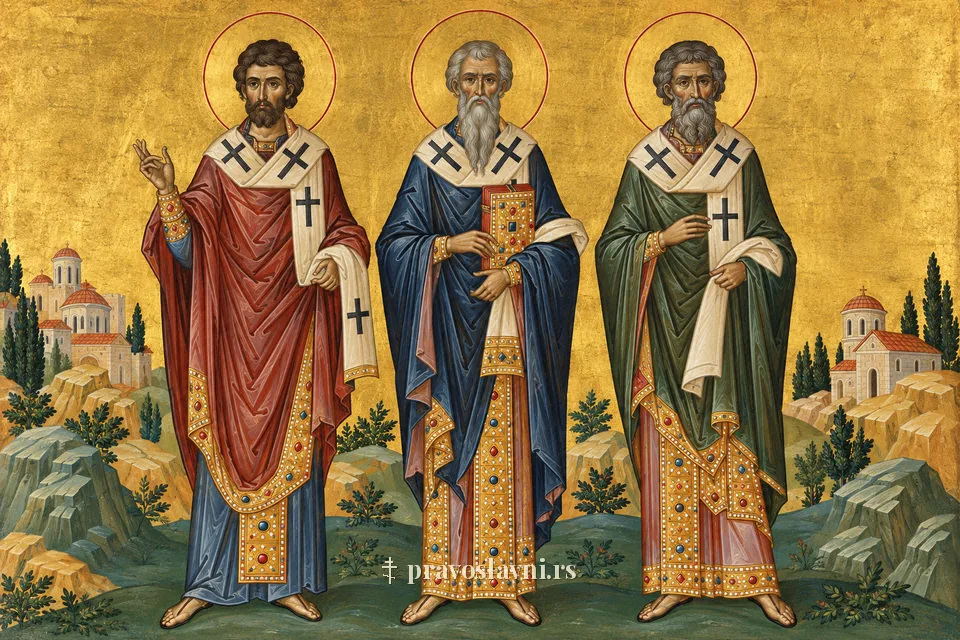
Holy Apostles Stachys, Amplias, Urban and others
What happenedStachys, Amplias, Urban, Narcissus, Apelles and Aristobulus, Apostles of the Seventy, preached Christ from Byzantium to Britain — some ended their lives in peace, and others as martyrs.
The six saints whom the Church celebrates today — Stachys, Amplias, Urban, Narcissus, Apelles and Aristobulus — belong to the Seventy Apostles, and on this the Prologue and their Life agree. They did not all preach in the same region, nor did they finish their course in the same way: some died in peace, others as martyrs.
Sixteen years of episcopal service in Byzantium — that is the only number that the sources give at all for these six, and it belongs to Stachys. He was appointed to that see by the Apostle Andrew the First-Called, whose fellow worker and companion he was. Their Life records that together they built a church at Argyropolis, around which a multitude of believers gathered; Stachys led them devotedly towards salvation right up to his peaceful end.
Aristobulus too ended his life in peace, and so, according to their Life, did Apelles. For Aristobulus, the brother of the Apostle Barnabas, distant Britain was both his field of preaching and the place of his death. Apelles was entrusted with Heraclea in Thrace, and their Life credits him with numerous conversions.
Macedonia and Lydda, which is also called Diospolis of Judea, each received a bishop from Andrew: Urban and Amplias. Both the Prologue and their Life count the two of them among the martyrs. What drove their opponents, the Hellenes and the Jews, to kill them is explained only by their Life: the two bishops were not content with preaching, but also pulled down the idols.
The third martyr, according to their Life, was Narcissus, whom the Apostle Philip appointed bishop in Athens. While the Prologue stops there, their Life adds that for the sake of the Gospel he endured many torments and ended his life as a martyr.
About these men we do not know the years, nor the details of their everyday life. We do know, however, what matters most: that they served faithfully where God had sent them. Some taught their flock long and patiently, others laid down their life for Christ. Their example teaches us that every service is of value when it is carried out with zeal and with love — and that a true disciple of Christ does not run away even when the service asks for life itself.
Full Life
Six Names From the Seventy
Among the Seventy Apostles the Church also counts the six whom we celebrate today: Stachys, Amplias, Urban, Narcissus, Apelles and Aristobulus. On this the Prologue and the Life agree.
Not much has been preserved about them. The sources give neither the years of their birth nor the years of their death. The only number that is mentioned is sixteen — that is how many years Stachys was a bishop. But even the little that we know says enough: these were men who gave their lives so that others might come to know Christ. They left behind them many faithful whom they had brought to Christ. Some ended their lives in peace, after long pastoral labour, and some shed their blood for Christ.
They have something else in common. Almost all of them were connected with one of the great apostles: Stachys, Amplias and Urban worked beside St Andrew the First-Called, Narcissus was appointed by St Philip, and Aristobulus was the brother of the holy Apostle Barnabas. Thus the faith was handed on from person to person — from those who first received the call to those who continued their work. Behind almost every one of these names there stands a city or a region and a community of the faithful.
Stachys, Shepherd of Byzantium
The episcopal see of Byzantium fell to a man whom Andrew the First-Called knew well, for Stachys was his fellow worker and travelling companion. The church in Argyropolis — built, the Life says, with the help of Andrew himself — became the place around which a large community of Christians gathered.
His ministry was not a ministry of honour, but a ministry of labour. He met his end in peace, as an elder who for sixteen years patiently taught his people the way of salvation and cared for them devotedly. His life shows that holiness does not always have to be loud. Sometimes it is year after year of faithful, patient care for the people God has entrusted to you.
Amplias and Urban: Preaching Unto Blood
From the same circle of Andrew came two more bishops, whom he ordained in person. One was a shepherd in Judea, in the city that is called Lydda or Diospolis, and the other in Macedonia — Amplias and Urban. The regions were different, but the task was the same.
Both of them preached Christ. The Life says that their zeal did not stop at words: they also pulled down the statues of the false gods, and this brought them death at the hands of the Hellenes, that is, the pagans, and of the Jews. The Prologue is silent about this, but it too counts them both among the martyrs. Thus their ministry also received the seal of blood.
Narcissus, Apelles and Aristobulus
Narcissus, Bishop of Athens, was not appointed by Andrew, but by the Apostle Philip. The Prologue records nothing more about him than that appointment. The Life also ascribes to him torments that he endured for the sake of the Gospel, and a martyr's end, just as with Amplias and Urban.
The Life remembers Apelles for the multitude of people he converted in Heraclea of Thrace, where he was bishop, and for his peaceful death in the Lord.
Of them all, the one who travelled farthest was Aristobulus, the brother of Barnabas: he preached in Britain, and in Britain, as both sources testify, he gave up his soul to God in peace.
At the end the Life directs the reader to 4 January, to the Synaxis of the Seventy, where more can be read about these apostles.
Each in His Own Place
Neither the Prologue nor the Life states a lesson, but it suggests itself. Each one worked wholeheartedly and devotedly in the place that was his: in Byzantium, in Lydda, in Macedonia, in Athens, in Heraclea, in Britain. Some served long and peacefully, some ended their service with a martyr's death. But all were ready for whatever God might give. That is a call for us too: that where we are — in the family, at work, in our own region — we should serve faithfully, and not give up when it becomes hard.
Other saints of the day
Holy Martyr Epimachus
St Epimachus, an Egyptian by birth, went off into the desert while still a young man, following the example of St John the Baptist; his Life adds that his parents were devout Christians and that he lived for a long time on the mountain of Pelusium. In the desert there was no elder to guide him, and the Prologue and his Life say that he was formed in virtue from within by the Holy Spirit, together with his love for God. News of the persecution in Alexandria, where the pagans were putting Christians to death, drew him out of his solitude after many years, for he too wished to shed his blood for Christ. He interrupted a festival which the pagans were celebrating by smashing the idols and overturning the altar in the temple, in front of those gathered there. Before the governor Apellianus, as his Life tells, he wanted to strike the judge, but the guards stopped him. While he waited in prison for his tortures, he encouraged the Christians who were shut up there for the faith, and his Life says that after his words all of them readily laid down their lives for Christ. Under torture he kept repeating: “this my Lord endured, and this I too wish to endure.” A woman from the crowd, who was weeping over him, then — according to the Prologue and his Life — thanks to the martyr's blood gained sight in an eye which until then had not seen, and she cried out: “great is the God in whom this sufferer believes!” He was beheaded, according to the Prologue, around the year 250. His example bears witness that not even the best human teacher can give what love for God gives: out of a desert-dweller without an elder it made a martyr ready to suffer like his Lord.