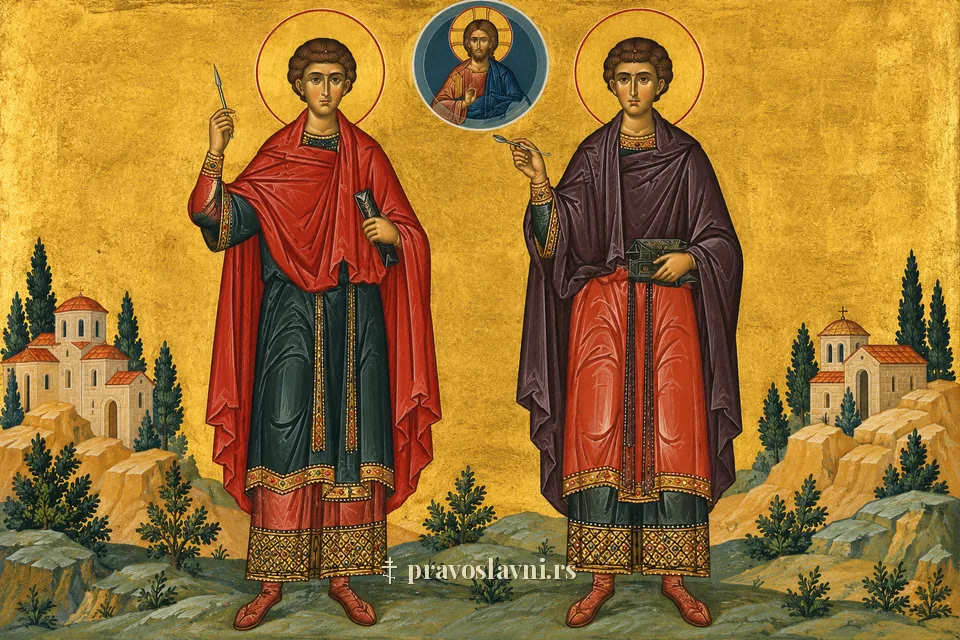
Cosmas and Damian were physicians who took nothing for their healing. They kept to Christ's words “Freely you have received, freely give” (Mt 10:8), and so the Church calls them unmercenaries and physicians without payment.
The brothers came from Asia; their mother Theodota was a Christian and their father a pagan, so they received the faith from her. When she was left a widow, Theodota lived for Christ and brought up her sons in the Scriptures and in virtue.
The brothers studied the art of medicine, but the Prologue says that their strongest remedy was the name of Jesus Christ. Their Life credits them with the gift of healing illnesses and casting out demons, and even of helping animals.
The strictness of Cosmas is best seen in the story of Palladia. This woman, who had long been ill, recovered, according to their Life, when the brothers came to her. The brothers refused her gifts, but Damian, whom the woman had secretly, without Cosmas knowing, bound in the name of the Holy Trinity, out of reverence for that name did not refuse her three eggs. Cosmas was grieved all the same and, according to their Life, expressed the wish not to lie beside his brother after death.
Cosmas was the first to die. When the time came for Damian's burial, their Life says that a camel, a dumb creature, spoke up and said that he had not accepted the eggs for the sake of gain, but for God's sake. Both of them died peacefully, and God revealed that their place was in the same grave at Pheremna.
They went on helping after their death as well. The Prologue and their Life remember a man who, after sleeping in a field, carried a snake inside him; according to their Life, when at the point of death he called upon the holy physicians, they appeared to him and he woke up well. Their Life also tells of the wife of Malchus, whom they delivered from the devil who wanted to kill her — because her husband had entrusted her to them before setting out on a journey.
From this the Prologue draws a lesson: whoever glorifies God by his life, God glorifies him after death as well. Cosmas and Damian teach us that God's gifts are not for sale — what we have received free of charge, we should also share free of charge.
Full Life
Physicians Without a Price
Seldom has anyone healed so much, and taken so little, as the brothers Cosmas and Damian. They studied medicine as other physicians did, but they never asked payment for their work. The words of Christ “Freely you have received, freely give” (Mt 10:8), which both the Prologue and their Life quote, were for them a rule of life. Hence the names by which the Church remembers them: unmercenaries and physicians who took no pay.
Their chief remedy did not lie in medicines. The Prologue says that the strongest power of their healing was the name of Jesus Christ. According to their Life, their gift did not stop at the body: the sick rose up, evil spirits departed, and even animals received help.
Their Mother's Faith
The root of this selflessness was in the home. Their faith came to them from their mother Theodota; their father was a pagan. Their homeland was Asia. When she was left a widow, Theodota gave her whole life to Christ — here their Life compares her with the widow in the First Epistle to Timothy, who prays day and night. She taught her children the Scriptures and virtue, and the Prologue says that God helped her in this. Her sons grew up to be true Christians.
Three Eggs
Cosmas was unyielding about healing free of charge, and that is why one small incident between the brothers was hard to bear. Their Life tells of Palladia, a woman whom illness had kept in bed for years. When the brothers entered her house, the illness vanished. They refused the gifts she offered. Palladia, however, would not accept this. She found a way to catch Damian alone and to bind him, with three eggs, by an oath in the name of the Holy Trinity; he took them, but only out of reverence for the name of the Trinity, and not as payment.
Cosmas saw payment in this and was grieved. His last wish, according to their Life, was a hard one: that after death he should not rest beside his brother. Cosmas departed first. When Damian died as well, no one knew what to do. Then, according to their Life, a dumb creature was given speech: a camel testified that Damian had not taken the eggs in order to be paid, but for the sake of God's name, and so he ought to lie beside Cosmas. Thus God showed what He wished, and the grave in Thereman received them both. Neither the one nor the other died a martyr's death, but peacefully, and on this both sources agree. Their wonderworking help did not cease even when they had departed from this world.
When People Call Upon Them
Both the Prologue and their Life remember a man who, after sleeping in a field, carried a snake inside him. The night he spent in mortal pain ended with his cry, as their Life says: “Holy physicians, Cosmas and Damian, help me!” According to their Life, the saints came, the snake left him in his sleep, and he woke at dawn in good health, while those who saw it glorified God.
Another story from their Life concerns Malchus, whose house was near the church of the holy brothers in Thereman. Before a long journey he entrusted his wife to the saints, and said to her: “I will send you a sign and I will take you to myself”. The devil made use of this: he came as an acquaintance, with that sign, and led the woman away. The oath she demanded of him before the altar, calling upon Cosmas and Damian, did not stop him: he took her to a deserted place, intending to kill her. In her distress she prayed to God and called upon the saints, remembering Abraham, Isaac and Jacob, the three youths in the furnace and St Thekla. The brothers appeared, the devil, after their rebuke, vanished down the cliff, and they told her that they were servants of Christ and that they had come because Malchus had entrusted her to them. Her testimony of her deliverance was afterwards heard in the church, where, thankful to God, she kissed the icon of the holy brothers.
From this the Prologue draws a clear lesson: whoever glorifies God by his life, God glorifies him even after death. Their Life adds that God's gift is not merchandise, and that whoever serves God selflessly has His help and can deliver others from evil as well. Cosmas and Damian teach us to give to others, without reckoning, what we have received from God — knowledge, strength, time.