Saint of the day
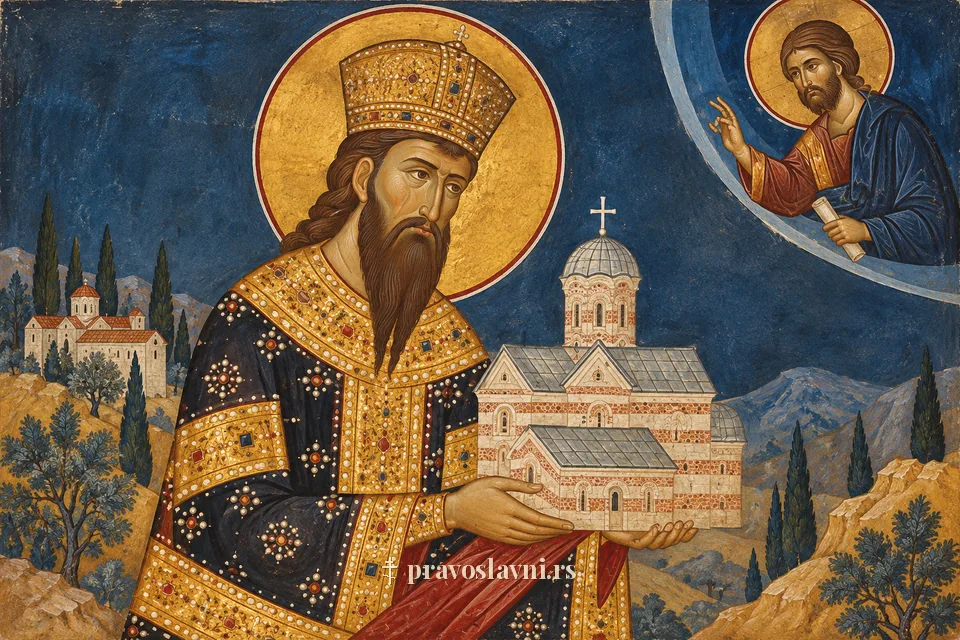
Holy King Stefan Dečanski
What happenedSt Nicholas appeared to the blinded Stefan, holding his eyes in the palm of his hand, and told him not to be afraid.
Read the LifeOrthodox Calendar · 11 November according to the Julian calendar
Tuesday, 24 November 202611 November (according to the Julian calendar)Save your slava — you'll get a reminder a week and a day before.
Send a greeting card →What happenedSt Nicholas appeared to the blinded Stefan, holding his eyes in the palm of his hand, and told him not to be afraid.
Read the Life
You may eat meat, eggs, milk and dairy products, as well as any other food — but try to be moderate.
More about the fast →
Many families celebrate their Krsna slava (family patron saint's day) today
More about the feast →
“Blessed are the meek, For they shall inherit the earth.”
— Mt 5:5Sung at the Slava (family patron saint's feast) and on the saint's feast day.
In the patience of thy struggles of good suffering thou didst endure manifold wounds, and after thy repose thou receivest from God a crown with the ranks of the martyrs, and worthily dwellest in the land of the meek, O blessed one: entreat Christ God for us, that He grant great mercy unto our souls.
Translation: pravoslavni.rs
The holy King Stefan Dečanski, Milutin's son and Dušan's father, spent three years as a hostage among the Tatars while he was still a boy. Later he governed Zeta. His stepmother Simonida, who wanted the throne for a son of her own, slandered him, according to his Life, before his father, and Milutin ordered that Stefan be blinded. This took place at Ovče Polje, beside the church of St Nicholas. Comfort was brought to him, according to both sources, that very same night by St Nicholas, who appeared to him in a dream.
He was sent with his sons to Constantinople and shut up in the monastery of the Pantokrator. There he prayed without ceasing, and gave his allowance to the poor. The Emperor valued his wisdom. When he was asked about the heretic Barlaam, Stefan said: “Dangerous people should be driven out of society.” The Emperor followed his advice. In the fifth year of his exile his sight was restored by the same saint, who appeared to him once again. Out of humility, according to his Life, he did not speak of the miracle, and he accepted the death of his younger son Dušica with the words of Job: “The Lord gave, and the Lord has taken away.”
He returned to his homeland and was reconciled with his father, and after Milutin's death he was crowned in 1321 at Prizren. Only then did he take the bandage from his eyes. At Velbužd in 1330 the Serbian army under Dušan's leadership defeated the Bulgarians, and Stefan gave the defeated Tsar Michael an honourable burial. Near Peć, on the Bistrica, he built the monastery of Dečani, which, according to the Prologue, is one of the peaks of the Serbian heritage of piety, with its church of the Ascension made of hewn marble, and not far from it a hospital for the infirm as well.
The courtiers then set Dušan at odds with his father. Stefan was imprisoned at Zvečan and strangled there on 11 November 1331. Before his death he left gold with the abbot Arsenije for the monastery and the poor. When, according to his Life, the grave was opened after seven years, the body was incorrupt, and many of the sick recovered. His relics rest at Dečani.
St Stefan teaches us to bear injustice without bitterness and to be merciful and humble. God made good even out of the evil that was done to him.
Stefan, the son of Milutin and the father of Dušan, grew up in Christian piety. His Life records that at about ten years of age he was given as a hostage to the Tatar khan Nogai, so that an invasion by the Tatars might be avoided, and that he was freed after three years, when Nogai was killed in internal fighting. He married Maria, the daughter of the Bulgarian ruler, and received Zeta to govern.
According to his Life, his stepmother Simonida wanted her son Constantine to inherit the throne, and so she slandered Stefan, saying that he was preparing to seize power. Milutin set out against Zeta. Stefan was led away in chains to the neighbourhood of Skopje and, on his father's orders, was blinded at Ovče Polje, beside the church of St Nicholas. That night, according to the Prologue and his Life, the pain brought him to the brink of death, and when he fell asleep for a moment, a hierarch bathed in light stood before him and comforted him: “Stefan, do not be afraid; here are your eyes in the palm of my hand.” He introduced himself as Nicholas, Bishop of Myra in Lycia, and the pain eased.
With his sons Dušan and Dušica, Stefan was sent to Constantinople. At first he lived in a separate palace, and then he was confined in the monastery of the Pantocrator. There he prayed without ceasing, was the first to come to the services, gave his allowance to the poor and refused the gold that was sent to him. The monks marvelled at him, and the Emperor used to invite him to court, and talked and dined with him. According to the Prologue, neither among the monks nor in the whole capital was there anyone wiser, meeker or a greater ascetic than he.
The capital was divided at that time by the dispute which Barlaam had started about the light of Tabor. When the Emperor asked for his opinion, Stefan was decisive: “Dangerous men should be driven out of society.” The Emperor ordered that Barlaam be arrested, but he, having been warned, fled to Rome.
In the fifth year of his exile, on the eve of the feast of St Nicholas, while the saint's Life was being read, Stefan dozed off. The hierarch from the first vision, according to the Prologue and his Life, now kept his word: he made the sign of the cross over his eyes and said that the Lord, who gave sight to the man born blind, would restore his sight too. Stefan woke up and could see. Not even the monks learned what had happened: out of humility, his Life says, he put the bandage on again and kept silent. When his younger son Dušica died in exile, he accepted it with the words of Job: “The Lord gave, and the Lord has taken away.”
At the entreaties of Archbishop Danilo, of the elders of the Holy Mountain and of the Byzantine envoys, Milutin, according to the Life, brought him back after eight years of exile. Father and son were reconciled, and Stefan received the region of Budimlja to govern. After Milutin's death Stefan was crowned at Prizren on Theophany 1321 as Uroš the Third. Then, before everyone, he took the bandage off his eyes.
The Bulgarian Tsar Michael, who had married Stefan's sister and then driven her away, made an alliance with Andronicus the Younger against Serbia and refused Stefan's call for peace. His Life records that in the battle of Velbužd, on 28 July 1330, the Serbian army led by Dušan defeated the Bulgarians. Michael was put to death on Dušan's orders, and Stefan buried his body with honour in Milutin's monastery of St George at Nagoričane.
After the victory Stefan, with the blessing of Archbishop Danilo, built the monastery of Dečani on the river Bistrica near Peć, with its church of the Ascension made of red and white dressed marble. Gratitude for his restored sight, as the Prologue interprets it, is built into these walls, which the same source counts among the most precious witnesses of Serbian piety and the rare works of Byzantine art. Not far from the monastery Stefan also built a hospital for the sick, the infirm and the old.
His Life says that St Nicholas appeared to him once more and announced that he would soon depart to the Lord. The courtiers convinced Dušan that his father intended to blind him or kill him, and Dušan rebelled. Stefan was captured in the fortress of Petrič near Nerodimlje and taken to Zvečan, where Dušan's men strangled him on 11 November 1331. Before his death he gave Abbot Arsenije gold for the monastery and for the poor.
He was buried at Dečani, in the tomb which he himself had prepared. Seven years later, according to his Life, a radiant man asked in a dream that the tomb be opened; when the archbishop, the bishops and the clergy did so, the body was incorrupt and fragrant. His Life also lists the healings that followed then — from a blind man who received his sight on touching the relics, to the deaf, the dumb, the lame and the paralysed. The reliquary with the relics stands to this day at Dečani in front of the iconostasis, and help from them, according to the Life, is received by people of all faiths.
Stefan bore injustice without bitterness: his father blinded him, and his son took his life. He humbly concealed even a miracle, and was merciful to the poor and to a defeated enemy. God turned even the evil done to him to good and glorified him with incorrupt, wonderworking relics.
St Menas was an Egyptian by birth and served as a Roman soldier in the region of Cotyaeum, under the tribune Firmilian, in the time of Diocletian and Maximian. A desolate mountain, on which he lived among the wild beasts, in fasting and prayer, became his home when he left the army after the imperial decree against the Christians. He proclaimed his faith publicly, before a crowd gathered at a pagan celebration with games and races: he came down from the mountain and from a piece of high ground confessed the true God. Before the governor Pyrrhus he said: “I am a servant of Jesus Christ, the King of heaven and earth.” He was subjected to severe tortures, but he said that invisible heavenly soldiers were helping him and that God was fire to him. Asked how a soldier could speak so well, he answered, as his Life records, that Christ had promised to give the word for such an hour. At last he declared before the governor: “Christ's I was, and am, and shall be.” After he was put to death by the sword outside the city, the faithful gathered up what was left of him and carried it to Alexandria, where a church later rose over the relics. The Prologue records that he suffered around the year 304. Both sources glorify him as a wonderworker who hastens to the help of those who call upon him, and who punishes the unrighteous, appearing as a horseman. His Life lists many of his miracles after death which were written down by Timothy, Archbishop of Alexandria, among them the raising to life of a murdered merchant. St Menas teaches that faith in the true God is stronger than fear, pain and worldly power.
Separate page: Great Martyr Menas →
Venerable Theodore was born, as his Life records, in the year 759 in Constantinople, into the family of Photinus, an official of the imperial treasury, and Theoctiste. Under the influence of his uncle Plato, an abbot, the family gave away its estate, set its slaves free and settled in Bithynia. At the age of twenty-two he was tonsured a monk by Plato at Sakkoudion, and when Plato withdrew, Theodore was chosen as abbot. His Life says that he condemned the adulterous marriage of Emperor Constantine with Theodote and refused his bribe, for which he was exiled to Thessalonica together with eleven companions. After Constantine's fall he was brought back by Empress Irene, and she and Patriarch Tarasius gave him the Studion Monastery, in which there were twelve monks at that time. The community grew to about a thousand monks. Theodore ordered the monastic life after the model of the rule of Basil the Great, with property held in common, obediences and common work, and the Studite rule spread far and wide. He wrote homilies, hymns, canons and letters, and so they called him a second Basil. When Leo the Armenian revived iconoclasm, Theodore went out with his monks in a procession with icons, and for this he was persecuted, scourged, and held in prison for more than three years in Smyrna, in hunger, cold and heat. In the Prologue he is remembered for three things: for his suffering for the icons, for his wise ordering of monastic life and for his teaching of Orthodoxy. He reposed, according to the Prologue, in the year 826, at the age of sixty-eight. From his life it can be seen that a monk, out of love for Christ, willingly accepts martyrdom, and that the truth must be confessed fearlessly even before emperors.


