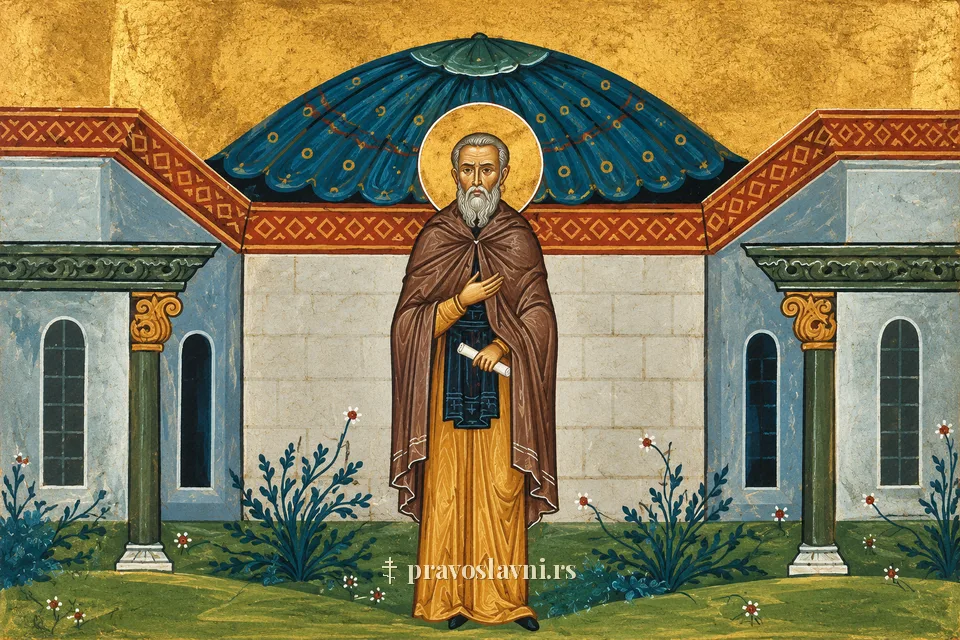
Saint of the day
Venerable Gregory of Decapolis
What happenedVenerable Gregory of Decapolis spent the rest of his life as a stranger and a wanderer, healing people and bravely defending the veneration of the holy icons.
Read the LifeOrthodox Calendar · 20 November according to the Julian calendar
Thursday, 3 December 202620 November (according to the Julian calendar)What happenedVenerable Gregory of Decapolis spent the rest of his life as a stranger and a wanderer, healing people and bravely defending the veneration of the holy icons.
Read the Life
No meat, dairy products, eggs or fish — oil and wine are allowed.
This is a recommendation — for your own fast, consult your priest or spiritual father.More about the fast →
Today the Church keeps the commemoration of a saint · not a Red Letter day.
More about the feast →
“For here we have no continuing city, but we seek the one to come.”
— Heb 13:14Venerable Gregory of Decapolis was born in Decapolis, and his Life mentions Irenopolis as his native town; his father was called Sergius. As an eight-year-old he began his schooling, and in his youth he fasted, worked and helped the poor. He did not want to marry, and so, in secret from his parents, he became a monk in the desert.
In one monastery he opposed an iconoclast abbot and, according to his Life, was severely beaten because of it. Then he lived for a long time with Abbot Symeon, a relative of his mother, and after that as a hermit in a cave, where, according to the Life, he overcame the demons with the cross. The Prologue and the Life mention the light and the fragrance in his cave, and the Life also mentions the gift of working miracles which he received at that time.
His Life says that, like Abraham, he received God's call to a life of wandering. From then on he was always travelling, and the Life records many events from those journeys. A poor man who took him in under his roof on Proconnesus, in spite of the emperor's prohibition, soon became rich. Gregory himself forgave a man who had beaten him and obtained repentance for him by prayer, saved by prayer a man who had fallen into the sea, set free the possessed in Rome and in Sicily, and in Thessalonica, where he lived in poverty, he helped a poor woman to find the means to live.
As a priest he was a fearless defender of the icons, in his homilies and in his writings. Both sources speak of the appearances of angels of which he was counted worthy. In the end he went to Constantinople to fight against iconoclasm. The Life says that he learned in advance when he would die and that he asked to be carried to the guesthouse. He reposed in peace in Constantinople, in the ninth century, as the Prologue records, and at his tomb, according to the Life, healings took place.
His life shows that holiness is gained by voluntary exile, by humility, by patience under persecution, by unceasing prayer and by zeal for the holy icons. Having finished his earthly wandering, Gregory now rejoices with the angels.
Venerable Gregory of Decapolis spent the greater part of his life as a traveller, without a permanent home. His Life explains this wandering by a call from God, like the one which Abraham once received. He wanted to go to the capital and to fight for the icons there, but, by God's providence, he instead went from place to place until his death. The Prologue and his Life bear witness that everywhere he was remembered for his ascetic labours and miracles.
By birth he was from Decapolis, and his Life also mentions the city of Irenopolis. His father was called Sergius, and both his parents were Christians of good standing. As an eight-year-old he began his schooling and came to know the Holy Scriptures well. He spent his youth in fasting, work and prayer, helping the poor as well. He did not want marriage, and so, in secret from his parents, he became a monk in a monastery in the wilderness.
His Life says that his mother, when she was left alone, approved of his choice and persuaded him to move to the monastery where his brother was. The abbot of that monastery was an iconoclast; Gregory opposed him in front of everyone and was severely beaten for it. He took refuge with Symeon, a relative of his mother, who was the abbot of another monastery, and he lived there for about fourteen years, enjoying general respect.
With the abbot's blessing he then became a hermit and settled in a cave in a gorge. His Life speaks of the demons who attacked him in various ways and of how he overcame them with the sign of the cross. The Prologue and his Life also record a wondrous light, accompanied by a sweet fragrance, which for days did not go out in his hiding-place. The abbot, according to his Life, concluded that the light was from God and urged him on to still greater effort. His Life also says that he then received healing, peace from temptations and the gift of working miracles.
Of the many events from his travels which his Life records, some show the power of his prayer and others his righteousness. The man who gave him a roof on Proconnesus, although the Emperor did not allow it, soon became rich. The man who beat him in Aenus he forgave, and by his prayers obtained repentance for him. The gold offered in Rhegium he refused, because he knew how it had been acquired, and he rebuked the givers. A man who fell from a ship into the sea was saved by his prayer. In Rome, in Sicily and on the road among the Saracens he set the possessed free and healed the sick, and one sinful woman in Sicily he led to the monastic life, so that her house became a monastery.
In Thessalonica he lived in poverty, in the monastery of St Menas. His Life says that a devout widow fed him there, and that to a poor woman who had nothing to live on he said: “Go, begin your work, and God, the father of the poor, will send you help.” Her home, according to his Life, was restored with what she found in the ground at his word.
As a priest he became one of the defenders of the icons, and his homilies and writings turned many cities away from heresy. Both sources speak of the appearances of angels of which he was counted worthy. According to his Life, he gave up going to pagan Bulgaria, having foreseen the unrest there: “I see that the sun does not shine there”.
With his disciples Joseph and John he went to Constantinople to fight against iconoclasm, and he did not return to Thessalonica. His Life says that he learned in advance when he would die. He reposed peacefully in Constantinople, and the Prologue records that this was in the ninth century. At his tomb, according to his Life, healings took place.
The path of Venerable Gregory was a path of voluntary exile, humility, patience under persecution and unceasing prayer, together with zeal for the holy icons. Having finished his earthly wandering, he now rejoices with the angels.
St Proclus was a close disciple of St John Chrysostom and decided who would be admitted to him. His Life relates an unusual event from those days: a certain nobleman, who had been slandered before the Emperor Arcadius, used to come at night to ask for Chrysostom's help, and for three nights in a row Proclus, looking through the keyhole, noticed that someone was sitting with Chrysostom and speaking quietly to him. Determined to discover who it was, he vowed to keep a complete fast and vigil until he found out, and the answer, according to his Life, he found on the icon in Chrysostom's room: it was the Apostle Paul. The nobleman then received help. Later he was also consecrated Bishop of Cyzicus, but, according to his Life, because of the resistance of the heretical clergy he returned to Constantinople. After the death of Patriarch Maximian he was chosen as Patriarch of Constantinople, and he was enthroned on Great and Holy Thursday. Chrysostom's relics were translated, at the urging of Proclus, from Comana to Constantinople, when the Emperor Theodosius and his sister Pulcheria were reigning. The Prologue and his Life remember his time as patriarch for a devastating earthquake and for the miracle that stopped it. The Trisagion hymn, which has been sung in the Church ever since, came to people, according to both sources, through a child: during a procession outside the city, in which the patriarch, the emperor, Pulcheria and the people took part, the child vanished into the heights and came back, and then told of the angelic singing he had been listening to. As soon as the people began to sing the same hymn, the tremors ceased. Having wisely guided the Church for twenty years, Proclus, according to the Prologue, reposed in peace in the year 446.


