Saint of the day
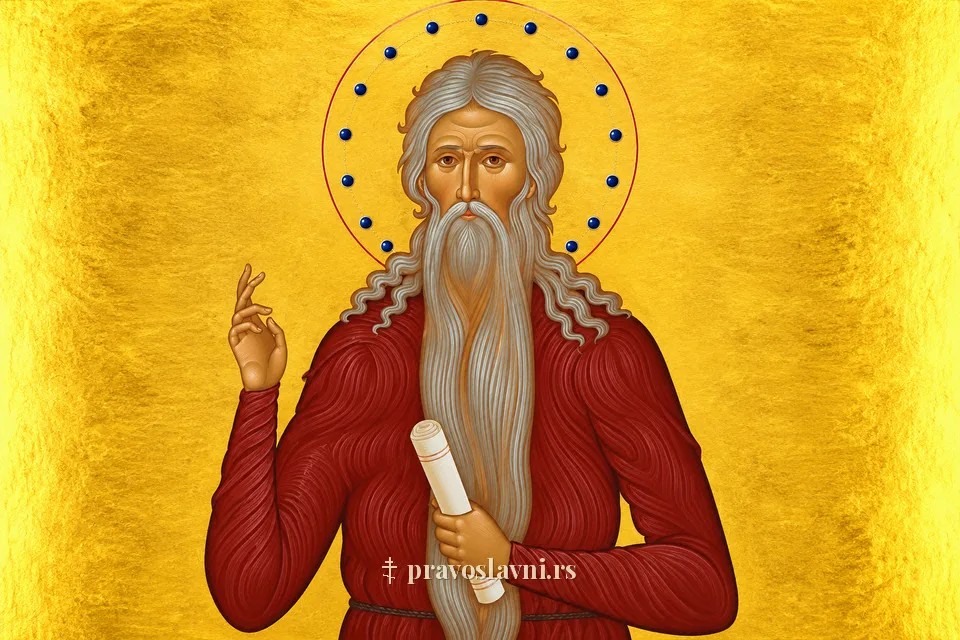
Venerable Macarius of Egypt
What happenedA demon admitted to St Macarius that he surpassed him in fasting and vigil, but could not overcome his humility.
Read the LifeOrthodox Calendar · 19 January according to the Julian calendar
Monday, 1 February 202719 January (according to the Julian calendar)What happenedA demon admitted to St Macarius that he surpassed him in fasting and vigil, but could not overcome his humility.
Read the Life
You may eat meat, eggs, milk and dairy products, as well as any other food — but try to be moderate.
More about the fast →
Today the Church keeps the commemoration of a saint · not a Red Letter day.
More about the feast →
“Because narrow is the gate and difficult is the way which leads to life, and there are few who find it.”
— Mt 7:14Not even a thief, according to his Life, did Macarius stand in the way of: finding him among his belongings, he helped him and let him go in peace. That small incident reveals the man who to this day is called Macarius the Great.
He was a native of Egypt, from the village of Ptinapor near the Nitrian desert. His father Abraham was a priest, and his mother was Sarah. His Life says that his parents waited for him a long time and that the birth of a son was promised to them in a dream. His parents wished him to marry and he obeyed them, but the marriage did not last long — his wife soon died. When he had buried his parents too, he gave away their property to the poor and went off into solitude.
He learned under a certain old desert-dweller, and then under Anthony the Great, at whose side he also was in the hour of his death. The Prologue reckons that he spent sixty years in the life of the desert. His Life says that at the age of forty he began to heal and to prophesy, and that the monks in Scetis took him as their spiritual father.
Slander did not pass him by either. His Life records that a certain girl falsely accused him and that the villagers publicly humiliated him, and when the truth came to light and the villagers came to beg forgiveness, he went away that same night. Demons attacked him as well, but he drove them off by prayer and by the name of Christ. One of them, according to the Prologue and his Life, had to admit that he could not defeat him in humility, even though he himself needs neither food nor sleep.
God worked wonders through him, even raising the dead, says the Prologue. His Life states that he healed the possessed and the sick and that, before a heretic who denied the resurrection, a brother who had only just been buried answered his call from the grave.
The advice which, according to the Prologue, he often gave to his disciple Paphnutius runs: “Judge no one, and you will be saved.” His death, according to the Prologue and his Life, was announced to him nine days in advance — Anthony and Pachomius appeared to him, and in his last days a cherub as well. He reposed in the year 390, having lived for 97 years.
His path teaches us that humility is a virtue which evil cannot overcome.
The Prologue and the Life call him Macarius the Great. The Prologue numbers him among the younger contemporaries of Anthony the Great and says that he lived for six decades in the desert, in an ascetic struggle that was both inward and outward. He was thin regardless of whether he ate or not, and when he was asked why that was so, he answered: “From the fear of God.”
The Life says that he was born in Egypt, in the village of Ptinapor near the Nitrian desert. His father Abraham was a priest, and his mother was Sarah. For a long time they had no children, and an attack by barbarians left them in poverty. The Life records two dreams: in the first the forefather Abraham told his father to move to Ptinapor and promised him a son in his old age, and in the second, when his father fell gravely ill, an angel promised him both recovery and a son, and for the child he appointed in advance the name Macarius, which means “blessed”. His father recovered at once, Sarah conceived in her old age, and the boy was baptised and taught the Holy Scriptures.
He entered into marriage because his parents wished it, but, as the Life says, he remained a virgin. While he was at the Nitrian lake, a radiant man appeared to him in a dream and directed him to settle in the desert. His wife died soon afterwards, and then his father and mother as well.
An old hermit from the neighbourhood taught him prayer, fasting and the weaving of baskets. When the bishop ordained him priest of the village church, Macarius felt this as a burden and withdrew to another village. There slander awaited him: a girl who had become pregnant by a certain young man accused him. The Life records that the villagers beat him and led him shamefully through the village. The truth came to light when the girl, in a difficult labour, confessed what had really happened. The villagers came to ask his forgiveness, and he left that very night.
He spent three years in a cave on the Nitrian mountain, and then became a close disciple of Anthony the Great on Mount Pharan. He was with Anthony when the latter was dying and, according to the Life, received his staff. The Life says that, when he reached the age of forty, he became a priest and the spiritual father of the monks of Scetis, and God then granted him to heal the sick, to prophesy and to cast out unclean spirits.
Nor did the demons, according to the Life, leave him in peace: they frightened him with apparitions and with attacks on his dwelling, and once they even appeared as an army on horseback. He defended himself by chanting psalms, praying and making the sign of the Cross, and they would vanish as soon as he uttered the name of Christ. Humility, according to the Prologue and the Life, was the thing that not even a demon could withstand: he himself admitted that he surpasses the ascetic in abstaining from food and sleep, for he needs neither the one nor the other, but that before his humility he is powerless.
The Prologue says that God gave him the power to work miracles, and even to raise the dead. The Life records many such deeds. Once a man brought him his wife, whom someone's sorcery had turned into a mare in the eyes of those around her; Macarius explained that the illusion exists only in the gaze of the onlookers, and when he poured blessed water over her, they again saw a woman in her. When a Hieracite was spreading the teaching that there is no resurrection, Macarius prayed and called out to a brother who had only just been buried; the dead man answered from the grave, and the heretic fled. A man falsely accused of murder he delivered by asking the murdered man himself, who confirmed his innocence; who the real murderer was, Macarius did not wish to learn, for that, he said, was not his affair.
Nor, according to the Life, did he stand in the way of a thief: having found him among his belongings, he even helped him and let him go in peace. In the time of the Emperor Valens the Arian bishop Lucius sent soldiers against the hermits, and Macarius and Macarius of Alexandria, according to the Life, were taken away to a pagan island. There they healed the daughter of a priest of the idols, the priest was baptised, the whole island received the faith, and the temple became a church.
Death did not find him unprepared: according to the Prologue and the Life, Anthony and Pachomius announced it to him nine days beforehand, and in those last days he also saw a cherub and heard from him that the time had come for him to leave this world. He lived for 97 years and reposed in the year 390.
He used to tell the monks to pray briefly: “Lord, as You will and as You know, have mercy on me!” The Prologue also preserves a piece of advice that his disciple Paphnutius often heard from him: “Judge no one, and you will be saved.” His life bears witness that humility is a virtue which evil cannot overcome. He also taught how much power there is in a spoken word — it can both corrupt a good man and correct a bad one.
St Mark of Ephesus was born in the year 1391 in Constantinople, in the distinguished Eugenikos family, and at baptism he received the name Manuel. His father George, a deacon of Hagia Sophia and a teacher in its school, died when the boy was thirteen years old. Manuel became an excellent scholar of rhetoric, philosophy and mathematics, and he taught in the school which his father had headed, and among his pupils was George Scholarios. At about the age of twenty-five he gave away his property to the poor and became a monk with the name Mark. He lived on the island of Antigone, and then in the monastery of St George in Mangana, where he was ordained a hieromonk. In the year 1437 he became Metropolitan of Ephesus, which, according to his Life, he accepted only out of obedience. In Ferrara and Florence, where the council in Italy was being held, neither the Emperor nor the Pope was able to shake him: he defended the teaching that the Holy Spirit proceeds from the Father alone, and he refused to let the faith be decided by voting. He alone did not sign the union, and to those who urged him to give way he said: “Never, O man! What concerns the Church is not settled by compromises.” He left his last testament to his disciple George, who would later, as Gennadius, become patriarch: to defend Orthodoxy, for “The corruption of the Universal faith is the common ruin”. He reposed in peace and was buried in the monastery of St George in Mangana; the Prologue gives the year 1452, and his Life 1444. The Church remembers him as a man who stood alone in defence of the faith and did not give way.


