Saint of the day
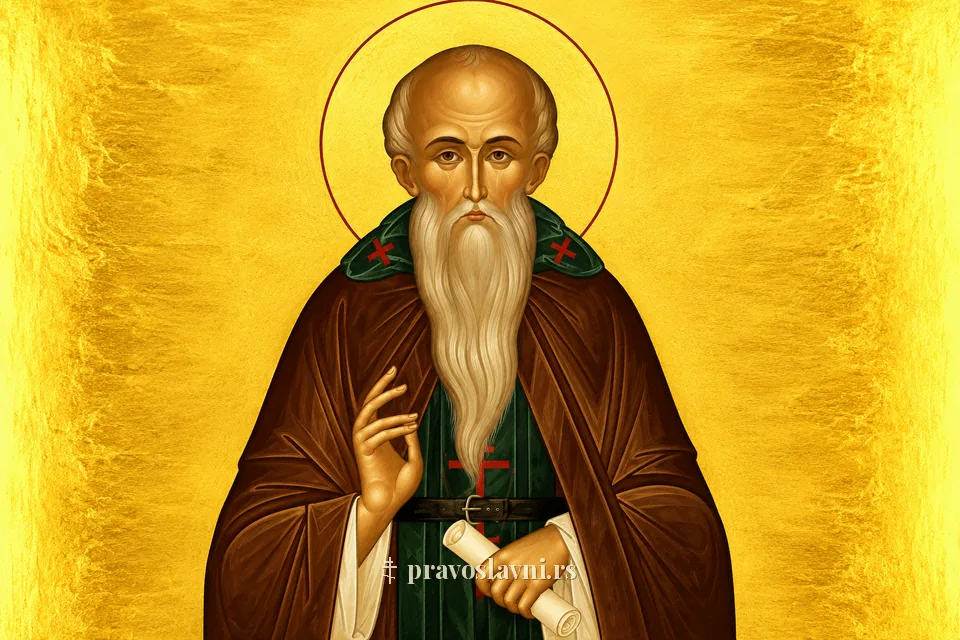
Venerable Maximus the Confessor
What happenedSt Maximus the Confessor chose to endure trial, mutilation and exile rather than keep silent about the truth that Christ has two natures and two wills.
Read the LifeOrthodox Calendar · 21 January according to the Julian calendar
Wednesday, 3 February 202721 January (according to the Julian calendar)Save your slava — you'll get a reminder a week and a day before.
Send a greeting card →What happenedSt Maximus the Confessor chose to endure trial, mutilation and exile rather than keep silent about the truth that Christ has two natures and two wills.
Read the Life
No meat, dairy products, eggs, fish or oil — food cooked in water.
This is a recommendation — for your own fast, consult your priest or spiritual father.More about the fast →
Many families celebrate their Krsna slava (family patron saint's day) today
More about the feast →
“For I have come down from heaven, not to do My own will, but the will of Him who sent Me.”
— Jn 6:38Humiliations, violence, exile and prison — all of this, according to the Prologue, was borne by one monk who would not keep silent about the truth concerning Christ.
Maximus was born in Constantinople, into a distinguished Orthodox family, and he received a high education in philosophy and theology. Against his will he served as first secretary at the court of the Emperor Heraclius. He left the court and became a monk in the monastery of Philippicus in Chrysopolis. The times of war took him first to Cyzicus, and then to Crete and to Africa.
At that time the teaching was spreading that Christ has only one will, and it was supported by the emperor himself. Maximus taught the opposite: just as there are two natures in Christ, so too there are two wills in Him. In Carthage he defeated the former patriarch Pyrrhus in a debate. When the Emperor Constans by an edict forbade all discussion of one will or two, Maximus in the year 649 persuaded Pope Martin to hold a council in Rome, which condemned both that edict and the heresy. The confession of faith for that council was written by Maximus himself.
After that, says his Life, he was brought in chains from Rome to Constantinople and led before the senate, where they falsely accused him of treason. He rejected it all. To those who demanded that he keep silent he replied: “To pass over a word in silence is to reject it.” Even before the senate he accepted the punishments which he had not chosen himself as God's cleansing of his sins; when they tried him for the second time, he was more than seventy years old.
He was mutilated, he was left without his tongue and his right hand, and he was condemned to lifelong exile. His Life gives the place as Schemaris, at the foot of the Caucasus. He learned in advance, through a vision, when he would die, and his Life also mentions three heavenly lights that appeared over his grave. His Life states that he reposed in 662, and the Prologue in the year 666.
Maximus teaches us that conscience and faith are worth more than fear before the powerful: silence about the truth is already a renunciation of it.
“To pass over a word in silence means to reject it.” With these words, as the Life records, Maximus answered those who demanded that he keep silent. Because of that truth he lost his freedom and his homeland, but he did not lose his faith.
He was born in Constantinople, into a respected Orthodox family, and received a high education in philosophy and theology. Against his will he served as first secretary at the court of the Emperor Heraclius. Nevertheless he left the court and became a monk in the Monastery of Philippicus at Chrysopolis; the Prologue adds that near the capital he was also at the head of a monastery as its abbot. The Persian advance as far as Chalcedon forced him to move to Cyzicus, to the Monastery of St George, to be with Bishop John. In the year 626, when the Persians and the Avars attacked Constantinople, he went with his disciple Anastasius to Crete, and then to Africa. In Carthage he came to know Sophronius, the later Patriarch of Jerusalem, who was likewise opposed to the new teaching.
At that time the teaching was spreading that Christ has only one will. It was upheld by Patriarch Sergius and Cyrus of Alexandria, and supported by the Emperor Heraclius. Maximus defended the faith that to Christ, who has two natures, there also belong two wills, and by this, as the Prologue says, he came into conflict with both the Emperor and the Patriarch. In Carthage he defeated in debate the deposed Patriarch Pyrrhus, who renounced his error, but later returned to it and was anathematised. When the Emperor Constans issued the Typos, by which he forbade all discussion of one or two wills, Maximus in the year 649 urged the newly elected Pope Martin to convene a council in Rome. The council condemned both the Typos and that heresy, and the confession of faith for it was written by Maximus himself.
In the year 653 Pope Martin was arrested, taken to Constantinople and exiled to Cherson, where he died. Nor, according to the Life, did the same fate pass Maximus by: both he and his disciple Anastasius were deprived of their freedom while still in Rome, and they arrived in the capital in chains. Before the senate he was falsely accused of treason, of handing over Egypt and Africa to the Saracens, and of Origenism. He rejected all of it. His disciple Anastasius was beaten because he would not testify against his teacher. When questioned about the Typos, he made it clear that his condemnation had not been directed at the ruler, but only at the document, which ran counter to the faith. Nor would he be in communion with the see of Constantinople, because those who occupied it had rejected the councils.
He was exiled to Bizya in Thrace, and on the way to a new place of exile, in Selymbria, the clergy came out to meet him. At the second trial he was more than seventy years old — he himself said that he was 75. Before the senate, the Life records, he said: “I thank God that He cleanses my voluntary sins by involuntary punishments.” As the Prologue and the Life record, he was mutilated — he was left without his tongue and his right hand, and his disciple Anastasius suffered the same. Another disciple of the same name, Anastasius from Rome, was spared because he had once been an imperial secretary; it was he who later wrote the Life.
He was sentenced to exile for life. The Life names Schemaris, at the foot of the Caucasus, as the place, and says that his disciple Anastasius died on the way. The Prologue records that he spent three years there in prison. The Life says that he learned in advance, through a vision, when he would die. He reposed in exile and was buried there — according to the Life on 13 August 662, and according to the Prologue in the year 666. The Life adds that his grave was afterwards glorified by a sign from heaven: three lights of unearthly radiance.
The Prologue says in brief that he endured from men every kind of humiliation and violence, both from the mighty and from the common people, and that he also went through exile and prison. And yet he remained faithful.
Maximus teaches us that conscience and faith are worth more than fear before earthly rulers. Silence about the truth is not neutrality — it is already a renunciation of it.
St Neophytus suffered for Christ as a fifteen-year-old, in the time of the Emperors Diocletian and Maximian, when the governor Decius ordered the inhabitants of Nicaea to offer sacrifices to the idols: the boy went out into the square and confessed Christ. He was a native of that same Nicaea in Bithynia, the son of the Christians Theodore and Florentia. His Life remembers his kindness even from his school days — he used to give his meal to his poor companions and go without food himself. Already at that time miracles took place through him, by the power of God: he gave the children water from a rock, but he forbade them to speak about it. When, according to his Life, his mother breathed her last from fear after a white dove had spoken to her in a human voice, Neophytus said to his grieving father: “My mother has not died, but has fallen fast asleep.” He raised her up, and many pagans then came to believe. A cave on Mount Olympus, to which that same dove directed him, became his home after he had sent a lion away from it. Under torture he repeated only: “Son of God, have mercy on me!” According to his Life, not even the furnace in which he spent three days did him any harm. In the arena the wild beasts would not touch him; among them was also the lion from the cave on Olympus, which behaved meekly towards him, and Neophytus sent it back to its cave. He was killed with a spear. His life shows that even a child can be faithful, merciful and pure, and that he chose eternal life above the commands of a man of power.


