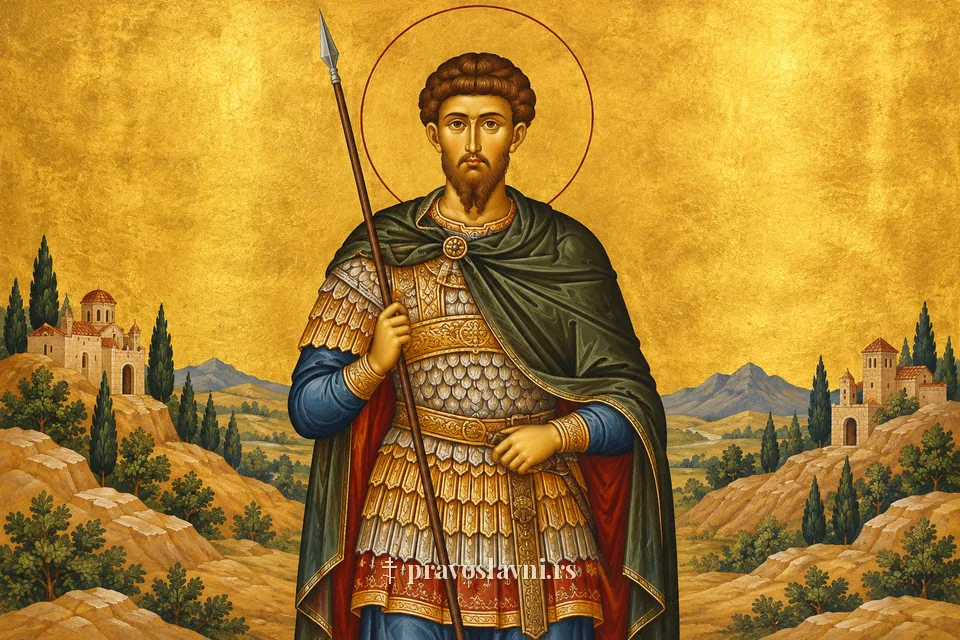
Saint of the day
Great Martyr Theodore the Tyro
What happenedSt Theodore the Tyro chose the fire rather than deny Christ, and even after his death he kept the faithful from defiled food.
Read the LifeOrthodox Calendar · 17 February according to the Julian calendar
Tuesday, 2 March 202717 February (according to the Julian calendar)Save your slava — you'll get a reminder a week and a day before.
Send a greeting card →What happenedSt Theodore the Tyro chose the fire rather than deny Christ, and even after his death he kept the faithful from defiled food.
Read the Life
You may eat meat, eggs, milk and dairy products, as well as any other food — but try to be moderate.
More about the fast →
Many families celebrate their Krsna slava (family patron saint's day) today
More about the feast →
“No one engaged in warfare entangles himself with the affairs of this life, that he may please him who enlisted him as a soldier.”
— 2 Tim 2:4Christians honour St Theodore the Tyro with koliva, a dish of wheat and honey. The Life explains where that custom comes from. Long after Theodore's death, the Emperor Julian the Apostate ordered that food sprinkled with the blood of sacrifices to idols be sold in the markets of Constantinople. St Theodore then appeared to Archbishop Eudoxius and told him that the faithful should not buy in the markets, and that he should give the poor koliva, as was the custom in Euchaita. The Emperor's plan came to nothing, and that is where the custom just mentioned comes from.
Who was this saint? According to the Life, a soldier in the Marmarite regiment at Amasea, in Pontus. The Prologue interprets his name Tyro as “recruit”, while the Life says that he had already fought in the East. During the persecution under the Emperors Maximian and Maximinus he did not hide that he was a Christian, and he refused to offer sacrifice to the idols. The Life records that he then set fire to a pagan shrine, for which he was brought before the governor and beaten.
He was thrown into a sealed prison to die of hunger. On the first night Christ appeared to him, and the prison shone with light, full of angels, while the guards were frightened by the sight of white figures beside the prisoner. The governor, according to the Life, went in and found only Theodore in his chains. The Prologue records Christ's words: “Do not be afraid, Theodore, I am with you.” The Life adds that the Holy Spirit fed him, so that he refused both the bread and the water which the governor sent him.
Neither the honours offered him nor the tortures made him waver. He answered the governor: “With my Christ I was and I am, and I shall be.” He was condemned to death by fire; before the fire was lit, according to the Life, he made the sign of the Cross, and in the flames he gave up his soul to God, in the year 306. His body, according to the Life, was given an honourable grave in the house of the devout Eusebia in Euchaita.
St Theodore chose death by fire rather than deny Christ. And the koliva with which Christians honour his memory keeps alive the remembrance that God watches over His faithful and delivers them from hidden snares.
“I am a soldier of my King, Christ” — that, as his Life records, is how St Theodore spoke of himself. His second name, the Tyro, is explained by the Prologue with the word “recruit”, and it says that he had only just entered the army. His Life, however, speaks of a soldier who with many comrades had already fought in the East and had then been transferred to the Marmarite regiment. That regiment was in Amasea, a city in Pontus, and it was commanded, according to his Life, by Brincas.
When the Emperors Maximian and Maximinus began a persecution of the Christians, Theodore did not hide his faith and refused to offer sacrifice to the idols. The imperial decree, according to his Life, offered Christians a choice: either food from the sacrifices to the idols and peace, or the court. Brincas urged him to obey, and the captain Posidonius questioned him about the Son of God. He was given several days to think it over, but he spent them in prayer, encouraging the Christian prisoners to hold fast to Christ. His Life records that he then set fire to the temple of the mother of the gods.
The city official Cronides seized him and brought him before the governor Publius. According to his Life, Theodore admitted the deed and mocked the powerlessness of the goddess, and so Publius had him beaten. After that, so that he would die of hunger, they shut him up in a prison and put a seal on the door.
But on the first night Christ appeared to him. The Prologue records His words: “Do not be afraid, Theodore, I am with you.” According to the Prologue, the Lord told him no longer to feed on what the earth gives, and promised him eternal life with Himself. His Life says that from then on the Holy Spirit fed him.
The prison shone with light and a multitude of angels appeared, who, according to his Life, joined in his singing. Fear seized the guards as well: with Theodore they saw some others in white clothing, although the prison, according to his Life, was still under seal. Publius went in himself, but he found no one except Theodore, bound as before, and so he sealed the prison again. He ordered that bread and water should be given to him every day, but Theodore refused it, saying that the Lord was feeding him.
At the second hearing, according to his Life, Publius offered him the rank of high priest and honours if he would offer sacrifice. Theodore refused and was put to severe tortures, and during that time he sang a psalm. When the governor mocked him for placing his hope in Christ, he answered that neither he nor anyone who calls upon Christ would be put to shame — the shame would fall on Publius himself. The people demanded that an end be put to it. Asked once more to offer sacrifice, Theodore called the governor a son of the devil and said: “With my Christ I was and I am, and I shall be.”
He was condemned to death by fire — his Life says, for disobedience to the imperial authority and for faith in Jesus, crucified under Pontius Pilate. The wood for the pyre, according to his Life, was gathered from the houses round about, and when Theodore made the sign of the cross, the fire was lit. So, in the year 306, he ended his earthly path in the flames and went to God. His Life says that the Holy Spirit made the fire mild for him and that he died in prayer. His body was obtained by a devout woman, Eusebia, and, according to his Life, she buried it in her own house in Euchaita.
His Life also tells of a miracle that happened much later. After Constantius, the son of Constantine the Great, Julian the Apostate came to the throne and turned to idolatry. He ordered the city prefect of Constantinople that food and drink sprinkled with the blood of sacrifices to the idols should be sold in the markets.
Then St Theodore showed himself to Eudoxius, Archbishop of Constantinople, while he was awake, and told him to forbid the faithful to buy in the markets. To the question of what the poor would live on, Theodore answered that he should give them koliva, a dish of wheat and honey such as was prepared in Euchaita. Then he said who he was and vanished. The archbishop called the faithful together and did as he had been told, and so the Emperor's plan did not succeed; put to shame, the Emperor gave it up, and trade was once again as it had been before. In memory of that, Christians honour St Theodore with koliva.
God guards His faithful and delivers them from hidden snares, and koliva keeps the memory of that care and of the help of St Theodore. The martyr who chose fire rather than deny Christ remained, after death as well, a faithful soldier of his King.


